

Last Tuesday, a 34-year-old marketing executive in Chicago typed this into ChatGPT: “I’ve had a dull ache behind my right eye for three weeks. It gets worse when I look at screens. What could this be and what kind of doctor should I see?”
ChatGPT responded with four possible causes, ranked by likelihood. It explained why an ophthalmologist would be a better first step than an optometrist for her symptoms. It asked a follow-up question about her screen time habits. And when she asked “can you recommend someone in Lincoln Park,” it gave her three names – pulled from the web, not from any directory she had ever heard of.
She did not open Google once.
That patient story is no longer unusual. It is the new normal. And it is happening at a scale that should make every doctor, clinic owner, and hospital marketing director pay very close attention.
OpenAI confirmed that 230 million people ask ChatGPT health and wellness questions every single week. Over 40 million people use ChatGPT specifically for healthcare questions every day. In January 2026, OpenAI launched ChatGPT Health – a dedicated product that lets patients connect their medical records, lab results, Apple Health data, and wellness apps directly into the conversation.
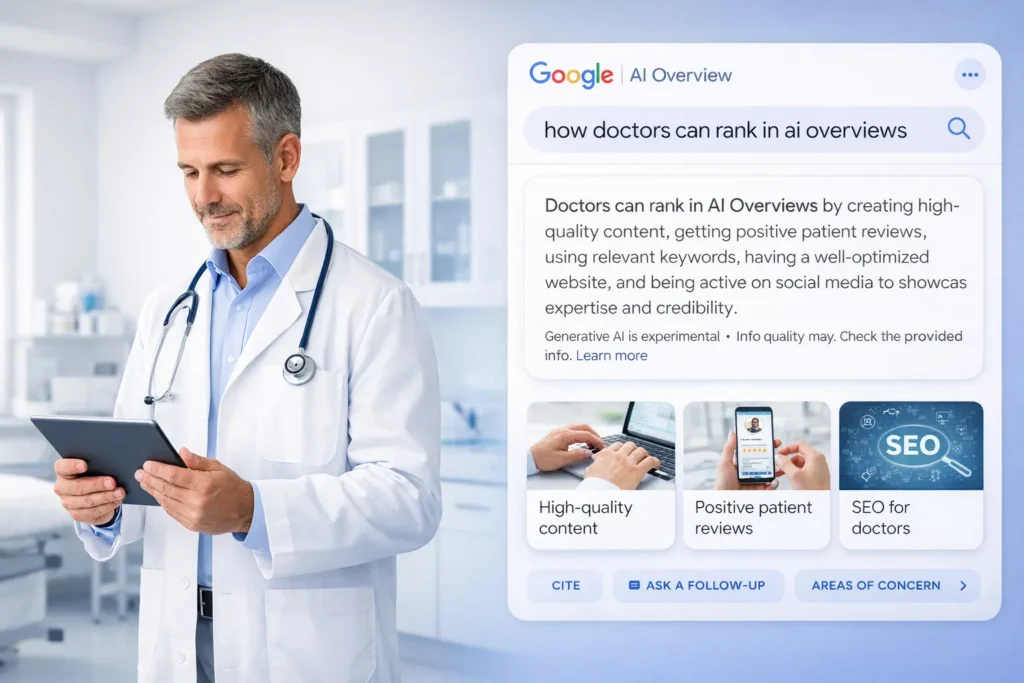
Meanwhile, Google is not standing still. Its AI Overviews now appear on 88% of all healthcare queries, answering patient questions directly on the search results page before they ever click a link. BrightEdge data shows that treatment queries hit 100% AI Overview coverage. Every single one.
So where are patients actually going to find their next doctor? The answer is not simple – and that is exactly why this matters. The patient journey has fractured across multiple platforms, and most medical practices are only visible on one of them.
This article breaks down the real data, the real patient search patterns, and what it means for your practice’s visibility strategy in 2026.
The Numbers That Changed Everything in January 2026
Three things happened in the first two weeks of January 2026 that permanently altered the healthcare search map.
January 7, 2026: OpenAI launched ChatGPT Health. This was not a minor product update. It was a dedicated healthcare experience inside ChatGPT that lets patients connect their electronic health records from over 2.2 million U.S. healthcare providers (through a partnership with b.well), sync Apple Health data, link MyFitnessPal, Weight Watchers, Peloton, and Function lab testing. Patients can now upload a PDF of their blood work and ask “what does this mean in plain English” and get a personalized answer grounded in their own medical history.
January 7, 2026: OpenAI published usage data that stunned the industry. One in four of ChatGPT’s 800 million weekly active users submits a healthcare prompt every week. A majority of health conversations happen outside normal clinic hours, which tells you patients are turning to ChatGPT when they cannot reach their doctor.
January 11, 2026: Google quietly removed AI Overviews from certain medical queries after a Guardian investigation found misleading health information in some AI-generated summaries. Google began tightening which health topics get AI treatment and which stay with traditional results.
These three events created the landscape we are now operating in. Two AI giants – Google and OpenAI – are competing for the same patient’s attention, at the same moment in their health journey, with very different approaches.
What the Patient Search Journey Actually Looks Like Now
Forget everything you thought you knew about how patients find doctors. The 2026 patient journey does not start and end on Google. It zigzags across platforms in a way that most medical practices are not tracking at all. Understanding how patients discover and choose doctors has never been more complex – or more important.
Here is what the data shows about how patients actually move from symptom to appointment:
Stage 1: “Something Feels Wrong” – The Symptom Research Phase
This is where ChatGPT is winning, decisively.
A Rock Health survey of 8,000 U.S. adults in December 2025 found that 32% of consumers have used an AI chatbot for health information – double the 16% from just one year earlier. Of those users, 64% engage with health AI weekly or more. And 74% of AI health users are going to general-purpose tools like ChatGPT rather than provider-offered chatbots.
Why? Because ChatGPT gives patients what Google never could: a conversation.
When a patient types “I have a sharp pain in my lower right abdomen that started two days ago” into Google, they get a list of links and an AI Overview paragraph. When they type the same thing into ChatGPT, it asks follow-up questions. “Is the pain constant or does it come and go?” “Have you had any fever?” “Does it hurt more when you press on it?” The patient feels heard. They feel like something is actually trying to figure out what is wrong.
Research backs this up. A UC San Diego study found that healthcare professionals rated ChatGPT answers as more empathetic than responses from human doctors. A separate study testing GPT-4o on realistic medical prompts found it answered correctly about 85% of the time – notable given that human doctors misdiagnose patients 10-15% of the time.
A scoping review of 63 empirical studies published in March 2026 concluded that ChatGPT consistently outperforms Google Search in factual accuracy and information quality for health queries.
Stage 2: “What Are My Options?” – The Treatment Comparison Phase
This stage is split between platforms. Patients bounce between ChatGPT and Google depending on what kind of answer they need.
For understanding treatment options in plain language: ChatGPT wins. Patients ask things like “what is the difference between arthroscopic knee surgery and a total knee replacement” and get a clear, conversational comparison without medical jargon.
For seeing real patient reviews, ratings, and before-after evidence: Google still wins. Google Business Profile reviews, star ratings, and the visual credibility of a well-built practice website cannot be replicated by ChatGPT.
This is the stage where your content needs to exist on both platforms. A well-structured treatment comparison page on your website can get cited by Google AI Overview. A clear, physician-attributed answer on your site can also be surfaced by ChatGPT’s web browsing capability.
Stage 3: “Who Should I Trust?” – The Doctor Selection Phase
Here is where it gets interesting. A January 2026 Gallup report found that 73% of patients still consult their doctor or another medical professional for health information. Only 16% consult AI chatbots for doctor selection.
But look deeper at the subgroups. Among what Gallup calls “Health Self-Navigators” – patients who actively research their own care – 39% are now using AI chatbots to help choose their provider. These are the patients who compare five doctors before booking. They are the ones reading every review, checking every credential. And they are now asking ChatGPT: “Who is the best orthopedic surgeon in Dallas for ACL reconstruction?”
ChatGPT answers that question. It pulls from the web, references physician credentials, and sometimes names specific doctors. If your practice is not structured in a way that AI systems can find and cite you, you are invisible to this growing segment of patients.
Stage 4: “I’m Ready to Book” – The Appointment Phase
Google wins this stage completely. And it is not even close.
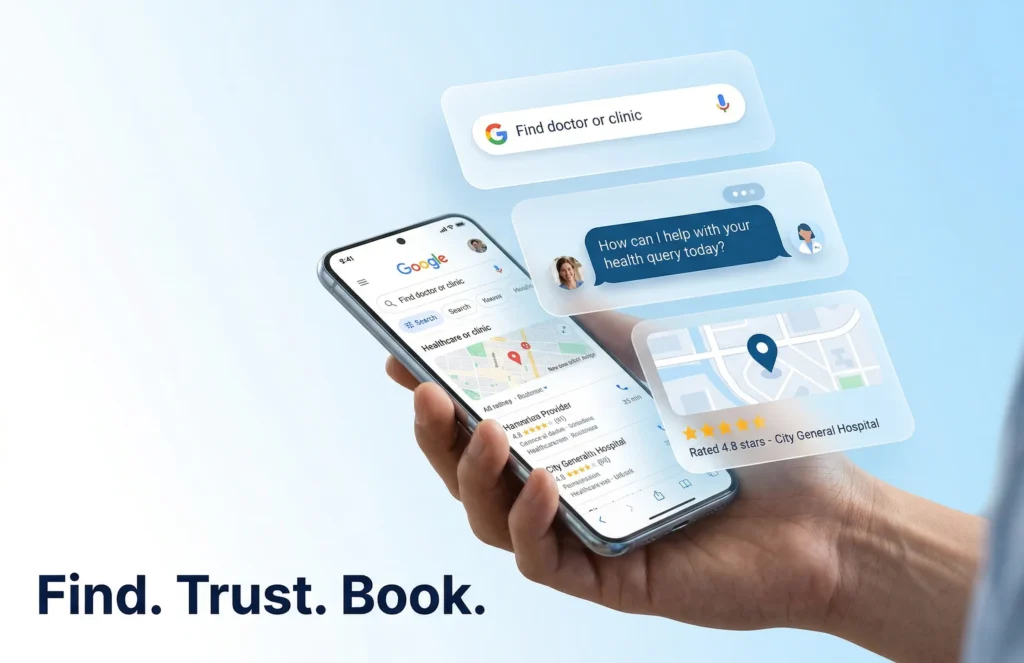
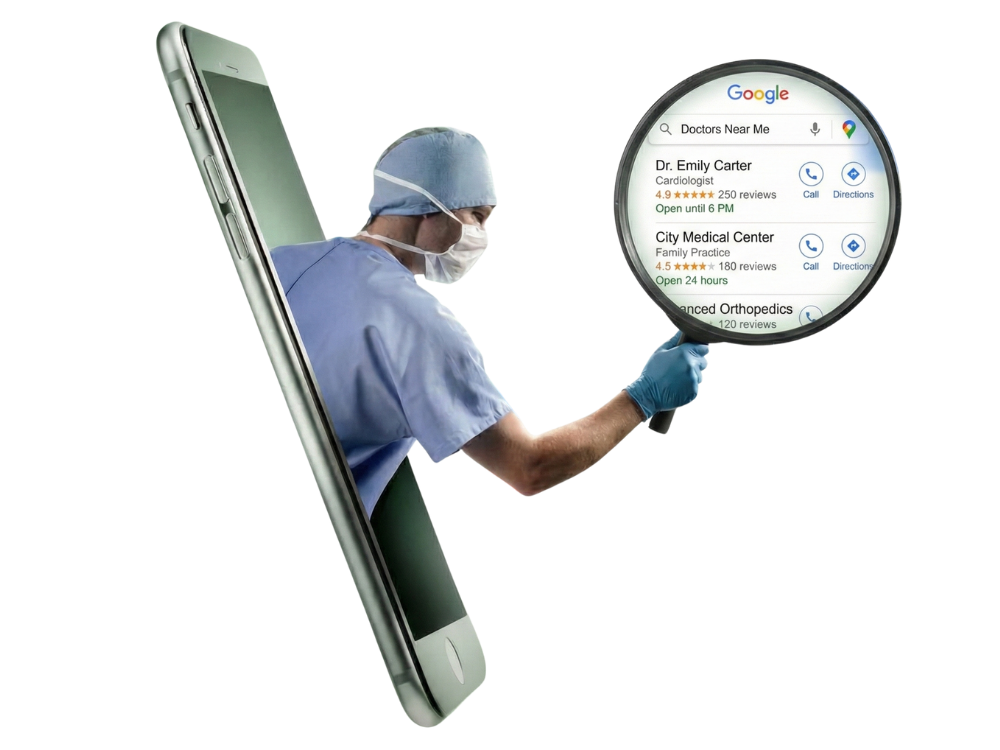
BrightEdge confirmed that Google has 0% AI Overview presence on local “near me” healthcare queries. When a patient searches “orthopedic surgeon near me” or “dermatologist accepting new patients Dallas,” they get the traditional map pack, Google Business Profile listings, and organic results.
ChatGPT cannot book appointments. It cannot show real-time availability. It cannot display a map with directions to your clinic. For the final conversion step – the actual appointment booking – Google remains the only game that matters.
Real Patient Search Scenarios: How People Use Each Platform
Theory is useful. But real scenarios show the split more clearly. Here are five actual search patterns that represent how patients in 2026 are navigating between ChatGPT and Google.
Scenario 1: The New Parent at 2 AM
Maya, 29, in Houston. Her 8-month-old has a 101.5 fever and a rash on his chest. It is 2:14 AM. She opens ChatGPT on her phone and types: “my baby has a fever and chest rash should I go to the ER or wait until morning.”
ChatGPT asks three follow-up questions about the rash pattern, the baby’s behavior, and whether the fever responds to medication. It explains the difference between viral rashes and more serious presentations. It tells her that if the rash does not blanch when pressed, she should go to the ER immediately. Otherwise, urgent care in the morning is likely fine.
Maya checks the rash. It blanches. She feels reassured enough to wait. At 8 AM, she opens Google and searches “pediatric urgent care near me open now.” She books from the map pack.
ChatGPT owned Stage 1. Google owned Stage 4.
Scenario 2: The Executive With Chronic Back Pain
James, 52, in Atlanta. He has had lower back pain for six months. His primary care doctor said “try physical therapy.” He did. It did not help. Now he wants to understand his surgical options.
He opens ChatGPT: “I’ve had chronic lower back pain for 6 months, PT didn’t help, what surgical options should I consider and what questions should I ask a spine surgeon?”
ChatGPT gives him a detailed comparison of microdiscectomy, spinal fusion, and artificial disc replacement. It generates a list of 10 questions to ask his surgeon. He screenshots the list.
Then he opens Google: “best spine surgeon Atlanta reviews.” He reads Google reviews, checks websites, and books with a practice whose website had detailed treatment comparison pages that matched exactly what ChatGPT told him.
ChatGPT educated him. Google converted him. The practice that matched both platforms won.
Scenario 3: The Insurance Researcher
Priya, 41, in New Jersey. She just switched jobs and has new insurance. She uploads her insurance card PDF into ChatGPT Health and asks: “Does this plan cover dermatology visits? Do I need a referral?”
ChatGPT Health reads the plan document, tells her dermatology is covered with a $40 copay, and no referral is needed for in-network providers. She asks: “What dermatologists near Princeton are in this network?”
ChatGPT cannot answer that reliably. She switches to Google: “Aetna PPO dermatologist Princeton NJ.” She finds a practice through the map pack and calls the office.
ChatGPT handled the insurance question. Google handled the provider search.
Scenario 4: The Lab Results Decoder
David, 38, in Phoenix. He just got blood work results through his patient portal. His cholesterol is flagged. He screenshots the results, uploads them to ChatGPT Health, and asks: “Is this bad? What should I change?”
ChatGPT explains his LDL, HDL, and triglyceride numbers in plain language. It suggests dietary changes and tells him to discuss statin medication with his doctor. He then asks: “What foods specifically lower LDL cholesterol?”
He gets a detailed, personalized answer. He never touches Google for any of it.
ChatGPT owned the entire journey. No Google needed.
Scenario 5: The Second-Opinion Seeker
Linda, 56, in Denver. She was told she needs a hysterectomy. She is not sure. She asks ChatGPT: “My doctor says I need a hysterectomy for fibroids. Are there less invasive options? What should I consider?”
ChatGPT explains uterine fibroid embolization, myomectomy, and MRI-guided focused ultrasound as alternatives. It outlines the pros and cons of each. It tells her the questions to ask her gynecologist. Then she searches Google: “best gynecologist second opinion fibroids Denver” and books a consultation.
ChatGPT challenged the first diagnosis. Google helped her find the second opinion. The practice with content about fibroid alternatives captured her.
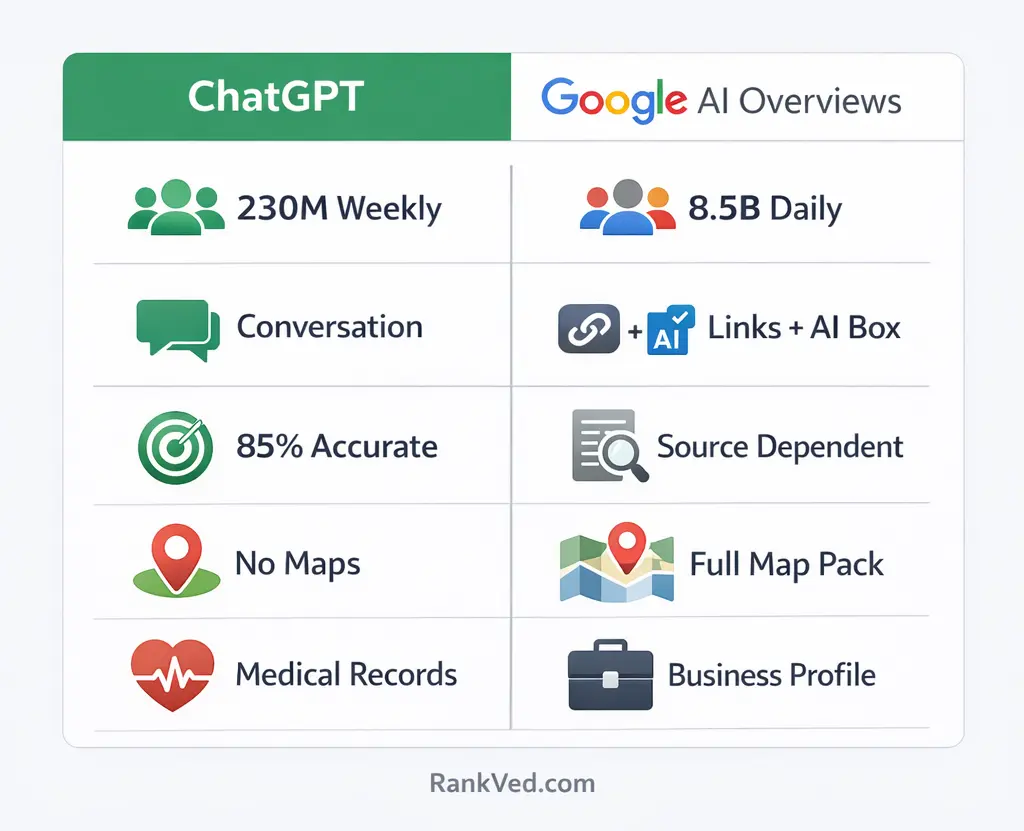
ChatGPT vs Google: The Full Data Comparison for Healthcare
Let us put every major data point side by side so you can see exactly where each platform stands.
| Metric | ChatGPT | |
|---|---|---|
| Weekly health users | 230 million (OpenAI, Jan 2026) | 1+ billion health questions daily (Google) |
| Daily health queries | 40+ million (OpenAI report) | Not disclosed separately |
| AI-generated answer format | Conversational, multi-turn dialogue | AI Overview paragraph + source links |
| Medical accuracy (studies) | ~85% on realistic prompts (Penn State study) | Varies by source quality |
| Empathy rating | Rated more empathetic than human doctors (UCSD study) | No conversational empathy |
| Healthcare AI coverage | 5%+ of all chats are health-related | 88% of health queries trigger AI Overview (BrightEdge) |
| Local “near me” support | Limited and unreliable | Full Map Pack + Google Business Profile |
| Medical records integration | Yes – ChatGPT Health via b.well (2.2M providers) | No direct integration |
| Appointment booking | Not supported | Supported via GBP + scheduling links |
| Patient reviews visible | Not natively displayed | Full review system with star ratings |
| Content freshness signal | Web browsing pulls current sources | 85% of AI citations from last 2 years |
| Schema markup impact | Moderate (helps entity recognition) | High (directly influences AI citations) |
Key takeaway: ChatGPT is winning the research phase of the patient journey. Google is winning the booking phase. Practices that optimize for only one platform are losing patients at the other end of the funnel.
What This Means If You Run a Medical Practice (The Part Your Board Keeps Asking About)
If you are a hospital marketing director or clinic owner, your leadership team is probably asking one version of this question: “Should we be worried about ChatGPT?”
The honest answer: yes – but not in the way they think.
ChatGPT is not going to replace Google for doctor discovery. Patients are not abandoning Google to book appointments through an AI chatbot. What ChatGPT is doing is capturing the research phase of the patient journey that used to happen on your website.
Previously, a patient would Google “ACL surgery recovery,” land on your blog post, spend four minutes reading it, and then click your “Book a Consultation” button. Now, they ask ChatGPT the same question, get a comprehensive answer in 30 seconds, and only visit your site if ChatGPT either cited you as a source or they later search for a surgeon on Google.
The practical impact:
- Your blog traffic from informational queries is declining – even though your rankings have not changed – because patients are getting answers from AI before clicking any link
- Your “brand discovery” is now split across two platforms. Some patients first encounter your practice name in a ChatGPT answer. Others find you through Google Maps. Your content strategy needs to feed both
- The patients who do click through from AI sources convert at higher rates. They arrive already educated, already warmed up, and already closer to booking
- Your competitor who publishes physician-attributed, clearly structured, schema-marked content is showing up in both Google AI Overviews and ChatGPT citations. If that is not you, they are winning patients you never even knew were searching
The 5-Step Action Plan for Medical Practices in 2026
Here is what to do about it. Not theoretical strategy – actual implementation steps.
Step 1: Make Your Practice “Citable” by AI Systems
Both Google AI Overview and ChatGPT pull from web content. The content that gets cited has three consistent features: it directly answers a specific question, it is attributed to a credentialed physician, and it is structured with clear headings and concise paragraphs.
Audit your top 20 pages. If any clinical content is attributed to “Admin” or “Staff,” fix it today. Add physician name, credentials, specialty, and a linked bio page.
Step 2: Build Your “Answer Library” for Both Platforms
Create content that targets the specific questions patients ask ChatGPT. These are not traditional SEO keywords. They are conversational queries like:
- “What is the difference between a torn meniscus and ACL tear”
- “How do I know if I need surgery for carpal tunnel”
- “Is it normal to have chest pain after eating”
- “What questions should I ask my doctor about a breast biopsy”
Each answer page should start with a direct 40-60 word answer, followed by deeper explanation, followed by physician commentary. This structure feeds both Google AI Overview extraction and ChatGPT web browsing.
Step 3: Add an LLM.txt File to Your Website
An llm.txt file tells AI crawlers which pages on your site to prioritize. Google does not use it, but ChatGPT’s and Perplexity’s web browsing systems do reference it. Think of it as robots.txt for AI models. Add it to your root domain and list your most important treatment pages, physician bios, and FAQ pages. Here is a step-by-step guide to creating and implementing your llm.txt file.
Step 4: Double Down on Google Business Profile for Conversions
ChatGPT cannot book appointments. Google can. Your Google Business Profile is where the patient journey ends, regardless of where it starts. Ensure your profile has complete service listings, recent patient reviews (aim for 5+ new reviews monthly), professional clinic photos (not stock images), accurate hours and insurance information, and an active posting schedule.
Step 5: Track Your Visibility Across Both Ecosystems
Most practices only track Google rankings. That is now insufficient. You also need to monitor whether AI platforms are citing or recommending your practice.
Run these checks monthly:
- Search your core treatment queries on ChatGPT. Does your practice get mentioned? If not, your content is not structured for AI citation
- Search your core queries on Google. Do you appear in the AI Overview sources? If not, your content lacks the authority or structure signals AI needs
- Search your practice name on Perplexity and Gemini. Are you being referenced? These platforms are growing fast among health-conscious patients
This is the new version of “checking your Google rankings.” But now you are checking across four platforms, not one.
Why Most Medical Practices Are Invisible on ChatGPT (And How to Fix It)
Here is the uncomfortable truth. When patients ask ChatGPT “who is the best cardiologist in Miami,” most practices do not appear. Not because their doctors are not excellent – but because their digital presence was built entirely for Google.
A website optimized for Google has keywords in the right places, backlinks from directories, and a Google Business Profile. That is necessary but no longer sufficient.
A website that ChatGPT can cite needs:
- Physician entity recognition. Your doctor’s name, credentials, and specialty need to be structured with Person and Physician schema markup so AI systems can identify them as real, credentialed medical professionals
- Structured answer blocks. Not blog posts that ramble for 2,000 words before reaching the point, but content that leads with a clear answer and builds depth underneath
- External authority signals. Links to published research, medical society memberships, and peer-reviewed references tell AI systems your content is clinically sound, not marketing copy
- An llm.txt file. This tiny text file on your server acts as a roadmap for AI crawlers, pointing them to your most authoritative pages
The practices that build for both ecosystems – Google’s healthcare SEO framework and AI search optimization for doctors – are the ones winning patients in 2026.
The Forecast: Where Healthcare Search Is Heading in the Next 12 Months
Based on the data trends, here is what medical practices should expect by early 2027:
- ChatGPT Health will expand beyond the U.S. and add more provider integrations. Patients will be able to ask “who in my insurance network treats this condition near me” and get a direct answer with booking links
- Google will integrate more AI into local results. BrightEdge data shows Google tested and removed AI from local queries – but the direction is clear. Expect AI-enhanced local results by late 2026 or early 2027
- Patient trust in AI for health information will continue rising. The Annenberg survey found 75% of people who search online say AI-generated responses provide them with the answer they need sometimes or often. That number will only grow as ChatGPT Health matures
- Practices with multi-platform AI visibility will outperform those optimizing only for Google by a widening margin. The gap between AI-visible practices and AI-invisible practices will become as significant as the gap between page-1 and page-3 rankings was in traditional SEO
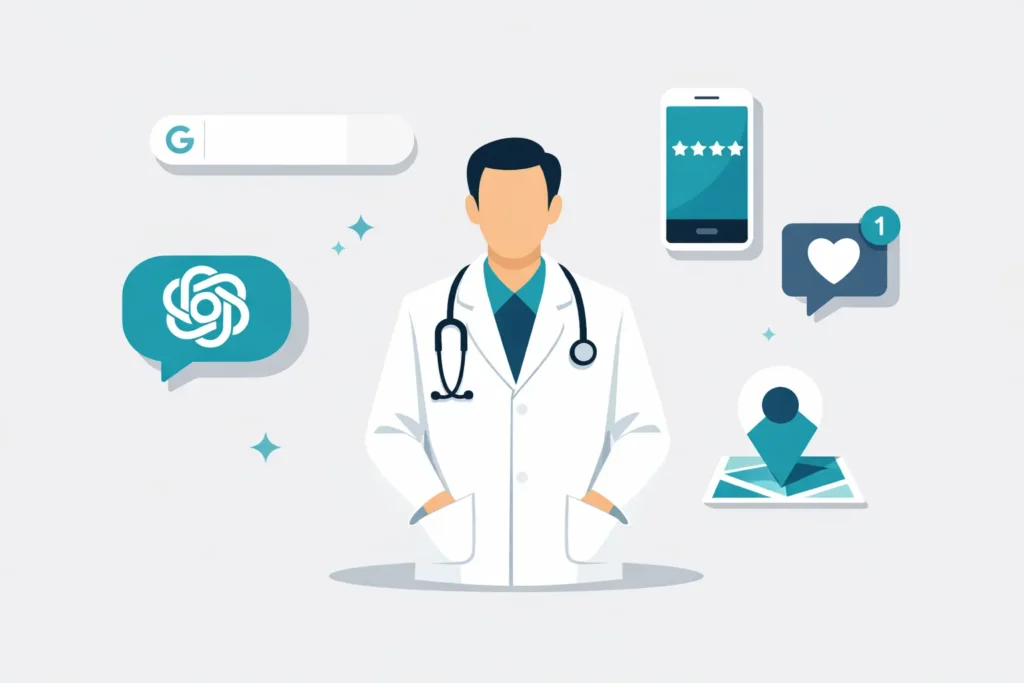
The bottom line: The question is no longer “Google or ChatGPT.” The question is “how do I show up on both?” Patients are not choosing one platform over the other. They are using both – at different stages of their health journey, for different reasons, at different times of day. The medical practices that understand this shift and build for it will capture patients at every stage. The ones that do not will keep wondering why their traffic is declining while their rankings stay the same.