

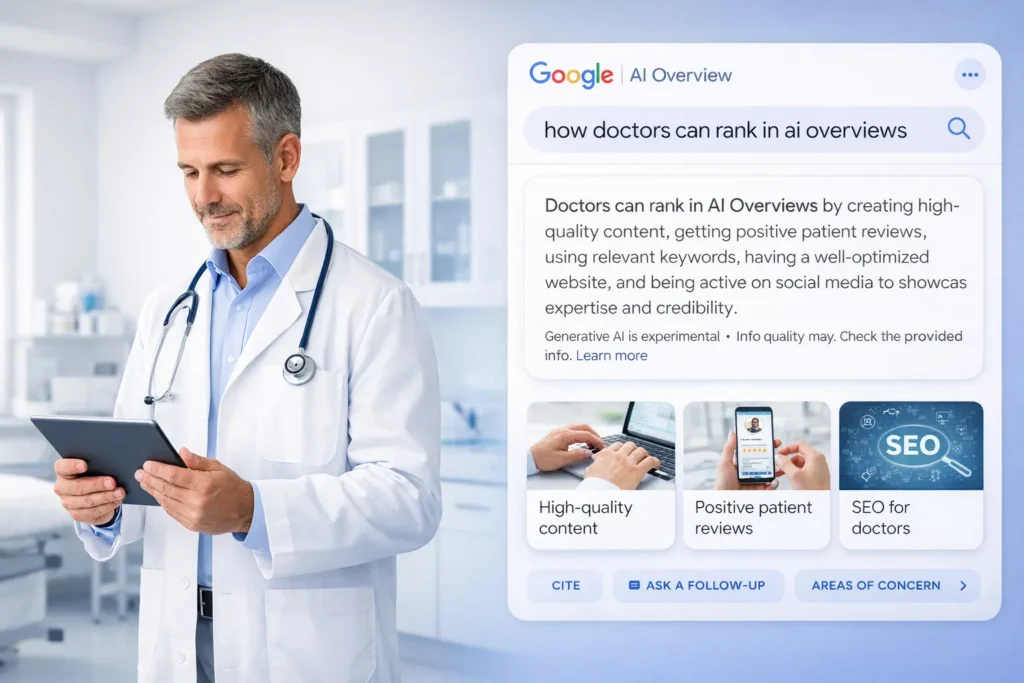
Something strange is happening to your clinic’s website traffic. Your rankings have not changed. Your content is still on page one. But fewer patients are clicking through to your site.
The reason is sitting right at the top of Google’s search results – a blue box of AI-generated text that answers your patient’s question before they ever see your website link. Google calls it AI Overview. And it is quietly reshaping how patients discover doctors, compare treatments, and choose where to book appointments.
According to BrightEdge research tracking healthcare keywords from 2023 to 2025, AI Overview now appears on 88% of all healthcare-related queries. Treatment and procedure queries hit 100% coverage. That means every single time a patient searches “knee replacement recovery” or “best treatment for lower back pain,” Google answers the question itself – often pulling from sources that are not your website.
For doctors and medical practice owners in the United States, this is not a future problem. It is happening right now, in every city, across every specialty. The practices that figure out how to get cited inside these AI-generated summaries will own the top of Google’s results page. The rest will watch their traffic decline – even while their rankings stay exactly the same.
This guide breaks down exactly how Google AI Overview works for healthcare queries, what signals it uses to pick sources, and the specific steps your medical practice needs to take to appear in that box above organic results.
What Google AI Overview Actually Is (And Why It Replaced Your Page 1 Traffic)
Google AI Overview is an AI-generated summary that appears at the very top of search results, above paid ads, above the local map pack, and above every organic listing. When a patient types a health-related question, Google’s Gemini model reads content from across the web, synthesizes an answer, and presents it in a conversational paragraph with selective source links underneath.
Before AI Overview existed, a search like “what causes sharp chest pain on the left side” would return ten blue links. The patient would click through to WebMD, Mayo Clinic, or your cardiology blog to find the answer. Now, Google provides the answer directly. The patient reads it, gets enough information, and often never scrolls down to the organic results at all.
This is what the industry calls a “zero-click search.” The search ends without a single website visit.
Research from Skai’s 2025 analysis of over eight billion impressions found that when AI Overviews appear, organic click-through rates drop significantly. For healthcare specifically, the pattern is even more pronounced because most health queries are informational. Patients want answers, not websites.
But here is the part most doctors miss. AI Overview does not eliminate the opportunity. It changes the opportunity. When your practice is cited as a source inside an AI Overview, you appear above position one. You appear above the map pack. You appear before patients even consider scrolling. That is the new position zero in healthcare search.
How Many Healthcare Queries Actually Trigger AI Overviews in 2026
The numbers here are staggering, and they have grown rapidly over just two years.
BrightEdge’s three-year tracking study of healthcare keywords shows a clear acceleration:
- December 2023: 59% of healthcare queries triggered an AI Overview
- December 2024: Rapid growth following multiple core algorithm updates
- December 2025: 88% of healthcare queries now trigger an AI Overview
But the coverage is not uniform. Google treats different types of healthcare queries differently:
| Query Type | AI Overview Presence (Dec 2023) | AI Overview Presence (Dec 2025) | Change |
|---|---|---|---|
| Treatment and procedure queries | 45% | 100% | +55 points |
| Pain-related queries | 58% | 98% | +40 points |
| Symptoms and conditions | 57% | 93% | +36 points |
| Medical coding (ICD-10, CPT) | 67% | 90% | +23 points |
| Local provider searches (“near me”) | Tested | 0% | Removed entirely |
That last row is the most important finding for medical practices. Google tested AI Overviews on local “near me” queries – and then removed them entirely. Searches like “dermatologist near me” or “pediatric dentist near me” still rely 100% on traditional local results: the map pack, local organic listings, and Google Business Profile.
What this means for your practice: Your informational content (blog posts about conditions, treatment guides, symptom explainers) now competes inside AI Overviews. Your local visibility (Google Business Profile, local landing pages) still operates under traditional SEO rules. You need separate strategies for each.
Why Some Doctors Get Cited by Google AI and Others Get Ignored
Google AI Overview does not randomly select sources. It applies a strict set of trust signals – and for healthcare content, those signals are even more demanding because Google classifies medical information as YMYL (Your Money or Your Life).
Here are the five signals that determine whether your practice gets cited:
Signal 1: Physician Attribution on Every Medical Content Page
Content published under “Admin” or “Marketing Team” will never appear in an AI Overview for a health query. Google’s quality guidelines require medical content to be written or reviewed by a credentialed healthcare professional. The physician’s name, credentials, specialty, and a link to their professional profile page must be visible on every piece of clinical content.
This is not optional. It is the single most common reason healthcare websites get ignored by AI systems. A blog post about ACL surgery recovery written by “Dr. Sarah Mitchell, MD, Board-Certified Orthopedic Surgeon” with a linked author bio carries weight. The same content attributed to your marketing agency carries none.
Signal 2: E-E-A-T Signals Built Into Your Site Architecture
E-E-A-T stands for Experience, Expertise, Authoritativeness, and Trustworthiness. Google added the extra “E” for Experience in December 2022, and for healthcare websites, it is the most important ranking factor – for both traditional search and AI Overview citation.
What Google looks for on medical websites:
- Author bio pages for every physician who contributes content, with credentials, board certifications, years of practice, hospital affiliations, and professional headshots
- External validation signals like links to published research, medical society memberships, and Google Scholar profiles
- Clinical citations within content that reference peer-reviewed studies, medical association guidelines, or government health sources (NIH, CDC, WHO)
- A clearly visible editorial review process showing that medical content is reviewed by qualified professionals before publication
Signal 3: Medical Schema Markup That Makes Your Content Machine-Readable
Schema markup is structured code added to your website that tells Google exactly what your content is about, who wrote it, and what type of page it is. For AI systems, schema is not just helpful – it is how they identify and categorize your content before deciding whether to cite it.
The four essential schema types for healthcare websites aiming for AI Overview citation:
- MedicalOrganization or MedicalClinic schema on your homepage and location pages – tells Google you are a legitimate medical entity with specific address, phone, hours, and specialties
- Physician schema on every provider bio page – connects each doctor to their credentials, specialty, hospital affiliation, and NPI number
- FAQPage schema on every page with patient questions – structures your Q&A content so AI can extract it directly as a featured answer
- Article schema with author markup on every blog post and content page – links your medical content to the credentialed physician who wrote or reviewed it
According to Google Search Central’s structured data documentation, JSON-LD is the recommended format for implementing schema. Healthcare pages with comprehensive schema markup see significantly higher engagement rates in search compared to those without it.
Signal 4: Answer-First Content Structure
AI Overview is designed to extract quick, clear answers. If your content buries the answer under three paragraphs of introduction, Google’s AI will skip your page and pull from a competitor who puts the answer first.
The ideal content structure for AI Overview citation follows this pattern:
- Start with a direct, concise answer to the question in the first 40-60 words
- Follow with supporting context, data, and clinical detail
- Include numbered steps or frameworks when explaining processes
- Add expert commentary from the physician author
- Close with a clear recommendation or next step for the patient
This is called “answer-first” or “inverted pyramid” structure. It mirrors how medical professionals communicate – lead with the diagnosis, then explain the reasoning.
Signal 5: Consistent Patient Reviews and Trust Signals
Google’s AI does not cite websites that lack trust signals. For healthcare, patient reviews are the strongest trust signal outside of content quality. A medical practice with 200+ Google reviews, a 4.5+ star rating, and consistent NAP (Name, Address, Phone) data across directories tells both traditional search and AI systems that this is a real, trusted practice.
Health systems like Universal Health Services have publicly stated they are focusing on Google review generation specifically to increase visibility in AI-driven search platforms.
The 7-Step Framework to Get Your Medical Practice Into Google AI Overview
Theory is useful. But what doctors actually need is a step-by-step implementation plan they can hand to their marketing team or SEO agency. Here is the exact framework.
Step 1: Audit Your Physician Attribution Across All Content
Go through every blog post, treatment page, and condition guide on your website. If any page has medical content without a named physician author and linked bio, fix it immediately. Every clinical page needs:
- The physician’s full name and credentials (e.g., “Dr. Rajesh Patel, MD, FACC”)
- A linked author bio page with their professional background
- “Medically reviewed by” or “Written by” tag with date of review
- Person schema connecting the author to their credentials in code
Step 2: Implement the Four Essential Schema Types
Work with your developer or SEO agency to add JSON-LD schema markup to every relevant page. Start with the highest-traffic pages first. At minimum, every healthcare website needs:
- MedicalClinic or MedicalOrganization on homepage and location pages
- Physician schema on all provider bio pages
- FAQPage schema on any page with patient questions
- Article schema with author attribution on all blog content
Validate your markup using the Google Rich Results Test after implementation. Invalid or incomplete schema is worse than no schema at all.
Step 3: Restructure Your Content Pages for AI Extraction
For every treatment page and condition guide, restructure the content to follow the answer-first pattern:
| Section | Purpose | Ideal Length |
|---|---|---|
| Direct answer block | Answer the core question immediately | 40-60 words |
| Context paragraph | Explain the why behind the answer | 80-120 words |
| Numbered framework or steps | Break down the process clearly | 150-300 words |
| Expert commentary | Add physician perspective | 50-100 words |
| Patient-facing summary | Clear next step or recommendation | 30-50 words |
This structure makes it easy for AI to extract a clean answer block while still providing the depth that patients and traditional search algorithms require.
Step 4: Build Content Around AI-Triggering Query Patterns
Not all search queries trigger AI Overviews at the same rate. Based on BrightEdge data, healthcare queries with eight or more words are seven times more likely to generate an AI Overview. That means long-tail, question-based queries are your primary target.
Examples of high-trigger healthcare queries:
- “What is the recovery time for knee replacement surgery in 2026”
- “How long does physical therapy take after rotator cuff repair”
- “What are the risks of LASIK surgery for patients over 50”
- “Is minimally invasive spine surgery better than traditional fusion”
Create dedicated content pages targeting these long-tail queries. Each page should follow the answer-first structure, include physician attribution, and carry full schema markup.
Step 5: Optimize Your Google Business Profile for Local Queries
Remember – Google removed AI Overviews from all local “near me” healthcare queries. This means your Google Business Profile and local SEO remain your primary patient acquisition channel for bottom-of-funnel searches.
Ensure your Google Business Profile includes:
- Complete service listings matching your website’s treatment pages
- Professional photos of your clinic, staff, and facilities (not stock images)
- A steady flow of recent patient reviews (aim for 5+ per month)
- Accurate hours, phone, address, and insurance information
- Regular posts with health tips, practice updates, and seasonal content
Step 6: Create an FAQ Engine That AI Can Parse
FAQPage schema is one of the fastest paths to AI Overview citation. When a patient asks “does insurance cover physical therapy” and your FAQ page has that exact question with a clear 30-word answer marked up with FAQPage schema, Google can extract and cite it in seconds.
Build FAQ sections on your most important pages using these real patient questions. Source questions from:
- Your front desk team (what do patients ask most often on the phone?)
- Google’s “People Also Ask” section for your target keywords
- Reddit and Quora threads about your specialty
- Your Google Business Profile Q&A section
Each FAQ answer should be 30-60 words, written in plain language, and directly answer the question without filler.
Step 7: Track AI Overview Citations – Not Just Rankings
Traditional SEO tracking measures your position in organic results. AI Overview optimization requires a different metric: citation presence. Are you being cited as a source in AI-generated summaries for your target queries?
BrightEdge recommends tracking two metrics in parallel:
- For clinical content: Track AI citation presence alongside traditional rankings
- For local content: Traditional position tracking still tells the full story since AI Overviews are not present on local queries
Run your target queries manually once per week and note whether your website appears in the AI Overview sources. AI Overviews are non-deterministic – the same query can cite different sources at different times of day – so consistent monitoring matters more than any single check.
How AI Overview Is Different from Traditional Healthcare SEO
Many doctors assume that ranking well in traditional search automatically means appearing in AI Overviews. The data says otherwise.
BrightEdge research found that only about 17% of sources cited in AI Overviews also rank in the organic top 10 for the same query. This means roughly five out of six AI Overview citations come from content that does not appear on the first page of traditional search results.
That finding changes everything about how medical practices should think about search visibility.
| Factor | Traditional SEO | AI Overview Optimization |
|---|---|---|
| Primary goal | Rank on page 1 | Get cited in AI summary |
| Key metric | Click-through rate | Citation presence |
| Content focus | Keyword density + backlinks | Answer clarity + E-E-A-T authority |
| Schema priority | LocalBusiness basics | Full medical schema stack |
| Author attribution | Nice to have | Required for citation |
| Content freshness | Moderate importance | High importance (85% of citations from last 2 years) |
| Local queries | Map pack + organic listings | AI Overviews not present (traditional rules apply) |
Key insight: AI Overview optimization and traditional SEO are not competing strategies. They are complementary. Your local SEO drives appointment bookings from “near me” searches. Your AI Overview optimization drives brand authority and visibility on informational queries. You need both.
What Happens to Medical Practice Traffic When AI Overviews Take Over
The traffic impact is real, but it is not evenly distributed across all page types.
Seer Interactive’s analysis of over 3,100 informational queries across 42 organizations found that organic CTR dropped from 1.76% to 0.61% when AI Overviews appeared. That is a 65% decline in click-through rate – not in rankings, but in the number of people who actually click your link after seeing it.
For a medical website that generated 10,000 monthly visits from treatment-related queries in 2023, the same rankings in 2026 might deliver only 3,000 to 4,000 visits. The content is still being consumed. But it is being consumed inside Google’s search results page, not on your website.
However, the traffic that does come through from AI-related searches tends to convert better. Patients who click through after reading an AI Overview arrive warmer, more informed, and more likely to book an appointment. The volume drops, but the quality increases.
Pages that hold traffic best:
- Location-specific service pages with booking functionality
- Physician profile pages with patient reviews
- Pages targeting navigational queries (patients already know your practice name)
Pages that lose traffic most:
- Generic symptom explainer blog posts
- Condition overview pages without unique physician perspective
- Treatment guides that match the exact structure of AI Overview answers
How to Optimize Your Medical Practice for Both Google AI and ChatGPT
Google AI Overview is not the only AI system patients are using. OpenAI reported that over 230 million people worldwide ask ChatGPT health and wellness questions every week. Roughly 25% of ChatGPT’s weekly active users globally submit health-related queries.
The good news: the optimization strategies for Google AI Overview and ChatGPT overlap significantly. Both systems rely on structured content, physician authority, and clear answer formatting. But there are differences worth noting.
| Factor | Google AI Overview | ChatGPT / Perplexity |
|---|---|---|
| Primary data source | Google’s indexed web (FastSearch) | Live web retrieval + training data |
| Schema markup impact | High – directly influences citation | Moderate – helps with entity recognition |
| Local query handling | Uses Map Pack, no AI Overview | Can recommend specific practices by name |
| Content freshness weight | 85% of citations from last 2 years | Varies by platform and crawl frequency |
| LLM.txt file relevance | Not used by Google | Helps AI crawlers prioritize pages |
For maximum AI search visibility across all platforms, your medical practice should implement both traditional SEO signals (schema, E-E-A-T, content structure) and AI-specific signals like an llm.txt file that tells AI crawlers which pages to prioritize.
Real-World Examples: Healthcare Practices That Appear in AI Overviews
To understand what success looks like, consider two fictional practices modeled after real implementation patterns:
Dr. Ananya Rao – Solo Dermatology Practice, Austin, Texas
Dr. Rao’s practice had strong local SEO but was invisible in AI Overviews for her core treatment queries. Her blog posts were attributed to “Staff Writer” and had zero schema markup. After implementing the framework above – adding physician attribution, MedicalClinic schema, FAQPage markup, and restructuring her top 10 blog posts with answer-first formatting – her practice began appearing in AI Overview citations for queries like “how long does Mohs surgery take” and “does insurance cover dermatology consultation.”
The changes took roughly 6 weeks to show results after Google recrawled the updated pages.
Sunrise Orthopedic Group – Multi-Location Practice, Dallas, Texas
Sunrise had a 50-page website with treatment guides, but every page used the same template structure: a long introduction, then a table of contents, then the actual content. AI Overview consistently skipped their pages because the answer was buried 400+ words into each page. After restructuring their top 20 treatment pages with direct answer blocks in the first 60 words and adding Physician schema linking each page to the treating orthopedic surgeon, citation presence increased across their target queries.
Common Mistakes Doctors Make When Trying to Appear in AI Overview
After working with healthcare clients, these are the mistakes that block AI Overview citation most often:
Mistake 1: Publishing medical content under “Admin” or your marketing agency’s name. Google will not cite unattributed medical content in AI Overviews. Period. Every clinical page needs a named physician author.
Mistake 2: Skipping schema markup entirely. Schema is how AI systems identify your content as medical, your authors as credentialed, and your practice as legitimate. Without it, you are invisible to machine reading.
Mistake 3: Burying the answer under long introductions. AI Overview extracts content from the first 60-100 words of a page. If your answer starts at word 400, Google will cite someone who puts it at word 10.
Mistake 4: Using stock photos of “fake doctors” instead of your real team. Trust signals include visual authenticity. Stock images signal generic content. Real clinical photos signal a real practice.
Mistake 5: Not tracking AI citation separately from rankings. You can rank #1 organically and still be absent from AI Overviews. You need to track both metrics independently.
What Google Keeps Out of AI Overviews for Healthcare – And Why It Matters
Google has made deliberate decisions to exclude certain healthcare topics from AI Overviews entirely. Understanding what is excluded helps you focus your AI optimization on topics where it actually works.
Topics with zero or near-zero AI Overview presence:
- Mental health crisis content (suicide prevention, self-harm resources)
- Eating disorder-related searches
- Addiction and substance abuse queries
- All local “near me” healthcare provider searches
- Visual-heavy medical queries (X-ray interpretation, skin cancer images)
For these topics, traditional SEO still governs your visibility completely. If your practice specializes in mental health or addiction treatment, your strategy should remain focused on E-E-A-T-driven organic SEO rather than AI Overview optimization.
For every other clinical specialty – orthopedics, cardiology, dermatology, OB/GYN, pediatrics, oncology, urology, and more – AI Overview optimization should be a core part of your 2026 healthcare SEO strategy.
The Next 12 Months: What Doctors Should Expect from AI Search
Google’s AI Overview system has stabilized. BrightEdge data shows that monthly volatility dropped to about 5 percentage points by late 2025, down from wild swings in early 2024. The experimentation phase is over. What you see now is Google’s established approach to healthcare AI Overviews.
Here is what to expect for the rest of 2026:
- AI Overview coverage will hold steady near 88-90% for healthcare queries – the system is at near-saturation for clinical content
- Local provider queries will remain AI-free, keeping Google Business Profile as the primary local visibility channel
- Content freshness will become an even stronger signal – 85% of current citations come from content published within the last two years
- Schema markup will shift from “nice to have” to baseline requirement for any medical website targeting organic search or AI visibility
- Multi-platform AI optimization (Google + ChatGPT + Perplexity + Gemini) will become standard practice for competitive medical markets
The bottom line: The practices that adapt now will own the top of search results for the next several years. The practices that wait will find it increasingly difficult to compete as AI-optimized competitors lock in citation authority.