

Sarthak Jain is the founder of RankVed, a healthcare SEO and AI search optimization agency. In this podcast-style conversation, he answers one of the most uncomfortable questions in medicine right now – why patients are choosing less skilled, less experienced doctors over highly qualified ones.
Series: The Visible Doctor – Episode 01
The Doctor With 20 Years of Experience Has an Empty Waiting Room. The Fresher Has a Queue. Why?
Host: Sarthak, I want to start with something that a lot of senior doctors are genuinely struggling with. A doctor with 20 years of experience, strong patient outcomes, way more surgeries – is losing new patients to someone who has been practicing for three years. How does that even happen?
Sarthak Jain (AI SEO Expert): It happens more than people realize. And it is genuinely painful for the senior doctor because by every clinical measure, there is no comparison.
But here is the thing.
The patient who chose that younger doctor has never seen a surgical report. They did not compare complication rates or years of training. That decision was made in about 8 minutes on a smartphone, late at night, before bed.
And in those 8 minutes, one doctor showed up clearly on Google. Had a clean profile on Maps. Had some articles, some reviews, some presence. The other doctor – the more experienced one – simply did not appear. Or appeared so weakly that the patient moved on.
Visible won. Not skilled. Visible.
“In 2026, patients are not choosing the best doctor. They are choosing the most findable one. And that gap is getting wider every month.”- Sarthak Jain, AI SEO Expert
Host: That sounds almost unfair.
Sarthak Jain: It is not unfair. It is just a shift that happened fast and most doctors missed it. BrightEdge data shows that over 68% of all online experiences begin with a search query and for healthcare that number is even higher because patients are making high-stakes decisions and they start by searching, not by calling a friend.
If your name is not in that search result, the decision is already made. Without you.
Patients Are Not on Google Alone Anymore – And This Changes Everything for Doctors
Host: So where exactly are patients searching now? Is it still just Google?
Sarthak Jain: No, and this is where it gets serious for doctors who have not kept up.
In 2026, a patient might open ChatGPT and type “best orthopedic surgeon in Pune.” Or ask Gemini “who is the most trusted IVF specialist near me.” Or search on Perplexity. Or get a recommendation from Microsoft Copilot.
These are not search engines in the traditional sense. These are AI systems giving direct answers. No list of ten blue links. One or two names, sometimes just one, and the patient calls that person.
Gartner projected that traditional search engine volume would decline by 25% by 2026 because of exactly this shift toward AI assistants. That is not a future prediction anymore. That is now.
So if a doctor is only thinking about Google rankings, they are already behind.
Host: And most doctors have no idea this is happening?
Sarthak Jain: Most do not. And the ones who do know often think it does not apply to them yet. That is the dangerous part. By the time it feels urgent, they have already lost 12 months of authority-building to a competitor who started earlier.
“The doctors who ignore AI search in 2026 are making the same mistake as doctors who ignored Google in 2012. The cost comes later. But it always comes.”
– Sarthak Jain
What Should Doctors Actually Focus On – Google, Maps, or AI Recommendations?
Host: Okay so here is the real question doctors are going to ask after hearing this. Where do I even start? Google rankings? Google Business Profile? AI recommendations? What actually matters most?
Sarthak Jain: All three. And I mean that literally, not as a cop-out answer.
The reason I say all three is because patients are not using just one platform. One patient opens Google. Another opens Maps. A third asks ChatGPT. If you are only visible on one of those, you are invisible to the other two patient groups.
So the framework we use at RankVed – what we call the 3×3 approach – is actually about ranking in the top 3 results across all 3 of these platforms simultaneously.
Platform 1 is Google Search results – your articles, your website, your featured snippets.
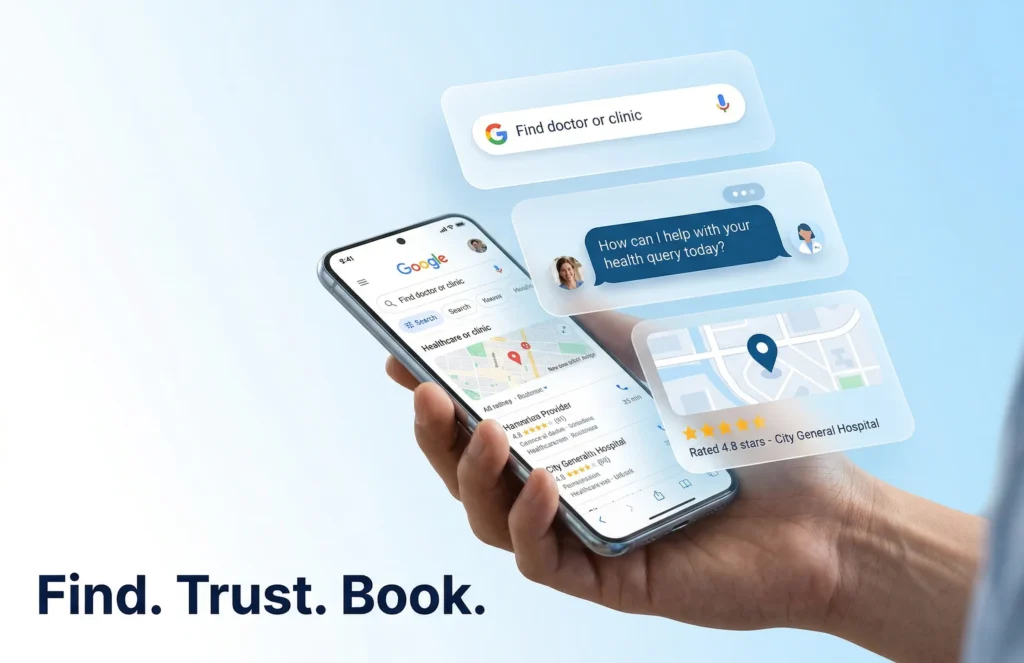
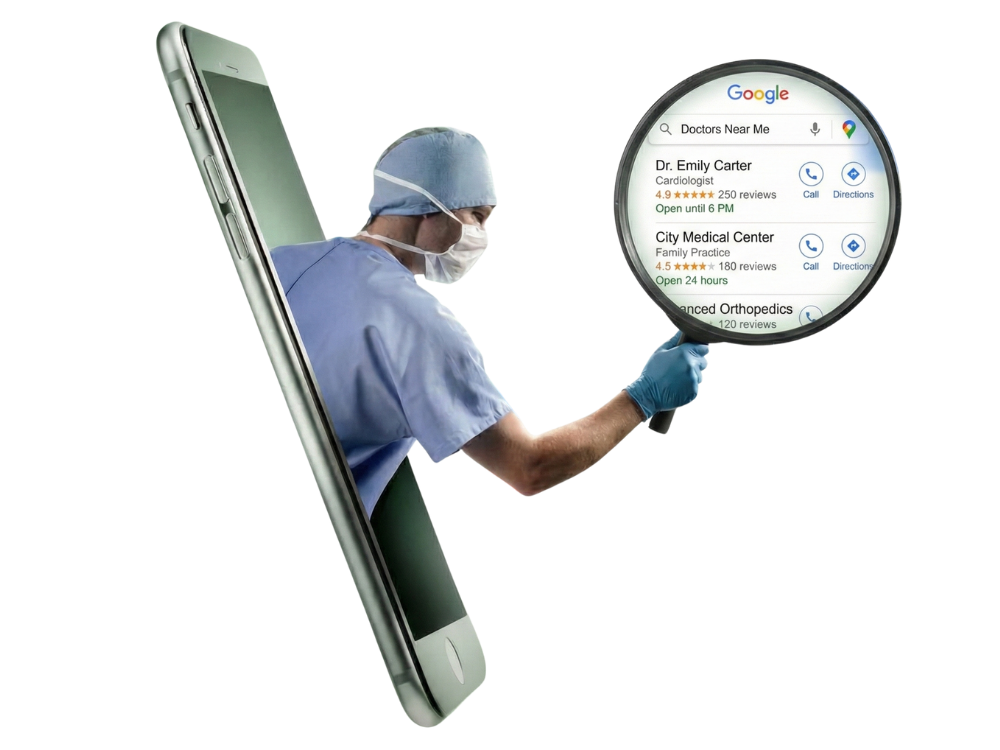
Platform 2 is Google Maps, which means your Google Business Profile – reviews, photos, updates, Q&A.
Platform 3 is AI search – getting your name recommended inside ChatGPT, Gemini, Claude, Perplexity, Microsoft Copilot when patients ask for specialists.
Miss any one of them and you are missing a real segment of patients who would have called you.
Host: So you need to be everywhere at once. That sounds like a lot.
Sarthak Jain: It is. Which is why most clinics that try to do this halfway end up with mediocre results across all three instead of strong results on even one. The strategy has to be built properly, layered in the right order, with the right technical foundation underneath it all.
How AI Engines Like ChatGPT and Gemini Actually Decide Which Doctor to Recommend to a Patient
Host: Walk me through how ChatGPT actually decides to recommend a specific doctor. Because that feels like a black box to most people.
Sarthak Jain: It is less mysterious than it sounds.
AI engines are trained on enormous amounts of web content. When a patient asks ChatGPT for a specialist recommendation, the system draws from patterns in that training. It looks for names that appear consistently and credibly across multiple sources.
So if your name shows up in three medical directories, two news articles, a well-structured website with schema markup, and a few strong review platforms – the AI has enough pattern confidence to include your name in its answer.
If your name exists only on a basic website and one Google Business Profile, the AI does not have enough signal. It skips you.
It is pattern recognition at scale. The doctors who are mentioned consistently across credible sources get recommended. The ones who are not, get skipped entirely.
Host: And how big is the AI search audience actually right now?
Sarthak Jain: Bigger than most doctors think. ChatGPT alone crossed 400 million weekly active users in early 2025. By 2026 those numbers have grown further and a significant portion of those users are asking health related questions. That is not a niche channel. That is a primary patient discovery channel for a growing segment of your market, and it is only going to get larger from here.
“If an AI engine cannot find enough credible information about you online, it will not recommend you. It will recommend someone else. Every time.”
– Sarthak Jain
The Real Danger for Doctors Who Ignore Digital Visibility in 2026 – It Is Not Just New Patients You Will Lose
Host: What happens to a doctor who decides to wait this out? Who says my referrals are fine, my existing patients come back, I do not need to worry about this yet?
Sarthak Jain: That is actually the most dangerous position to be in right now.
Referrals from colleagues are not permanent. Doctors retire. Referral networks shift. And the colleagues who are sending you patients right now – their own patients are searching online before they even follow the referral. If they search your name and find a weak digital presence, they second-guess the referral and look at someone else.
And existing patients – the ones who have been coming to you for years – their children are not loyal to you. When they need a doctor in your specialty, they search online. They do not automatically come to you because their parent did. They search, they compare, they decide based on what they find.
So the threat is not just losing new patients. The threat is that the patient base you have built over 20 years quietly erodes because the next generation of patients in your city never discovers you.
That is a slow bleed. And by the time it is visible in your appointment numbers, you have already lost years of compounding digital authority that your competitor has been building.
“The patients you have now are not guaranteed. Their families are searching online right now. If you are not there, someone else will be.”
– Sarthak Jain
The Steps Doctors Can Follow Right Now to Stop Losing Patients to Less Experienced Competitors
Host: Let us make this very practical. What can a doctor actually do? Give them the steps.
Sarthak Jain: Sure. Here is a straightforward starting path.
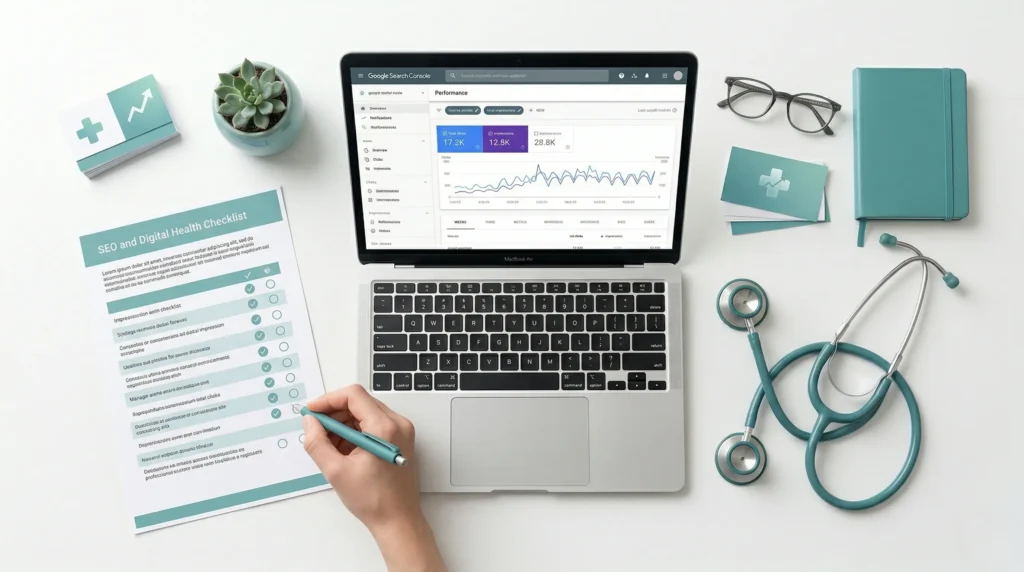
Step 1 – Run an honest audit of where you currently stand on all three platforms. Search your specialty and city on Google. Check if your name appears on page one. Open Google Maps and see what your profile looks like compared to the doctor ranking above you. Then ask ChatGPT who the best specialist in your specialty is in your city. See if your name comes up.
Step 2 – Fix your Google Business Profile. This is the fastest win available and most doctors have an incomplete one. Add real photos of your clinic and team. Write a proper description with your specialty and city. Get into the habit of responding to every review, good or bad. Update your services, post weekly updates, and add Q&A content that answers what patients actually ask.
Step 3 – Fix the technical foundation of your website. If your site loads slowly on mobile, Google already trusts it less. Add schema markup so search engines can clearly read your specialty, credentials, and location. Make sure your doctor bio lists your qualifications, publications, and experience clearly.
Step 4 – Build content that answers real patient questions in your specialty. Not generic health articles. Specific, helpful content about conditions you treat, procedures you perform, and decisions patients face. This is what gives Google and AI engines the material to extract answers from and attach your name to.
Step 5 – Get your name into credible external sources. Medical directories, local news features, health publications, doctor interview formats. This is what gives AI engines the cross-source confidence to recommend you over someone with just a decent website.
Step 6 – Keep doing it. This is not a one-time project. Search behavior changes. Algorithms update. The doctors who stay visible are the ones who treat their digital presence like a living system, not a one-time setup.
Host: And if a doctor does not have the time to manage all of this – which most do not – what then?
Sarthak Jain: Then they do not have to do it alone. These steps above are exactly what we do at RankVed, and we have already done this for 37+ clinics and medical practices. Including ranking several of them inside AI recommendations, which is still something almost no agency in India knows how to do properly.
If a doctor wants to see exactly where they stand right now and what the fastest path to visibility looks like for their specific specialty and city, they can book a 1-to-1 strategy call directly. We bring the data, the audit, and a clear 90-day plan. No generic advice.
Book Your 1:1 Strategy Call with Sarthak Jain – Click Here
Sarthak Jain’s Golden Tip for Every Doctor Reading This
Host: Last one. One golden tip from you. What is the single most important thing you want every doctor to take away from this conversation?
Sarthak Jain: Stop thinking of your digital presence as marketing. It is not.
Marketing is something you do when things are going well and you want more growth. What I am talking about is something different. Your digital presence in 2026 is your clinic’s front door. It is the first thing a patient sees, touches, and judges before they ever call you. Before they ever walk in.
If that front door is broken, outdated, or simply not there – patients walk past. They do not know your experience. They do not know your outcomes. They just move on to the doctor whose front door is open and welcoming.
The time to fix this is not when the waiting room is already empty. The time is now, while you still have momentum, still have a patient base, and still have time to build authority before a competitor does.
AI search is not coming. It is here. Patients are already using it. And every month that passes without a proper digital strategy is a month your competitor is getting recommended in your place.
That is the thing I want every doctor to sit with today.
Host: Sarthak, thank you. This was one of the most practical and honest conversations we have had on this topic.
Sarthak Jain: Happy to be here. And to every doctor listening – your skill is not the question. Your visibility is. And that is fixable. Let us fix it.
Frequently Asked Questions
Why is a younger doctor with fewer reviews getting more patients than me in 2026?
Because patients are finding doctors through Google, Maps, and AI search engines now, not through word of mouth alone. A younger doctor with an optimized digital presence ranks above you even if your clinical experience is significantly stronger. Search engines and AI tools rank digital authority, not years of practice.
Should I focus on Google rankings, Google Maps, or AI recommendations first?
All three matter and they work together. Google search drives awareness. Google Maps drives local discovery and direct calls. AI search engines like ChatGPT and Gemini are increasingly giving direct doctor recommendations. Missing any one of them means losing a real segment of patients every month. The order of priority is: fix your Google Business Profile first for fastest results, then your website, then build toward AI visibility.
How does ChatGPT decide which doctor to recommend to a patient?
AI engines like ChatGPT recommend doctors who appear consistently across credible online sources – medical directories, news mentions, structured websites with proper schema, review platforms. If your name appears in multiple authoritative places, the AI has enough pattern confidence to include you. If you only exist on one platform, you will be skipped.
What is the 3×3 framework Sarthak Jain refers to for doctors?
The 3×3 framework means ranking in the top 3 results across all 3 major patient discovery platforms: Google Search, Google Maps, and AI search engines (ChatGPT, Gemini, Perplexity, Microsoft Copilot, Claude). Being strong on one platform while absent on others leaves significant patient volume on the table.
Can I get recommended inside ChatGPT or Gemini without paying for ads?
Yes. AI recommendations are entirely organic. They are based on how credibly and consistently your name appears across authoritative web sources. No ad spend is involved. This is built through structured content, medical directory presence, backlinks from credible sources, and proper schema markup on your website.
How long does healthcare SEO take to show results in 2026?
Google Business Profile improvements typically show within 6 to 10 weeks. Organic Google rankings take 3 to 5 months of consistent effort. AI search recommendations develop over 4 to 8 months depending on how much cross-source authority exists. Results compound over time and do not disappear when ad budgets stop.
What happens if I do nothing about my digital presence right now?
Your current patient base ages. The next generation of patients in your city searches online and finds your competitor instead of you. Referral chains weaken because referred patients Google your name and find a weak presence, causing doubt. Over 2 to 3 years, even a strong existing practice loses significant new patient volume to more digitally visible competitors.
Is my Google Business Profile really that important for getting new patients?
Extremely. Studies show that 76% of patients who search for a local doctor on Google look at the Maps section first. An incomplete or inactive Google Business Profile directly reduces your chance of appearing in the local map pack. It is the fastest and most direct fix available to most doctors right now.
Do I need to write medical articles and blog content myself?
No. You need to review them for medical accuracy, but the creation, research, SEO structuring, and publishing can be handled by a specialized healthcare content team. Your job is to verify the clinical facts. The content strategy, keyword targeting, and optimization should be handled by someone who understands both healthcare and search.
What makes RankVed different from a regular digital marketing agency for doctors?
RankVed works exclusively with healthcare practices. Every strategy is built around medical ethics compliance, YMYL content standards, proper healthcare schema markup, and the specific combination of Google, Maps, and AI search optimization. Most agencies handle general SEO. RankVed handles the full visibility system doctors need in 2026 to get recommended across all three patient discovery channels.