

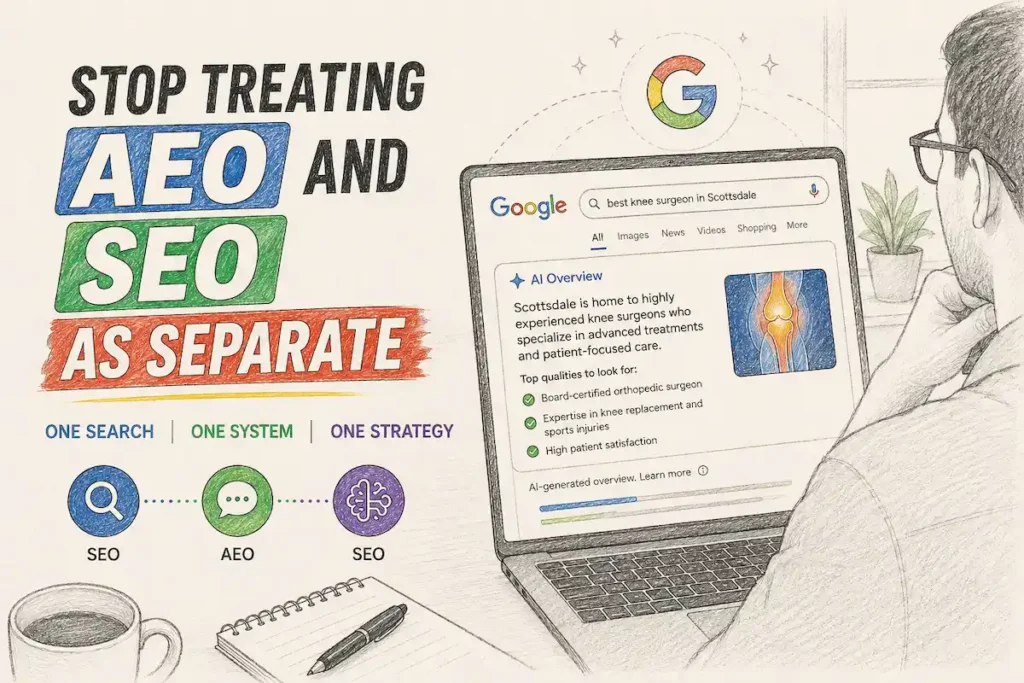
For the last couple of years, agencies have been selling AEO (Answer Engine Optimization) and GEO (Generative Engine Optimization) like they’re brand new fields. New skill sets, new retainers, new dashboards, new invoices.
Google Just Ended the AEO Debate
If you run a clinic or manage marketing for a hospital group, you’ve probably heard some version of this pitch already: “Your regular SEO won’t get you cited by ChatGPT, you need a whole new strategy for that.”
Google Just Ended the AEO Debate.
In May 2026, Google put that idea to rest, in writing. Google quietly updated its official documentation with a guide called “Optimizing your website for generative AI features on Google Search,” and it says something pretty direct:
“Optimizing for generative AI search is optimizing for the search experience, and thus still SEO.”
That’s not a throwaway line buried in a footnote. As Search Engine Journal reported, this is now Google’s official, formal position. It echoes what Google’s own Search Relations team, people like Gary Illyes and Cherry Prommawin, had already been saying out loud at Search Central Live events for months. Google is now telling marketers, in a published guide, that AEO and GEO are not new categories of work. They’re SEO wearing a new name and a bigger price tag.
If your clinic is currently splitting its marketing budget between “regular SEO” and some separate “AI visibility package,” this one sentence from Google should change how you plan the next twelve months.
Why This Hits Healthcare Harder Than Almost Any Other Industry
Patients have already made the shift that Google is now describing on paper. This isn’t theoretical for a dental practice or an orthopedic clinic. It’s already happening in exam rooms and waiting rooms right now.
According to the 2026 Patient Choice Report from rater8, AI-assisted healthcare search isn’t a niche behavior anymore. It’s mainstream, and it happened fast.
- Patient reliance on AI to choose a healthcare provider more than doubled in nine months, jumping from 17% to 36%.
- 47% of patients say they’ve used an AI tool like ChatGPT, Claude, Perplexity, or Google AI Overviews to research a provider, up from 31% earlier in the same year.
- Among patients aged 45 to 60, 64% used AI to research a doctor, compared with only 28% of patients aged 18 to 29. So this isn’t just a “younger generation” habit. It’s actually stronger among older, higher-value patients.
- When people searched for a new doctor over the past year, AI tools were cited as an influence by 36% of them, edging out Google search itself (34%) and even beating doctor referrals (32%).
- Inside Google’s own results, 37% of patients say they trust the AI Overview the most, compared to just 20% who trust a regular organic listing and 13% who trust the local map pack.
Sit with those numbers for a second. AI-assisted discovery has already pulled ahead of word-of-mouth referrals, and it’s running neck and neck with plain old Google search for how patients pick who treats them. If your clinic’s marketing plan still treats “get found on Google” and “get recommended by AI” as two separate projects with two separate budgets, you’re not being thorough. You’re duplicating work and paying twice for the same outcome.
What Google’s Guide Actually Tells You to Do
Google’s updated documentation gets into the mechanics of AI Overviews and AI Mode more than most agency blog posts bother to. And once you understand the mechanics, the strategy becomes obvious. Two systems really matter here.
1. Retrieval Augmented Generation (RAG)
AI Overviews don’t just make things up out of a general language model floating in the cloud. They pull answers from pages that are already indexed in Google’s core Search system. In plain terms, if your clinic’s website isn’t indexed and isn’t already ranking reasonably well through normal SEO, it can’t be pulled into an AI answer. It doesn’t matter how good your content is if Google never crawled it or trusts it enough to rank it in the first place.
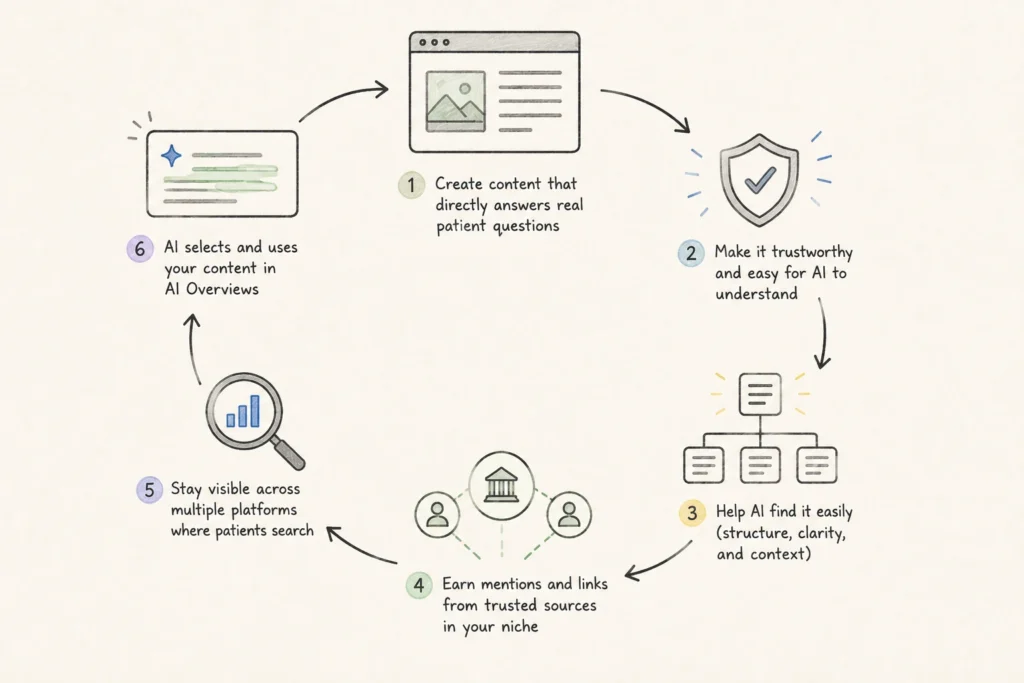
2. Query Fan-Out
Google’s AI systems take a person’s question and quietly generate a cluster of related sub-questions around it, then pull supporting content from several ranking pages to build one complete answer. That’s why a single thin page titled “Best Cardiologist in Chicago” almost never gets cited on its own. Google is usually assembling that AI answer from several sources that each cover one facet of the topic really well. One shallow page competing against five deep, well-organized pages doesn’t stand much of a chance.
Because both of these systems sit directly on top of classic Search ranking, Google’s practical advice for AI visibility ends up sounding almost identical to its advice for ranking well in regular organic search. Let’s break that down.
Building Content Google’s AI Actually Wants to Cite
A. Create Genuinely Non-Commodity Content
- Write from a first-hand clinical or operational perspective, not a summary of what five other sites already say.
- Aim for content that’s “helpful, reliable, and people-first,” and that goes beyond the kind of common knowledge any generic AI could already generate on its own.
- Structure your writing with clear, logical headings so both human readers and retrieval systems can scan it fast.
- Use real images, diagrams, or video where they add genuine clinical or procedural clarity, not stock photos for the sake of having images.
B. Get the Technical Foundation Right
- Meet Google’s basic indexing and crawlability requirements. An unindexed page has zero chance of ever being pulled by RAG, no matter how well written it is.
- Follow JavaScript SEO best practices so your content actually renders properly for Googlebot instead of showing up as a blank shell.
- Keep page experience strong (fast load times, solid mobile usability, good Core Web Vitals) across every device patients use.
- Cut down duplicate content across your location pages and service pages, which is a very common failure point for multi-location clinics and hospital systems that reuse the same template over and over.
C. Handle Local and Service Visibility on Purpose
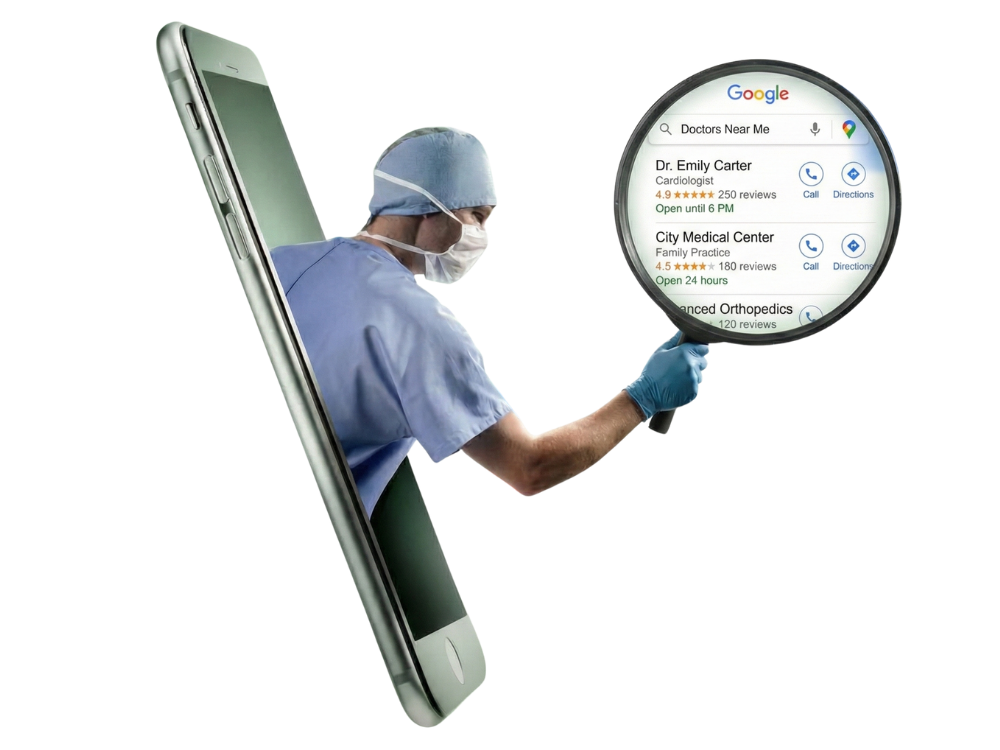
- Keep your Google Business Profile complete, accurate, and actively managed for every single location, not just your flagship clinic.
- Structure your service listings clearly, so Google can match comparison-style AI queries, like “physiotherapist near me who treats sports injuries,” to the correct, specific page instead of a generic homepage.
What Google Says You Can Stop Paying For
This is probably the part healthcare marketers most need to hear, because it’s exactly where a lot of “AEO agencies” have been overselling their packages. Google’s guide directly debunks several tactics that get pitched as essential for AI visibility.
- llms.txt files. Google Search doesn’t use them. If a vendor is charging your clinic to build one specifically for Google visibility, that line item on your invoice isn’t doing what they’re claiming it does.
- Artificial content “chunking.” Google’s systems already understand multi-topic pages just fine. Breaking a comprehensive service page into a bunch of tiny, disconnected micro-pages doesn’t help retrieval, and it can actually hurt your topical authority.
- AI-specific rewrites. You don’t need one version of your content “written for ChatGPT” and a separate version “written for Google.” Google’s systems already understand synonyms and semantic variation without any special treatment.
- Chasing inauthentic brand mentions. Paying to seed fake reviews or manufactured “mentions” of your practice around the web isn’t an effective strategy, and it can backfire badly under Google’s spam policies.
- Special AI-only schema markup. Structured data is genuinely useful for rich results, but Google’s guide is clear that it’s not a requirement for showing up in AI Overviews, despite what a lot of “schema for AI” sales pitches imply.
One more thing worth flagging. Google’s guide never actually uses the term E-E-A-T (Experience, Expertise, Authoritativeness, Trustworthiness). But the underlying expectation, real expertise, first-hand experience, genuine authority, is baked directly into what Google calls “non-commodity content.” For a medical practice, that translates into author bios with real, verifiable credentials, physician-reviewed articles, and pages that clearly reflect actual clinical experience. That kind of content consistently beats generic, templated health content, whether an AI is involved or not.
How This Plays Out for Doctors and Clinics, Specifically
Let’s take Google’s guidance out of the abstract and apply it to a few real healthcare scenarios, because that’s where this stuff actually gets useful.
1. Why Most Clinic Websites Will Never Get Cited in an AI Overview
Most clinic websites are built around templated service pages. A short paragraph describing the condition, a bulleted list of “why choose us,” and a contact form at the bottom. By Google’s own definition, that’s commodity content, which is basically the exact opposite of what RAG systems are designed to surface. Since Google’s AI answer gets assembled from multiple pages through query fan-out, a template page rarely earns a citation slot when it’s up against practices publishing detailed, physician-authored explanations of the same condition.
2. Why a Small Physiotherapy Clinic Might Outrank a Big Hospital System
Authority in AI search isn’t the same thing as brand size, and this surprises a lot of hospital marketing teams. A single-location physiotherapy clinic that publishes a detailed, first-hand explanation of a rehab protocol, complete with real patient outcomes, clear structure, and clean technical SEO, can genuinely out-cite a massive hospital system whose pages are thin, duplicated across dozens of locations, or buried behind a slow, clunky template. This is exactly the outcome Google’s guide predicts. Retrieval favors depth and clarity over domain size alone.
3. Where the Real Opportunity Sits for Healthcare Marketers
Since AEO and GEO tactics that skip over core SEO fundamentals simply don’t work, and since good SEO now doubles as AI visibility, the highest-leverage move for any healthcare marketing budget in 2026 is consolidation, not duplication. Here’s a practical framework to follow.
- Audit your existing service and condition pages for indexing issues and thin content before you buy any “AI optimization” add-on from a vendor.
- Rewrite your top-traffic condition and treatment pages with real clinical depth and named-physician authorship.
- Fix the technical SEO issues (site speed, duplicate location pages, crawlability gaps) that quietly block RAG retrieval without you even realizing it.
- Keep your Google Business Profile complete and current for every single location, since local visibility and AI Overview visibility are increasingly connected to each other.
- Track results through Search Console’s Generative AI Performance Report, rather than a third-party tool claiming it has special access to “internal” Google AI metrics. Google’s guide is explicit that no such privileged access actually exists.
Clinics that structure their content this way, deep, technically sound, physician-authored, and properly indexed, often become the exact sources AI systems pull from when a patient asks something like “who’s a good orthopedic surgeon near me” in ChatGPT, Gemini, or a Google AI Overview. That’s not luck. It’s the direct, predictable result of doing SEO well enough that AI systems actually have something worth retrieving from your site in the first place.
What’s Genuinely New: Agentic Search
There is one area where Google’s guide points to something that’s actually forward-looking, and it’s worth watching closely. Google calls it “agentic experiences,” which are AI systems that don’t just answer a question but go a step further and complete a task autonomously. Think booking an appointment or comparing providers on a patient’s behalf, without a human clicking through five different tabs.
Google’s guide references emerging standards like the Universal Commerce Protocol and points sites toward web.dev resources for making content “agent-friendly.” For healthcare specifically, this is a trend worth keeping an eye on. A scheduling system or provider-comparison tool that an AI agent can actually interact with directly may become the next real competitive advantage, long after this whole AEO-versus-SEO debate has quietly settled itself.
So Should Doctors Ignore AEO and GEO Entirely?
Not exactly, and it’s worth being precise here. The terms AEO and GEO aren’t meaningless. They’re useful shorthand for describing the goal of showing up in AI-generated answers. What Google is pushing back on isn’t the goal itself. It’s the idea that reaching that goal requires an entirely separate playbook, separate tools, and a separate invoice from an agency promising secret AI tricks.
A better way to think about it: AEO and GEO describe where you want to end up. SEO, done properly and applied to how modern retrieval systems actually work, is how you actually get there. Treat “AI visibility” as a lens you apply to your existing SEO work, not a brand new department you have to build from scratch.
The Strategic Takeaway for Healthcare Marketers
Google isn’t saying AI search doesn’t matter. It clearly does, and the data on patients choosing doctors through ChatGPT and Google AI Overviews makes that pretty undeniable at this point. What Google is saying is that you don’t need a separate strategy, a separate vendor, or a separate line item on your budget to win at it. You need SEO done properly, applied to the reality that generative retrieval systems now sit right on top of the same index, the same crawlability requirements, and the same content quality bar that’s defined good SEO for years.
For a deeper walkthrough of how to structure clinic content specifically for AI Overview inclusion, take a look at our guide on how to get your clinic into Google AI Overviews. And if you want a full technical and content audit measured against Google’s updated guidance, RankVed’s healthcare SEO services are built around exactly this framework, no separate “AI package” required.
Frequently Asked Questions
1. Is AEO different from SEO?
No, not according to Google. In its May 2026 documentation, Google states that Answer Engine Optimization isn’t a separate discipline. It’s SEO applied to generative AI search experiences, and it shares the same ranking systems, indexing requirements, and content quality signals as regular SEO.
2. What is GEO (Generative Engine Optimization), and do I need a separate strategy for it?
GEO refers to optimizing content so it gets cited by generative AI tools like ChatGPT, Gemini, and Perplexity. Google’s guide treats GEO the same way it treats AEO, as a rebranding of core SEO rather than a standalone strategy that requires its own separate tactics.
3. Do I need an llms.txt file for my clinic website?
No. Google’s guide is explicit that Google Search doesn’t use llms.txt files or similar special markup for its AI features. Skip it unless you have a different reason to add one.
4. How do Google AI Overviews decide which healthcare websites to cite?
AI Overviews use retrieval-augmented generation (RAG) to pull from pages that are already indexed and ranking well in core Search, plus query fan-out to assemble answers from several authoritative sources at once. A page has to meet standard SEO and indexing requirements before it’s even eligible to be retrieved.
5. Does structured data (schema markup) help my clinic show up in AI search results?
It can help with rich results and general visibility, but Google’s guide states plainly that it isn’t required for a page to be included in AI-generated answers.
6. Why do patients trust AI Overviews more than regular Google results?
According to the 2026 Patient Choice Report, 37% of patients trust the AI Overview the most when using Google, compared to 20% who trust standard organic results. That’s likely because an AI Overview synthesizes one clear answer instead of asking the patient to compare a list of listings themselves.
7. Should my clinic rewrite its content specifically for ChatGPT versus Google?
Google advises against this directly. Its systems already understand semantic variation and synonyms just fine, so one well-structured, genuinely high-quality version of your content is enough for both.
8. How many patients are actually using AI to find a doctor right now?
47% of patients have used an AI tool to research healthcare providers, and AI tools were cited as an influence in provider choice by 36% of patients who searched for a new doctor in the past year, both according to rater8’s 2026 Patient Choice Report.
9. Is E-E-A-T still relevant for AI search optimization in healthcare?
Yes, even though Google’s guide never uses that exact term. Its emphasis on “non-commodity,” first-hand, expert content maps directly onto E-E-A-T principles, which matter even more for medical content given Google’s health-content quality standards.
10. What’s the single biggest mistake healthcare marketers make with AI search visibility?
Treating AI visibility as a separate budget line from SEO. That usually means paying for “AEO packages” built around llms.txt files, AI-specific rewrites, or special schema, instead of just fixing the underlying content depth and technical SEO issues that actually determine whether a page can be retrieved at all.
11. Does JSON-LD help doctors appear in Google AI Overviews?
JSON-LD does not directly make a doctor’s website appear in AI Overviews. Google states there is no special schema or AI-specific markup required for AI features. However, accurate structured data can help Google better understand doctors, clinics, specialties, services and healthcare entities across a website.