

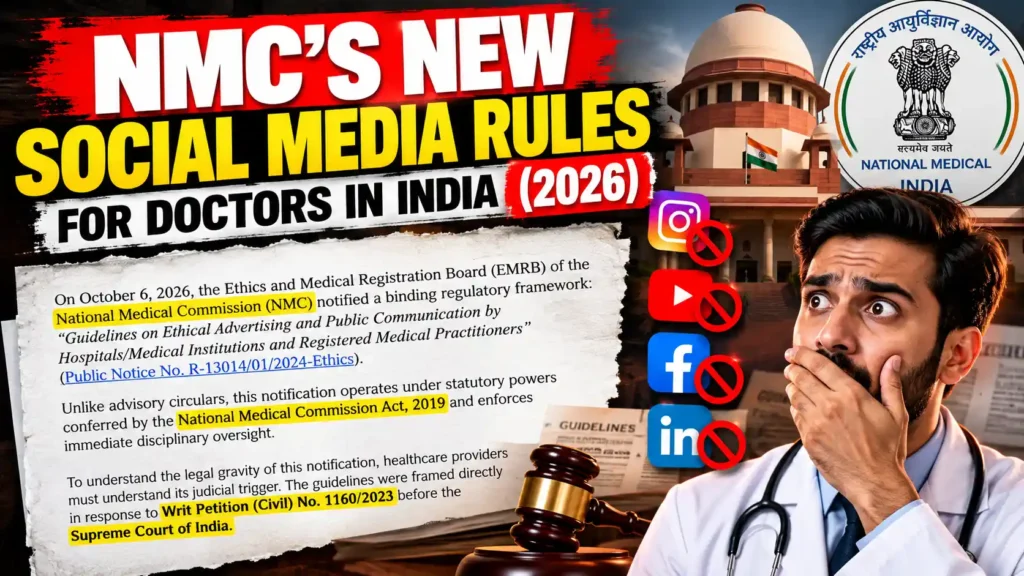
On October 6, 2026, the Ethics and Medical Registration Board (EMRB) of the National Medical Commission (NMC) notified a binding regulatory framework: the “Guidelines on Ethical Advertising and Public Communication by Hospitals/Medical Institutions and Registered Medical Practitioners” (Public Notice No. R-13014/01/2024-Ethics).
Unlike advisory circulars, this notification operates under statutory powers conferred by the National Medical Commission Act, 2019 and enforces immediate disciplinary oversight. If your hospital, clinic, or private practice maintains an active presence across Instagram, YouTube, Google Ads, or third-party discovery platforms, your marketing operations require an immediate compliance overhaul.
Editorial Note and Reading Guide: If you are looking for a quick introductory briefing on this notice, visit our executive summary of the NMC advertising notice. This document is an exhaustive legal compliance manual providing clause-by-clause statutory citations, clinical department operational analyses, comparative matrices, and a clinic sanitization protocol.
1. Statutory Origin: Why the Supreme Court and NMC Acted
To understand the legal gravity of this notification, healthcare providers must understand its judicial trigger. The guidelines were framed directly in response to Writ Petition (Civil) No. 1160/2023 before the Supreme Court of India, which scrutinized misleading healthcare claims, commercialized medical endorsements, and unregulated digital promotions across modern and traditional medicine.
The NMC integrated the core ethical mandates of the Indian Medical Council (Professional Conduct, Etiquette and Ethics) Regulations, 2002 directly into digital environments, closing regulatory gaps created by smartphones, social algorithms, and programmatic search advertising.
The Core Objectives Defined in Chapter 2 (Clause 2.1)
Under Clause 2.1, the framework establishes six non-negotiable regulatory goals:
- Ethical Framework: Provide a contemporary standard for truthful, non-commercial communication.
- Public Health Protection: Eradicate false, deceptive, exaggerated, or unsubstantiated medical claims.
- Ban on Solicitation: Prevent direct or indirect patient canvassing that induces unnecessary diagnostics or procedures.
- Regulate Digital Channels: Supervise promotional tactics across emerging digital tools, social networks, and artificial intelligence.
- Patient Privacy and Autonomy: Protect confidentiality in strict alignment with the Digital Personal Data Protection Act (DPDPA), 2023 and the IT Act, 2000.
- Statutory Alignment: Establish operational parity under the NMC Act, 2019 and the Clinical Establishments (Registration and Regulation) Act, 2010.
2. Clause-by-Clause Legal Analysis: Quoting the Exact Law
Below is the definitive examination of the operative clauses from the official NMC document, accompanied by statutory interpretation and real-world compliance benchmarks.
A. The Definition of Advertisement and Social Media (Chapter I, Clause 3.2 and 3.6)
“3.2 ‘Advertisement’ mean any form of communication, promotion, publicity, announcement, representation or dissemination of information in any medium, which directly or indirectly solicits, promotes or is intended to promote the professional services, reputation, skills, qualifications, achievements, facilities or commercial healthcare services of an RMP or hospital/medical institution.
For the purposes of these Guidelines, digital, social-media, sponsored, targeted, influencer-led, search-engine, platform-based, audio-visual, AI-generated or AI-assisted promotional communications shall be treated as advertising where their content or manner of dissemination has a promotional character.”
Statutory Interpretation:
The NMC removes any distinction between commercial media buying (such as newspaper ads) and organic digital content. An Instagram post published from a doctor’s personal profile that highlights surgical expertise, successful recoveries, or clinic facilities is legally categorized as an advertisement.
B. Mandatory Identity and Registration Disclosures (Chapter I, Explanations III and IV)
“Explanation III: RMP while publishing any Electronic media posts should transparently disclose their name, qualifications, registration status and SMR/NMR Registration number.
Explanation IV: Clinical Establishments while publishing any Electronic media posts should transparently disclose the names of the RMP with qualifications, registration status and SMR/NMR Registration number.”
Statutory Interpretation:
Every digital touchpoint must identify the treating practitioner using recognized qualifications. Brand pseudonyms, vanity clinic titles without doctor identification, or abbreviated degrees from unrecognized foreign courses violate Explanations III and IV.
Compliant Post Footer Example:
Published by Dr. Ananya Sen | MBBS, MD (Dermatology)
Registered Medical Practitioner | Delhi Medical Council (DMC/R/12345)
National Medical Register (NMR) Verified | Practice Address: Hauz Khas, New Delhi
C. Complete Ban on Patient Reviews and Testimonials (Chapter I, Expl. V and Chapter II, Clause 6.2)
“Explanation V: No RMP or hospital/medical institution shall solicit, purchase, procure, manipulate or cause to be published fake, paid or misleading patient reviews, ratings, testimonials, endorsements or recommendations for the promotion of medical services. An RMP shall not request or share patient testimonials, recommendations, endorsements or reviews for professional promotion on social media.
Clause 6.2: Patient consent shall not, by itself, make permissible any testimonial, endorsement, promotional patient story, before-and-after depiction, success claim or other advertising practice that is otherwise prohibited under these Guidelines or applicable law.”
Statutory Interpretation:
This is the most critical shift in Indian medical law. Historically, clinics operated under the assumption that a signed patient consent form granted immunity to share video testimonials or before-and-after transformations. Under Clause 6.2, patient consent cannot override a statutory prohibition. Publishing a promotional patient story on Instagram, YouTube, or your website is illegal, even with voluntary, written patient authorization.
D. Prohibited Claims, Superlatives, and Comparative Words (Chapter III, Clause 8.1.iii and ix)
“Clause 8.1.iii: Shall not advertise either personal achievements or professional success rates or number of patients treated with illustrative assertions such as ‘Guaranteed cures’, ‘Best doctors’, ‘No.1 Specialist’, ‘100% success’, ‘painless treatment’, ‘Miracle treatment’, ‘Exclusive cure’ or any other unverifiable or exaggerated claims by whatsoever name called.
Clause 8.1.ix: No RMP or hospital/medical institution shall make comparative claims such as ‘best’, ‘No.1’, ‘leading’, ‘most trusted’, ‘top’, ‘number one’, ‘unmatched’ or similar superiority claims unless the claim is objectively verifiable, based on a transparent and independently ascertainable methodology and is otherwise permissible under applicable law.”
Statutory Interpretation:
All subjective claims of excellence are prohibited. Touting awards purchased from commercial event agencies (such as “Best Cosmetic Surgeon of North India 2025”) is strictly banned. Any ranking cited must derive from a recognized, independent, public methodology with full disclosure of parameters and awarding bodies.
E. Third-Party Agency Liability and Banned Commercial Referral Fees (Clause 4.4, 8.1.vii, 8.1.viii)
“Clause 4.4: The fact that an advertisement or promotional communication is published through a digital platform, third party, advertising agency, influencer or other intermediary shall not, by itself, absolve an RMP or medical institution from responsibility for content which it has authorized, commissioned, sponsored, adopted or knowingly permitted.
Clause 8.1.vii: No RMP shall, directly or indirectly, offer, pay, solicit, receive or participate in any commission, rebate, bonus, gift, gratuity, referral fee, lead-generation fee or other consideration in relation to the promotion or advertisement of medical services.
Clause 8.1.viii: The engagement of advertising agencies, digital marketing agencies, influencers or online platforms shall not be structured in a manner that results in payment or consideration being linked to the procurement or referral of individual patients.”
Statutory Interpretation:
Doctors cannot shield themselves behind marketing agencies. If an agency creates a non-compliant Facebook ad promising guaranteed cure rates or offers free consultations, the registered doctor faces license suspension. Furthermore, performance marketing arrangements where an agency is paid per lead or per procedure booking are explicitly classified as unlawful referral fees.
3. Comprehensive Compliance Matrix: What You Did Before vs. What the Law Demands Now
The table below contrasts standard healthcare marketing practices in India with the revised mandates enforceable under the October 6, 2026 notification:
| Operational Area | Previous Practice (Now Prohibited) | Mandatory Standard Under 2026 Law |
|---|---|---|
| Patient Case Results | Publishing before-and-after photo collages of hair transplants, rhinoplasty, or bariatric results on Instagram and clinic websites. | Before-and-after imagery is completely banned for promotion. Permitted strictly in peer-reviewed scientific journals with documented, anonymized consent. |
| Patient Video Reviews | Recording patient recovery interviews in hospital corridors and publishing them as video testimonials with written consent forms. | Testimonials, endorsements, and promotional recovery stories are banned. Patient consent does not override this statutory ban (Clause 6.2). |
| Doctor and Hospital Branding | Using taglines like “Top 10 Cardiac Center,” “Premier Neurosurgeon in Delhi,” or “99.8% Surgical Success Record.” | Only factual descriptions of recognized specialties, active qualifications, equipment specifications, and verified accreditations (NABH/NABL) are allowed. |
| Pricing, Offers and Discounts | Promoting holiday health checkup packages, “20% off dental scaling this week,” or referral discounts for family members. | Discounts, limited-period offers, cashbacks, and inducements are banned. Hospitals and clinics must declare fixed, factual, non-misleading fee schedules. |
| Artificial Intelligence (AI) | Using generative AI avatars, synthetic patient voiceovers, and automated commercial ad copy across social media. | Commercial AI campaigns are prohibited. Permitted educational AI media must carry visible watermarks stating: “The origin of this content is AI.” Synthetic patient personas are strictly banned. |
| Signboards and Letterheads | Printing large photographs of the consulting doctor on outdoor clinic signboards, billboards, and prescription pads. | Displaying photos of RMPs on signboards, letterheads, and consulting room boards is deemed self-promotion and professional misconduct under Clause 9.2. |
| Online Aggregators (Practo, etc.) | Paying sponsorship fees to pin doctor profiles to the top of specialty searches or purchasing review boosts. | Platforms are prohibited from selling paid rankings. Listings must remain objective, transparent, and credential-based (Clause 9.4). |
4. Department-Specific Impact: How Key Specialties Must Pivot
While general hospitals must focus on directory compliance and facility claims, several specialized fields face significant operational changes:
1. Dermatology and Plastic Surgery
Aesthetic medicine relied heavily on side-by-side comparative imagery. That strategy is now prohibited.
- Mandatory Action: Archive all acne clearance timelines, rhinoplasty before-and-after galleries, liposuction comparisons, and anti-aging transformation reels.
- Compliant Pivot: Transition content to anatomical education, explaining the pathophysiology of conditions (such as how melasma develops), pre-procedure contraindications, and certified laser technology specifications.
2. Hair Restoration and Trichology
Claims such as “Guaranteed 10,000 Grafts,” “Permanent Hair Regrowth,” or displaying celebrity patient endorsements are banned under Clause 8.1.iii and 8.1.xi.
- Mandatory Action: Remove graft calculator promotions tied to fee discounts, delete celebrity endorsements, and strip claims of “unmatched density.”
- Compliant Pivot: Publish educational explanations of androgenetic alopecia patterns (Norwood scale), the procedural differences between FUE and FUT methods, and realistic clinical risk disclosures.
3. Orthopedics, Joint Replacement and Spine Surgery
Marketing claims promising “Painless Joint Replacement,” “Walk Within 2 Hours,” or advertising total numbers of implants completed violate Clause 8.1.iii.
- Mandatory Action: Remove claims guaranteeing painless recoveries, robotic superiority claims, and videos of postoperative patients walking in hospital corridors.
- Compliant Pivot: Focus on conservative arthritis management options, factual descriptions of robotic navigation infrastructure, physiotherapy protocols, and institutional rehabilitation capabilities.
4. IVF and Fertility Centers
Promoting “90% IVF Success Rates,” “Guaranteed Conception Packages,” or sharing emotional newborn delivery stories on social media is prohibited.
- Mandatory Action: Eliminate package discounts, success rate claims, and patient parent testimonials from all advertising campaigns and landing pages.
- Compliant Pivot: Provide objective educational guides on age-related fertility factors, ICSI process explanations, cryopreservation protocols, and transparent fee schedules.
5. Enforcement and Graded Penalties (Chapter V, Clause 10 and 11)
The NMC establishes an escalated disciplinary procedure executed through State Medical Councils (SMCs). Non-compliance carries serious professional consequences.
| Offense Hierarchy | Statutory Criteria | Prescribed Disciplinary Action |
|---|---|---|
| Level 1: First Violation | Initial non-compliance, such as omission of registration numbers or minor promotional wording. | Formal Warning + Compulsory Medical Ethics Training. |
| Level 2: Second Violation | Failure to correct identified infractions or repeating promotional campaigns. | Official Censure + Monetary Penalty. |
| Level 3: Third Violation | Continued defiance of ethical marketing standards and prior warnings. | License Suspension for 3 to 6 Months. |
| Serious Violation | Publishing misleading cure guarantees, patient financial inducements, or running digital mass solicitation campaigns. | Immediate Suspension for 6 to 12 Months. |
| Repeated Offender | Habitual disregard for ethical regulations across digital or physical media. | Removal from the Medical Register for 1 to 3 Years. |
Procedural Protections and Appeals (Clauses 10.2, 10.3, 11)
The framework guarantees natural justice. Disciplinary measures require a formal show-cause notice (Clause 10.2) and a reasoned speaking order (Clause 10.3). Doctors have a two-tier appellate mechanism:
- First Appeal: Filed before the EMRB, National Medical Commission within 60 days of the state council’s decision (Section 30(3) of the NMC Act, 2019).
- Second Appeal: If aggrieved by the EMRB’s order, a second appeal may be submitted directly to the National Medical Commission within 60 days (Section 30(4)).
6. Step-by-Step Clinic Digital Audit SOP
Follow this systematic Standard Operating Procedure (SOP) to audit your digital assets and align your marketing with the new standards:
- Website Content Sanitization: Audit your homepage, landing pages, and doctor bios. Remove all superlatives (“Best,” “No. 1,” “Top,” “Painless,” “Guaranteed”). Replace them with verified qualifications, training institutions, and clinical infrastructure details. For more structural guidelines, read our guide to compliant medical website design.
7. Frequently Asked Legal and Technical Questions
Can a clinic post educational videos about surgical procedures on YouTube?
Yes, provided the content is purely educational. Doctors may publish disease awareness and surgical education videos under Clause 5.1 and 8.2.iii. However, the video must not contain promotional solicitations (such as “Contact us for the lowest surgical package”), patient testimonials, or claims of superiority. The publishing doctor’s name, qualifications, and registration number must be prominently displayed.
Are unsolicited, organic Google Maps reviews considered a violation?
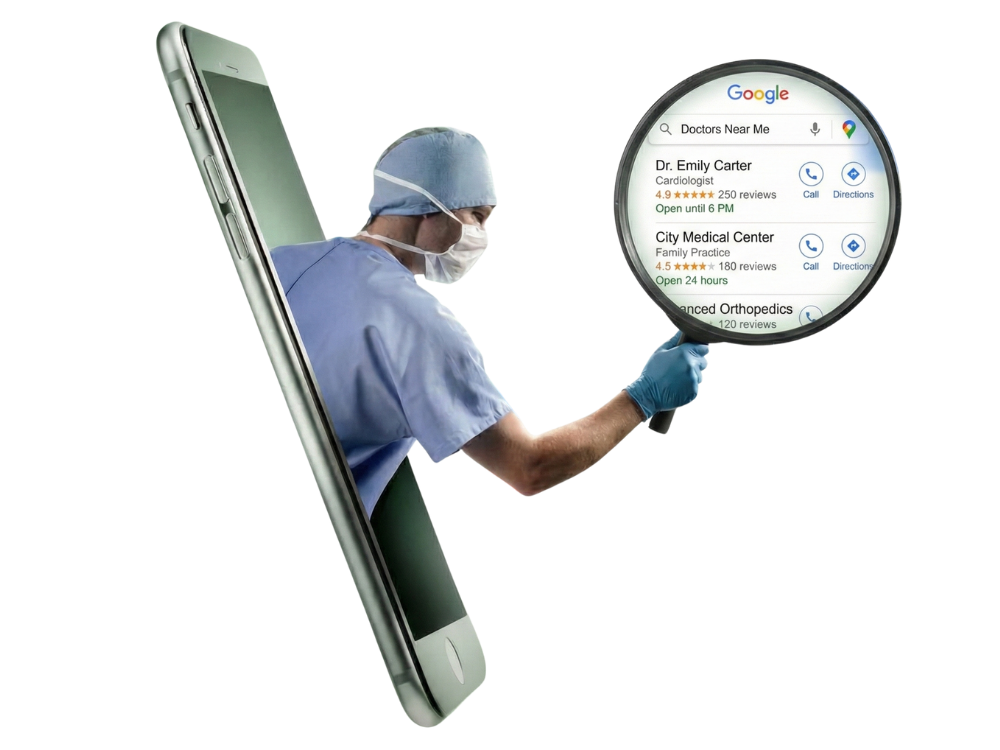
No, organic patient reviews on third-party platforms are not advertisements. Patients have a right to leave unsolicited feedback on public directories. However, clinics and doctors are strictly prohibited from soliciting, incentivizing, purchasing, or manipulating those reviews, and cannot re-post them as promotional graphics on their website or social media channels (Clause 3.2, Explanation V).
Can a hospital advertise its new MRI or Robotic Surgical Suite?
Yes. Under Chapter I, Explanation II and Clause 8.3.i, hospitals may share factual information regarding the installation of new equipment, technology, or diagnostic capabilities, provided the announcement does not claim superiority, guaranteed precision, or guaranteed clinical outcomes.
What should a doctor do if their marketing agency ran non-compliant ads without approval?
Under Clause 4.4, using an agency does not absolve the doctor of responsibility. If non-compliant ads were run, immediately issue a written directive to pause all active campaigns, request a formal audit report, archive all non-compliant creative assets, and document your corrective measures.
Statutory Documentation and Reference: This regulatory analysis is grounded in Public Notice No. R-13014/01/2024-Ethics, signed by Dr. Raghav Langer, Secretary, National Medical Commission, on October 6, 2026. For official verification and text reference, download the gazetted document via the official NMC document download portal or visit the primary National Medical Commission official portal.