

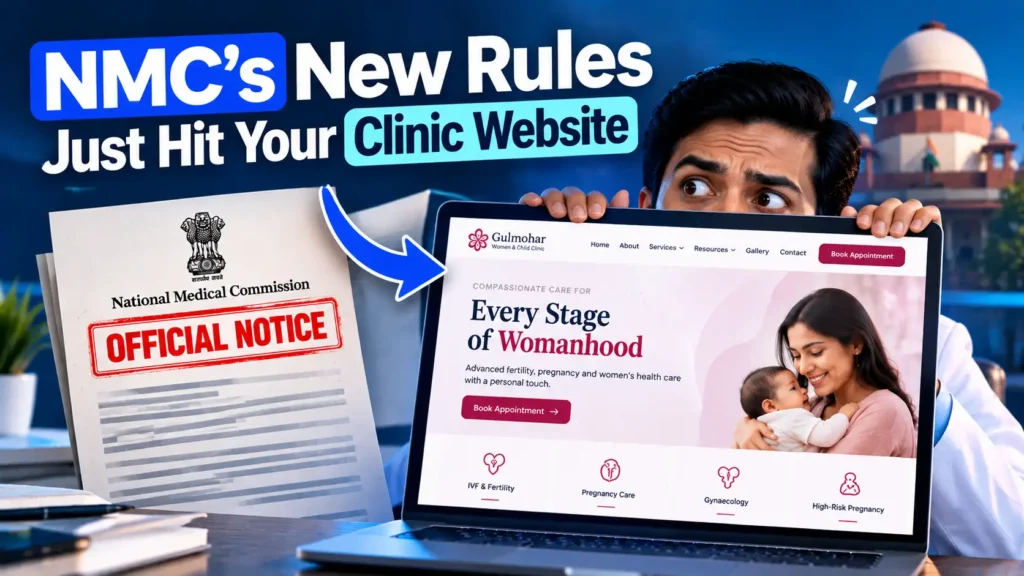
Your website is the single biggest compliance risk right now. It’s permanent, it’s public, and it’s the easiest thing for a patient, a competitor, or a State Medical Council to screenshot. This article walks through your website section by section, what NMC’s new guidelines mean for each one, real before-and-after examples, and exactly what happens if you ignore it.
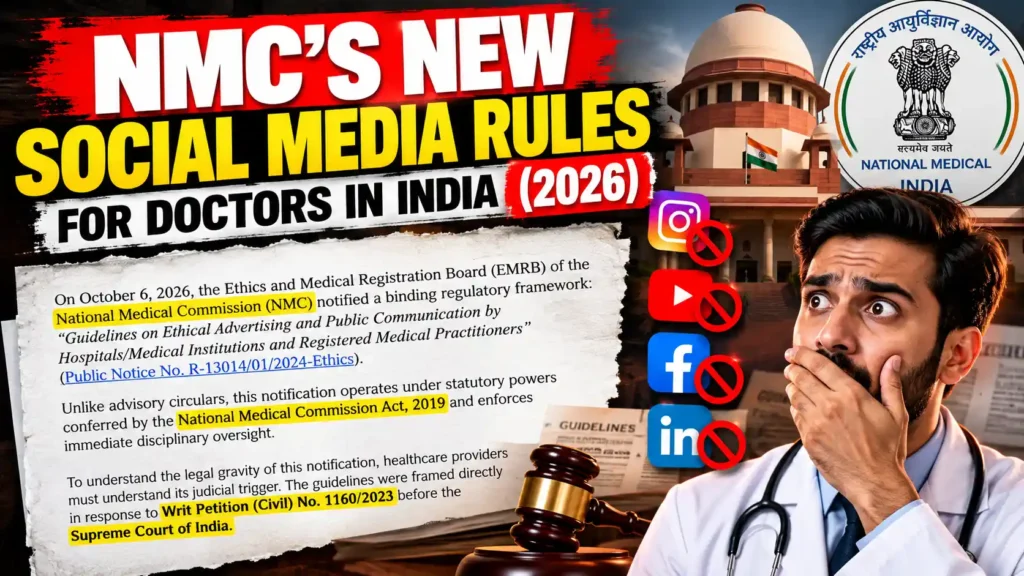
Source: National Medical Commission, Ethics & Medical Registration Board, Public Notice No. R-13014/01/2024-Ethics, dated October 6, 2026, in force with immediate effect. Official site: nmc.org.in
1. Why Your Website Is the First Thing to Fix
Social media posts scroll away. A website page sits there, indexed by Google, cached, and linked from your ads, your Google Business Profile, and your prescription pad. If an SMC or a patient wants to file a complaint, your website is Exhibit A. The guidelines apply directly to advertisement and public communication, and a website is specifically covered under both the RMP rules and the Hospital/Medical Institution Advertising rules.
2. Section-by-Section: What Changes on a Medical Website
Here’s a walkthrough of every section a typical clinic or hospital website has, with what the guideline allows, what it bans, and a real before/after rewrite.
2.1 Homepage Hero / Headline
This is where most clinic sites fail first. Superiority and guarantee language is explicitly banned, by whatsoever name called.
| Before (Non-Compliant) | After (Compliant) |
|---|---|
| “Best Orthopedic Hospital in Pune, No.1 in Patient Care” | “Orthopedic Care in Pune, 12 Specialists, NABH-Accredited” |
| “100% Painless Root Canal, Guaranteed” | “Root Canal Treatment with Modern Pain Management Techniques” |
| “India’s Most Trusted Fertility Centre” | “Fertility Centre, Serving Patients Since 2012” |
Rule applied: “Best,” “No.1,” “Guaranteed,” “Most trusted” are banned unless backed by an independently verifiable, disclosed methodology, which almost no clinic has.
2.2 “Why Choose Us” / Achievements Section
| Before | After |
|---|---|
| “50,000+ Successful Surgeries, Zero Complications” | “Performing joint replacement surgeries since 2008” |
| “Award-Winning Best Skin Clinic 2025” | Only keep if the award is real and independently verifiable, then disclose who gave it, when, and the criteria |
Rule applied: Advertising personal achievements or success rates with illustrative claims like “100% success” or unverifiable superiority is explicitly prohibited. Any ranking or award used in advertising must be independently verifiable, with methodology and date disclosed.
2.3 Patient Testimonials Section
This is the highest-risk section on most healthcare websites, and the simplest to understand: it has to go.
- Before: A carousel of patient photos with quotes like “Dr. Mehta saved my life, best doctor ever!”
- After: Remove the section entirely. Replace with factual content: your approach to care, your team’s qualifications, or a patient-education FAQ.
Rule applied: Patient consent does not by itself make a testimonial, endorsement, or promotional patient story permissible. An RMP shall not request or share patient testimonials, recommendations, endorsements, or reviews for professional promotion on social media or elsewhere.
2.4 “Before and After” Photo Galleries
- Before: A gallery of cosmetic/dental/dermatology transformation photos on the services page.
- After: Remove from the public website. If genuinely needed for scientific/educational purposes, it must be anonymized, consented, and published in that limited context only, not as marketing.
2.5 Doctor Bio Pages
Good news here, this one mostly survives as-is.
| Keep (Compliant) | Remove |
|---|---|
| Name, qualifications, registration number, specialty, years of experience, hospital affiliation | “Best [specialty] doctor in [city]”, unverifiable success-rate numbers, celebrity patient name-drops |
Rule applied: A directory or bio page with names, recognised qualifications, specialties, registration details, and availability serves a patient-information function, and is treated as materially distinct from a promotional advertisement.
2.6 Pricing / Packages Page
| Before | After |
|---|---|
| “Flat 30% Off on IVF Package, Book Today Only” | “IVF Package: ₹X, inclusive of consultation and monitoring (valid till [date])” |
| “Free Health Checkup Worth ₹2000 on Every Surgery Booking” | Remove, this is an inducement tied to procurement of treatment |
Rule applied: Lawful disclosure of charges, packages, or fees must be factual, transparent, and not misleading. But discounts, limited-period offers, and free procedures used in a way that encourages unnecessary consultation or treatment are prohibited.
2.7 Blog / Service Pages
- Before: “7 Reasons We’re the Best Dermatology Clinic in Mumbai”
- After: “What to Expect During Your First Dermatology Consultation”
Educational, factual blog content remains fully allowed, and is actually your safest and most effective tool going forward (more on this below).
2.8 FAQ Schema and Meta Titles/Descriptions
Don’t forget what’s invisible to patients but visible to Google: your meta title, meta description, and FAQ structured data. “Best IVF Centre in Delhi | 95% Success Rate” in your <title> tag is just as much a violation as it would be on the page itself, it’s still advertisement under the guideline’s definition, which covers any medium.
2.9 Chatbots and AI-Written Content
If your website chatbot or AI-written blog content makes promotional claims on your behalf, or uses AI to generate a “patient success story,” that falls under the explicit ban on AI-generated promotional content for commercial interest. Where AI-assisted content is used at all, it must carry a visible disclosure that it is AI-generated.
3. Quick Self-Audit: Does Your Website Violate the Guidelines?
Go through your website right now and check for these 10 things.
- Does your homepage use “best,” “No.1,” “top,” “leading,” or “most trusted” without independently verifiable proof?
- Do you have a patient testimonial section, carousel, or video?
- Do you display “before and after” photos anywhere public-facing?
- Do you claim a specific success rate or “100%” anything?
- Do you name-drop celebrity or high-profile patients?
- Do you use words like “guaranteed,” “miracle,” “painless,” or “exclusive cure”?
- Do you run limited-time discount banners tied to specific procedures?
- Does your doctor’s photo appear on signage or letterhead with self-promotional framing?
- Do your meta titles/descriptions contain unverifiable claims?
- Is any AI-generated content on your site undisclosed?
If you answered yes to 3 or more, your website needs an urgent compliance rewrite.
4. What It Actually Costs You If You Don’t Fix It (Penalty Structure)
This isn’t a soft advisory. The guidelines carry a formal, graded penalty mechanism enforced by the concerned State Medical Council (SMC), with appeal rights to the NMC’s Ethics and Medical Registration Board (EMRB).
| Violation Level | What It Means for a Website | Consequence |
|---|---|---|
| First Violation | e.g., an outdated “best clinic” banner still live | Warning + mandatory ethics training |
| Second Violation | Same claim still up after warning, or a new claim found | Censure + monetary penalty |
| Third Violation | Repeated non-compliance | Suspension of registration, 3–6 months |
| Serious Violation | Misleading cure claims, inducement offers, mass digital solicitation | Suspension, 6–12 months |
| Repeated Violations | Pattern of non-compliance despite prior action | Removal from medical register, 1–3 years |
4.1 Important Detail Most People Miss
Publishing through a web developer, agency, or freelancer does not shift the responsibility away from you. The guidelines are explicit: using a digital platform, agency, or intermediary does not, by itself, absolve the RMP or institution of responsibility for content it authorized, commissioned, or knowingly permitted.
4.2 The Process Before a Penalty Lands
You do get due process. A penalty is only imposed after a show-cause notice and a chance to explain or clarify, and the SMC must issue a reasoned, speaking order naming the specific violation. You can appeal to the EMRB within 60 days, and a second appeal is available after that.
That said, “we’ll fix it if someone complains” is a bad strategy, a show-cause notice and mandatory ethics training is still a disruption, a paper trail, and a reputational risk you don’t need.
5. Your Website Compliance Action Plan (Step-by-Step)
- Run the 10-point self-audit above across every page, not just the homepage, check service pages, landing pages, and blog posts too.
- Remove or rewrite superiority claims site-wide: “best,” “No.1,” “top,” “leading,” “100%,” “guaranteed.”
- Take down the testimonials section and any patient video content used for promotion.
- Remove before-after galleries from public pages.
- Rewrite your pricing page to be factual and transparent, remove inducement-style discount banners.
- Audit your meta titles and descriptions, these count too, don’t just clean the visible page.
- Check your FAQ schema and structured data for the same banned language.
- Disclose any AI-generated content clearly, or remove it if it’s promotional.
- Keep and expand factual, educational content, doctor bios, accreditation info, service explanations, and patient-education blogs. This is your safest, most effective content strategy now.
- Document the changes with dates, so you have a compliance record if ever questioned.
Here’s the upside nobody’s talking about: factual, well-structured, educational website content isn’t just the compliant option, it’s also what Google AI Overviews and tools like ChatGPT prefer to cite when recommending a doctor. Clinics that make this switch early often end up more visible in AI search, not less.
6. Frequently Asked Questions
6.1 Do I need to take my whole website down while I fix it?
No. Fix section by section, starting with the homepage and testimonials, since those carry the highest risk.
6.2 Can I keep “Best Doctor Award 2024” if I actually won it?
Only if you disclose the awarding organization, the criteria, and the date, and the award is independently verifiable. An unverified or vague award claim is treated the same as a fabricated one.
6.3 Is a doctor directory page on a hospital website considered advertising?
No. A directory listing names, qualifications, specialties, and availability is treated as a patient-information function, materially distinct from a paid or promotional advertisement.
6.4 What if my web developer uploaded the content, not me?
You’re still responsible if you authorized, commissioned, or knowingly permitted it. Review and sign off on every piece of content your agency publishes going forward.
6.5 Can I still mention my number of years in practice?
Yes, factual, verifiable information like years in practice, qualifications, and affiliations is allowed. It’s the superiority and success-rate claims layered on top that create the violation.
6.6 What counts as a “serious violation” that jumps straight to 6-12 month suspension?
Misleading cure claims, patient inducement, and mass digital solicitation are specifically called out as serious violations, these can attract heavier action even on a first instance.
6.7 Does this apply to hospital websites or only individual doctor websites?
Both. The guidelines separately cover RMP advertising and Hospital/Medical Institution advertising, hospitals can disseminate factual information but face the same ban on solicitation, inducement, and superiority claims.
Get Your Website Audited for NMC Compliance
We run full website compliance audits for clinics and hospitals, flagging every banned claim, testimonial, and gallery, and rewriting it into content that’s both compliant and built to rank. Check our healthcare SEO and website compliance services to get started.