

If you’re a doctor, clinic owner, or hospital admin in India, there’s a new rulebook for how you’re allowed to show up on social media, your website, and in advertising, and it came into force immediately. This article breaks down exactly what changed, in plain language, with the original wording quoted so you know it’s accurate, and a clear action plan at the end.
Source: National Medical Commission, Ethics & Medical Registration Board, Public Notice No. R-13014/01/2024-Ethics, dated October 6, 2026. Official site: nmc.org.in
1. What Exactly Did NMC Announce?
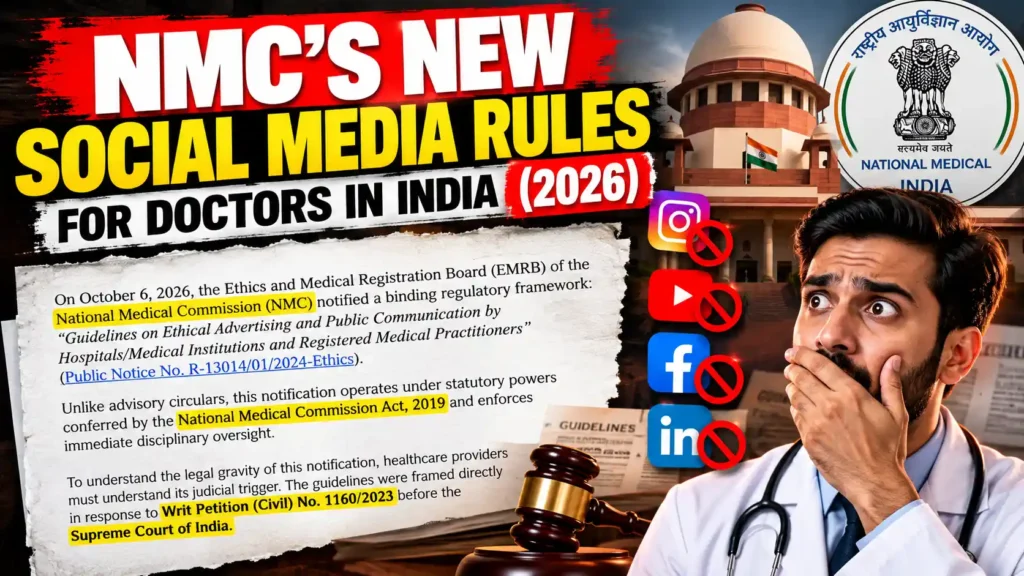
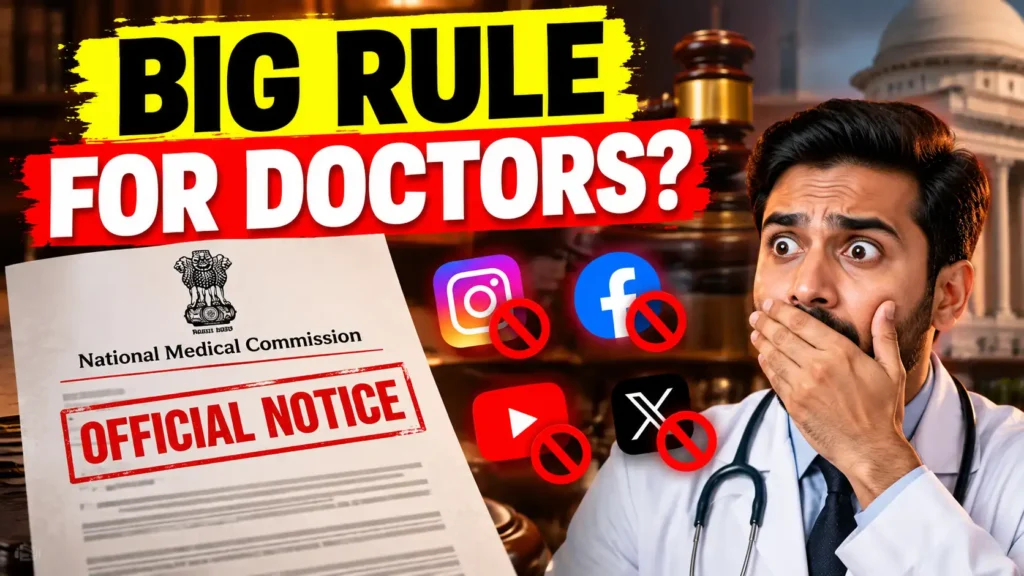
On October 6, 2026, the National Medical Commission’s Ethics & Medical Registration Board issued a public notice titled “Guidelines on Ethical Advertising and Public Communication by hospitals/medical institutions and Registered Medical Practitioners.” It applies to every Registered Medical Practitioner (RMP) and every hospital/medical institution in India, and it came into force with immediate effect.
“The Guidelines shall come into force with immediate effect.”
1.1 Why Did This Come Now?
The notice states these guidelines were framed in view of a Writ Petition (Civil) No.1160/2023 filed in the Supreme Court of India, read together with the Indian Medical Council (Professional Conduct, Etiquette and Ethics) Regulations, 2002.
1.2 The Four Goals Behind the Guidelines
“Preserve dignity of the medical profession. Prevent commercialization of health care. Protect patient interest and prevent misleading medical claims. Ensure healthcare communication remains informational, ethical and evidence-based.”
In plain English: NMC wants medical marketing to look and feel like patient information, not like a sale.
2. Who Has to Follow These Rules?
- Registered Medical Practitioners (RMPs) – any doctor registered under the National Register or a State Medical Register.
- Hospitals / Medical Institutions – any clinical establishment covered under the Clinical Establishments (Registration and Regulation) Act, 2010, or the applicable State Act.
- Anyone acting on their behalf – agencies, influencers, platforms, or third parties. Using a middleman does not remove responsibility; the guidelines say using a third party to do indirectly what you’re banned from doing directly is not allowed.
3. 12 Things You Can No Longer Do on Social Media, Website, or Ads
This is the part that affects your day-to-day digital presence the most. Here’s the full prohibited list, numbered for clarity.
3.1 No AI-Generated Promotional Content
AI-generated or AI-assisted promotional content/campaigns created for commercial gain are prohibited outright. Any permitted AI-generated content must carry a visible source mark stating it is AI-generated.
3.2 No AI-Manipulated Patient Images, Voices, or Testimonials
AI cannot be used to create or alter a patient’s image, voice, or clinical outcome, or to fabricate a synthetic endorsement pretending to be a real patient or doctor.
3.3 No “Before and After” Photos for Promotion
Surgical results, before-after photos, and celebrity-patient publicity are banned for promotional use. The only exception: strictly scientific or educational publication, with anonymized patient consent.
3.4 No Superiority or Guarantee Claims
Words and phrases like “Guaranteed cure,” “Best doctor,” “No.1 Specialist,” “100% success,” “Painless treatment,” “Miracle treatment,” or “Exclusive cure” cannot be used, by whatever name called.
Also banned: unverifiable comparison words
“Best,” “No.1,” “Leading,” “Most trusted,” “Top,” “Unmatched,” are all prohibited unless the claim is objectively verifiable through a transparent, independently checkable methodology, with full disclosure of the award/ranking source.
3.5 No Celebrity, Influencer, or Patient Endorsements
No doctor or hospital can use a celebrity, influencer, patient, or employee to promote services through testimonials, endorsements, or recommendations, paid or unpaid.
3.6 No Fake Followers, Reviews, Ratings, or SEO Manipulation
Procuring or manipulating fake followers, likes, reviews, ratings, comments, views, or manipulating search rankings/algorithms to look more credible than you are, is explicitly prohibited.
3.7 No Inducements, Discounts, or Fear-Based Marketing
Discounts, limited-period offers, contests, cashbacks, or free procedures cannot be used in a way that encourages unnecessary consultation or treatment. Fear-based marketing and creating unnecessary demand for procedures/diagnostics is also banned.
3.8 No Sharing of Identifiable Patient Data
Patient names, faces, photos, videos, medical records, or anomalies that can identify them publicly cannot be shared for advertising, even with consent, unless legally permitted safeguards are followed.
3.9 No Product, Drug, or Device Endorsements
RMPs cannot give any approval, endorsement, or statement about a drug, device, diagnostic product, or commercial product using their name, signature, photo, voice, or professional status, paid or unpaid.
3.10 No Commissions or Referral Fees Tied to Advertising
No commission, rebate, bonus, gift, or lead-generation fee connected to patient referral or procurement is allowed, including through marketing or digital agencies.
3.11 No Self-Photos on Letterheads or Signboards
Using your own photo on a clinic signboard, letterhead, or similar material counts as self-advertisement and is treated as unethical conduct.
3.12 No Live Surgery Broadcasts Outside NMC Framework
Live or commercial broadcast of surgical/clinical procedures must comply with the separate NMC framework on patient safety, consent, privacy, and non-commercialization.
4. What You’re Still Allowed to Post
The guidelines are restrictive, but they’re not a gag order. Here’s what stays legal.
4.1 Factual Information About Your Practice
- Clinic/hospital name, address, phone number
- Departments, facilities, and equipment (factual, no superiority claims)
- Operating hours and accepted insurance
- Accreditation status
- Consultation fees (factual, transparent, not misleading)
- A directory of doctors with names, qualifications, specialties, and availability (a hospital website listing this is treated as patient information, not as an ad)
4.2 Formal, Non-Promotional Announcements
An RMP may make a factual announcement about:
- Starting a practice
- Change of type of practice
- Change of address
- Temporary absence from duty
- Resumption of practice
- Succeeding to another practice
- Public declaration of consultation charges
4.3 Public Health Education
You can give lectures or talks on public health and diseases on TV, radio, or electronic media in your own name and designation, as long as you don’t promote your employer organization or monetize it through promotional marketing.
4.4 Educational Pamphlets and Research Publication
General health education pamphlets/brochures for patients are fine, as is publishing case studies in reputed medical journals, as long as there’s no guarantee of cure, no superiority claim, and nothing misleading.
5. Does This Actually Impact Your Website, Social Media, and Ads? (Yes, Here’s Exactly How)
Short answer: yes, directly. Here’s where it bites, channel by channel.
5.1 Your Website
- “Best clinic in [city],” “No.1 orthopedic surgeon,” “100% success rate” style copy on homepage/landing pages now needs to come down or be rewritten with factual, verifiable language.
- Patient testimonial sections and before-after galleries are high-risk and need a compliance review.
- A simple doctor directory with names, qualifications, and specialties is fine, that’s treated as patient information, not an ad.
5.2 Your Social Media (Instagram, Facebook, YouTube)
- Reels/posts with “before-after” transformations for promotion are no longer compliant, barring the strict scientific/educational exception.
- Patient testimonial reels, even with patient consent, fall foul of the guidelines, consent alone does not make a promotional testimonial permissible.
- Influencer or celebrity shoutouts for your clinic are banned, even if unpaid.
- AI-generated reels, AI voiceovers, or AI “patient” avatars used for promotion are explicitly banned.
5.3 Paid Advertising (Google Ads, Meta Ads)
- Offer-based ads (“20% off consultation this week”) that could be read as inducing unnecessary treatment are high risk.
- Comparison-based ad copy (“the best in town”) needs independently verifiable backing or it has to go.
- Lead-generation campaigns paying per lead/patient referral are now a direct violation if structured as pay-per-patient.
5.4 Google Business Profile and Listings
This guideline is specific to advertising and public communication by the RMP/institution, and doesn’t directly govern your Google Business Profile listing itself. But the content you post there (photos, posts, Q&A answers) still has to follow the same rules on claims and testimonials.
6. What Happens If You Don’t Comply? (Penalty Structure)
| Violation Level | Consequence |
|---|---|
| First Violation | Warning + mandatory ethics training |
| Second Violation | Censure + monetary penalty |
| Third Violation | Suspension of registration (3–6 months) |
| Serious Violation (misleading cure claims, inducement, mass digital solicitation) | Suspension (6–12 months) |
| Repeated Violations | Removal from medical register (1–3 years) |
Penalties are only imposed after a show-cause notice and a chance to explain. An aggrieved RMP can appeal to the Ethics and Medical Registration Board (EMRB) within 60 days, and a second appeal is also available.
7. What Should Doctors and Hospitals Do Right Now? (Action Plan)
Here’s a practical, do-it-this-week checklist.
- Audit your website copy. Search for words like “best,” “No.1,” “guaranteed,” “100%,” “miracle,” and rewrite them as factual statements.
- Pull down before-after content used for promotion, from your website, Instagram, and Facebook.
- Remove patient testimonial sections and testimonial reels, even old ones.
- Stop influencer/celebrity collaborations for clinic promotion, paid or organic.
- Review your ad campaigns for comparison claims and offer-based language that could read as inducement.
- Check any AI tools you or your agency use for reels, captions, or patient-facing content, disclose AI-generated content clearly, and never let AI touch patient images or voices.
- Brief your marketing agency or social media manager on this notice directly, since using a third party doesn’t remove your responsibility.
- Keep your factual information clean and ready: clinic name, address, services, accreditation, doctor directory, and transparent fees, this is still fully allowed and is what should carry your digital presence now.
Clinics that make this shift early, from promotional claims to clean, factual, patient-first communication, tend to come out ahead. It’s also exactly the kind of content structure that AI search tools like ChatGPT and Google AI Overviews trust and cite, so compliance and visibility end up pointing the same direction.
8. Frequently Asked Questions
8.1 Is this guideline a law, or just an advisory?
It’s a binding regulatory guideline issued by the NMC’s Ethics & Medical Registration Board, under the NMC Act, 2019. Violation can lead to disciplinary action, not just a warning.
8.2 Does this apply to my Instagram account if it’s personal, not clinic-branded?
If the account promotes your professional services, reputation, or skills in any way, direct or indirect, it falls under the definition of advertisement in these guidelines, regardless of whether it’s labeled “personal.”
8.3 Can I still post patient success stories with their permission?
No. Patient consent alone does not make a promotional testimonial or success story permissible under these guidelines.
8.4 Can hospitals still list their doctors on their website?
Yes. A directory with names, qualifications, specialties, registration details, and availability is treated as a patient-information function, materially different from a promotional ad.
8.5 Are discounts and festive offers completely banned?
Not entirely, but they can’t be structured in a way that encourages unnecessary consultation, diagnostics, or treatment. Factual, transparent fee disclosure is still allowed.
8.6 Can my marketing agency be held responsible instead of me?
Publishing through an agency, platform, or influencer does not by itself remove the RMP or institution’s responsibility for content they authorized, commissioned, or knowingly permitted.
8.7 What counts as “AI-generated content” under this guideline?
Any self-learning automated content, images, voice, video, or text, created or assisted by AI for a commercial/promotional purpose. If used at all (where permitted), it must be clearly disclosed as AI-generated.
8.8 Does this affect Google Business Profile reviews?
You cannot solicit, purchase, or manipulate fake or paid reviews/testimonials/ratings for promotion. Genuine, unsolicited patient reviews on third-party platforms aren’t the RMP’s own “advertisement,” but requesting or incentivizing them is prohibited.
8.9 What’s the first penalty for a first-time violation?
A warning plus mandatory ethics training, the penalties escalate from there with repeated or serious violations.
8.10 Where can I read the full guideline document?
It’s published by the NMC’s Ethics & Medical Registration Board. You can check the official NMC portal at nmc.org.in for the notice and annexed Guidelines, reference number R-13014/01/2024-Ethics.
Need Help Making Your Clinic NMC-Compliant Without Losing Visibility?
This is exactly the kind of transition we help healthcare brands navigate, rewriting claims-heavy content into factual, compliant, and still high-converting copy. Explore our healthcare SEO and compliance-safe digital marketing services to get your website and social presence audited against this guideline.