


YMYL stands for Your Money or Your Life. It describes content that can directly affect a person’s health, financial wellbeing, safety, or happiness. Healthcare websites sit at the top of that list. A patient who reads wrong information on your site and makes a harmful decision is not a hypothetical scenario. Google knows this, and it grades your pages accordingly.
This article gives you a 20-point YMYL compliance checklist for healthcare websites. Work through it section by section and you will know exactly where your site stands – and exactly what to fix.
By the end, you will understand what YMYL compliance actually means in 2026, why non-compliant health pages lose rankings and disappear from AI Overviews, and how to prioritise fixes based on effort and impact.
What Does YMYL Compliance Mean for Healthcare Websites?
YMYL is not an algorithm update. It is a classification Google applies to certain types of content before deciding how strictly to evaluate them. Once a page is classified as YMYL, Google’s quality signals – particularly E-E-A-T (Experience, Expertise, Authoritativeness, and Trustworthiness) – are applied at a much higher threshold than they would be for a recipe blog or a sports news article. If you want a full foundation on this topic before diving into the checklist, read our guide on YMYL in healthcare SEO first.
The Google Quality Rater Guidelines identify three healthcare categories that receive the highest scrutiny of all: pages containing medical advice or treatment information, pages about specific medications or supplements, and content covering mental health conditions or crisis situations. If your clinic website touches any of these – and almost every healthcare website does – you are operating under YMYL’s strictest rules.
What makes healthcare different from other YMYL categories is consequence. A finance website that gives bad advice might cost a reader money. A health page that gives wrong information could send a patient to the wrong treatment, delay a correct diagnosis, or in a serious case, cause real physical harm. Google understands this. Its quality raters are specifically trained to flag health content that lacks named authorship, lacks citations to credible sources, or contradicts current medical consensus.
This is not abstract. After the Helpful Content Update and its subsequent rollouts, websites with thin or unverified health content saw significant ranking drops. The mechanism is not a single penalty – it is a sustained reduction in trust signals that compounds over time. Pages that were once ranking in position three or four quietly fell to page two and then page three, without any manual action or visible warning.
YMYL compliance is the baseline your healthcare website must meet before technical SEO, backlinks, or content volume can do their work. Fix the foundation first.
The YMYL Healthcare Compliance Checklist
The following 20 checkpoints are grouped into four sections: authorship and credentials, content accuracy and sourcing, technical E-E-A-T signals, and off-page trust and reputation. Go through each one for your website and mark it as passing, needs work, or not started.
Authorship and Credentials
Authorship is the single most important compliance signal for health content. Google cannot verify what is written inside a page, but it can assess whether the person responsible for that information is qualified to write it. Anonymous health content is a YMYL red flag. Every health page on your site should have a named, credentialed author attached to it.
- Named medical author with credentials displayed on every health page. This means a byline at the top of each article or service page showing the author’s name, qualification (MBBS, MD, FRCS, or equivalent), and their specialisation. A generic “RankVed Editorial Team” or “Admin” author field will not pass YMYL scrutiny. Google’s quality raters look for a real person who can be held accountable for the information published.
- Author bio links to a professional registration profile. The author bio should not sit in isolation. It should link out to a verifiable external source – a General Medical Council (GMC) profile in the UK, a Medical Council of India (MCI) registration, a board certification page in the US, or an equivalent professional body. This one step transforms a name on a page into a verified medical professional in Google’s assessment.
- Last reviewed date visible near the top of every health article. Medical information changes. Treatment guidelines are updated. Drug interactions are reclassified. A health page with no reviewed date signals to Google that its currency cannot be confirmed. Place the “Last reviewed: [Month Year]” line directly below the title or H1, not buried in the footer. Google reads this as a freshness signal on YMYL content.
- Editorial policy page exists and is linked from health content. An editorial policy page documents how your website decides what to publish, how content is reviewed before publication, who reviews it, and what sources are considered acceptable. This page does not need to be long. It needs to exist and be linked from your health articles – either in the footer, the author bio, or a site-wide sticky element. Without it, your site has no documented quality process, which is a gap raters are trained to notice.
- No anonymous health content anywhere on the site. Review every page on your website that contains health information, treatment descriptions, symptom lists, medication explanations, or mental health guidance. Any page without a named author is a compliance gap. This includes old blog posts, FAQ pages, and service pages written by agencies years ago. Anonymous health content is one of the easiest issues to spot and one of the most damaging to leave unresolved.
Why this group matters: Authorship signals tell Google who is responsible for the information. Without them, even accurate content looks unreliable.
Content Accuracy and Sourcing
Google cannot read medical journals. But it can assess whether your content cites authoritative sources, avoids unsubstantiated absolute claims, and aligns with what reputable health bodies say. Content that does not meet these standards on a YMYL page will be rated as low quality, regardless of how well it is written.
- Medical claims cited with links to peer-reviewed sources or government health bodies. If your content states that a treatment has a certain success rate, or that a medication carries specific risks, that claim needs a source. Acceptable sources include PubMed-indexed studies, NHS guidelines, WHO recommendations, CDC advisories, and NICE guidelines. Citing a competitor’s blog or a wellness influencer does not count. The link should go to the specific study or guideline, not to a homepage.
- No absolute claims without evidence. Phrases like “cures diabetes,” “guaranteed to relieve pain,” or “100% safe for all patients” are absolute claims. They are almost never medically defensible, and Google’s quality raters are specifically trained to flag them. Replace these with evidence-based language: “studies suggest,” “may help reduce,” or “effective for many patients with early-stage.” This is not just a compliance issue – it is also a patient safety issue.
- Content aligns with current medical consensus. A page about vaccination that contradicts NHS or CDC guidance. A diabetes article recommending a diet approach that current endocrinology guidelines advise against. A mental health page offering advice that contradicts NICE recommendations. Any of these will fail YMYL scrutiny. Audit older content regularly. Medical consensus shifts. Your published content needs to shift with it.
- Medical disclaimer present on all health content pages. Every health page should carry a clear disclaimer stating that the content is for informational purposes only and does not constitute medical advice. Keep it plain English. Something like: “This content is intended for general information purposes only. It is not a substitute for professional medical advice, diagnosis, or treatment. Always consult your doctor or a qualified health provider with any questions about a medical condition.” Place it near the top of the article, not only in the footer.
- FAQs use FAQPage schema for structured data eligibility. If your health pages include a FAQ section – which they should, for both user experience and AI extraction – that FAQ section should be marked up with FAQPage schema. This tells Google the questions and answers are explicitly structured for that purpose. It improves eligibility for rich results and increases the likelihood of your content being extracted into Google AI Overviews. Google Search Central’s structured data documentation covers the exact implementation requirements.
Why this group matters: Accurate, sourced content is the foundation of medical trust. Compliance without accuracy helps no one.
Technical E-E-A-T Signals
E-E-A-T is assessed by Google’s quality raters using visible on-page signals. Many of these signals are technical – schema markup, HTTPS, page speed, and the presence of real contact information. A medically credentialed author on a slow, unsecured website still fails YMYL scrutiny.
- MedicalWebPage schema implemented correctly. MedicalWebPage is a schema type specifically designed for health content. It allows you to declare the medical audience, the health topic covered, and the last reviewed date – all as structured data that Google can read directly. Most healthcare websites, including many built by specialist agencies, do not implement this schema at all. This is a significant missed signal. Use JSON-LD format and validate your implementation using Google’s Rich Results Test.
- About page shows real team with real photos and qualifications. A healthcare About page that uses stock images of people in white coats is not just unhelpful – it actively damages E-E-A-T. Google’s quality raters are trained to distinguish generic stock imagery from real clinical teams. Your About page should show actual photos of your doctors, their individual qualifications, years of experience, and links to their professional profiles. This is one of the easiest wins for practices that already have a genuine clinical team.
- Contact information – address, phone number – is present and matches your Google Business Profile. NAP consistency (Name, Address, Phone) is a basic trust signal for any local business. For healthcare websites it carries additional weight because YMYL raters check whether the publisher of health content is a real, verifiable entity. If your website shows a different address than your GMB profile, or uses a contact form with no physical address, that is a trust gap.
- HTTPS sitewide with no mixed content warnings. An unencrypted healthcare website in 2026 is not just a technical failing – it signals to Google that patient data and user interactions are not being handled with care. Check for mixed content warnings (HTTP resources loading on HTTPS pages) using Chrome DevTools or a tool like Why No Padlock. Every page, not just the homepage, must be fully secure.
- Core Web Vitals pass, with LCP under 2.5 seconds. Page experience is a ranking factor on all websites. On YMYL pages, a slow, frustrating experience amplifies trust concerns. Largest Contentful Paint (LCP) – the time it takes for the main content to load – should sit under 2.5 seconds. Cumulative Layout Shift (CLS) should be under 0.1. Interaction to Next Paint (INP) should be under 200 milliseconds. Run your key health pages through Google PageSpeed Insights and address any issues flagged as poor.
Why this group matters: Technical signals tell Google that the infrastructure behind the content is trustworthy – not just the words on the page.
Off-Page Trust and Reputation
YMYL compliance is not only about what is on your website. Google also evaluates what the rest of the web says about you. Off-page reputation signals are particularly important for local healthcare practices where patient reviews and directory listings form a significant part of a clinic’s public profile.
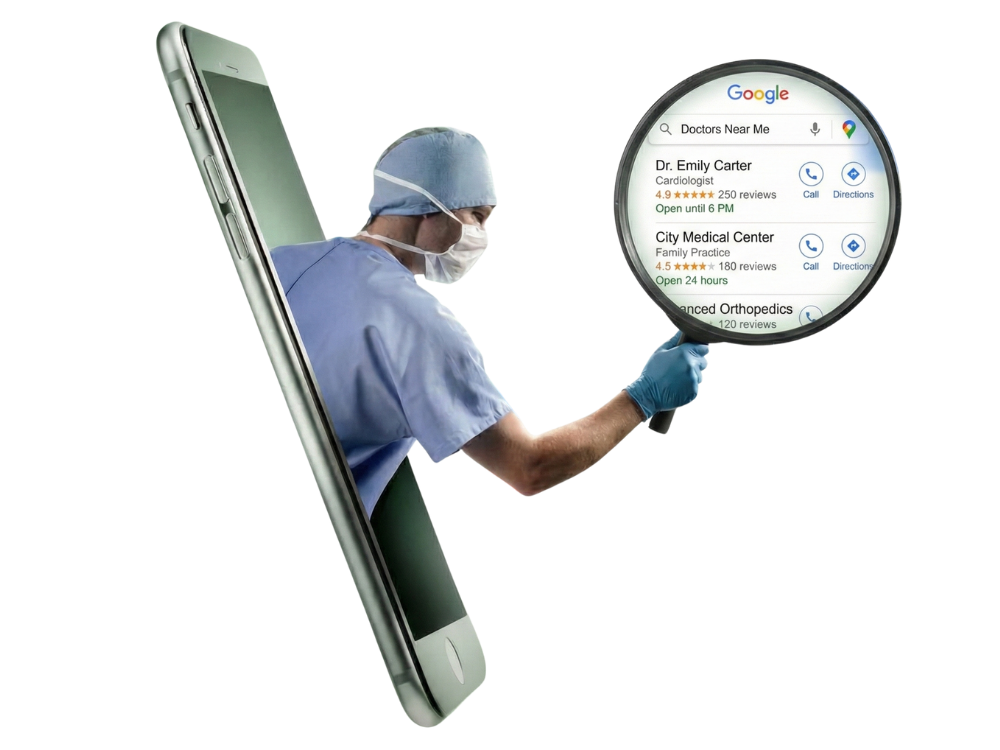
- Google Business Profile is verified and active with recent reviews. Your Google Business Profile is not just a local SEO asset. For healthcare practices, it is a YMYL reputation signal. Raters check whether the entity behind a health website is a legitimate, operating business with verifiable community trust. A verified GBP with active, recent patient reviews is evidence of that. Aim to maintain a response habit – answering reviews shows engagement and professionalism.
- Listed on authoritative medical directories relevant to your market. For practices in India, this means Practo, JustDial, and Healthgrades India. For US-based practices, Healthgrades, Zocdoc, and US News Health. For UK practices, NHS Choices and the Care Quality Commission directory. These listings function as third-party verification of your existence and specialisation. A healthcare website not listed on any recognised medical directory has a weaker off-page trust profile than one that is consistently present across several.
- No negative press or patient complaint threads ranking above the clinic website. If a patient searches your doctor’s name or clinic name and the third result is a complaint thread, a news article about a patient dispute, or a negative review aggregator page, that is a reputation risk. Google quality raters check this as part of their assessment. Set up Google Alerts for your clinic name and primary doctor names so you know what is ranking. If negative content is visible, a content and PR strategy is needed – not just an SEO strategy.
- Backlinks from medical institutions, hospitals, or healthcare publishers. Link quality matters more than link quantity on YMYL websites. A single backlink from an NHS page, a hospital network, a medical university, or a respected health journalism site carries more trust signal than fifty links from general directories or guest post farms. If your current backlink profile consists mostly of low-authority links, a medical PR and outreach strategy should be on your roadmap.
- No buying or exchanging links from irrelevant or low-authority websites. Paid link schemes are a ranking risk for any website. For healthcare websites under YMYL scrutiny, the risk is compounded. A clinic website with a backlink profile showing links from gambling sites, generic article directories, or unrelated niche blogs will fail the off-page trust assessment. Audit your existing backlink profile using Google Search Console and disavow any links you did not earn through legitimate means.
Why this group matters: Your reputation off-site reflects your credibility on-site. Google reads both.
What Happens If Your Healthcare Website Fails YMYL Scrutiny?
The consequences of YMYL non-compliance are not always immediate. That is what makes it dangerous. A healthcare website can fail multiple compliance checks and continue to rank reasonably well for a period – especially in low-competition local markets. But when an algorithm update arrives, non-compliant sites absorb the impact disproportionately.
Here is what YMYL failure looks like in practice.
Ranking drops for health-related queries. Google demotes pages that fail quality checks. This is not a manual action – it is an automated scoring reduction that affects how your pages compete in search. Once trust signals deteriorate, recovering rankings takes months, not weeks.
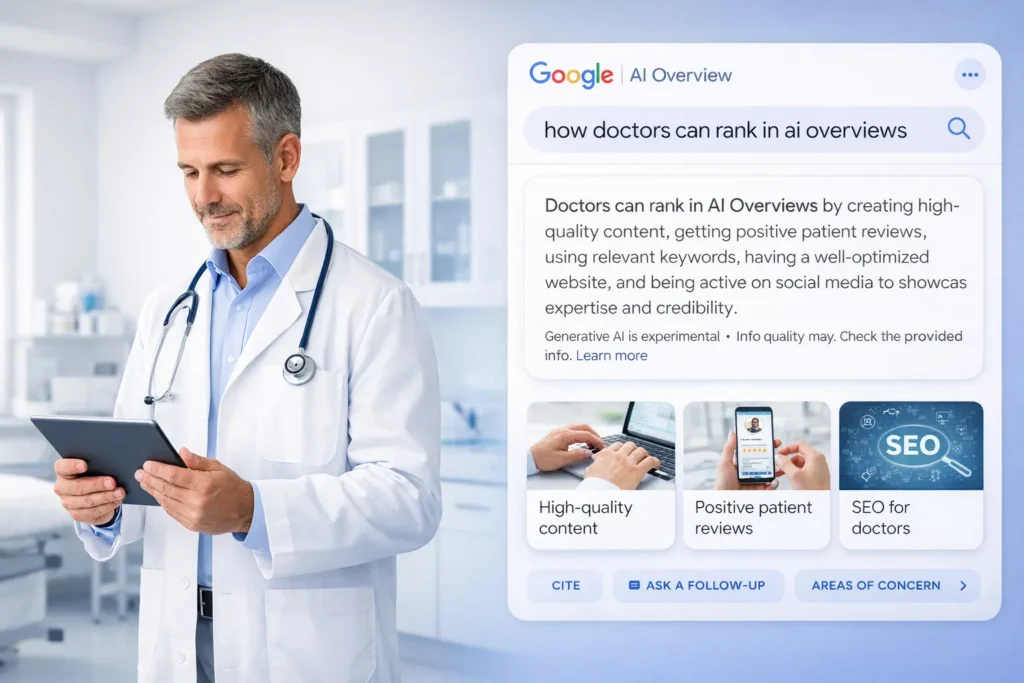
Exclusion from Google AI Overviews. Google AI Overviews preferentially extract content from pages that demonstrate strong E-E-A-T. YMYL-non-compliant healthcare pages are almost never cited in AI answers. As AI Overviews become the first result seen for health queries, websites without compliance signals are invisible at the top of the page even if they rank in position three below it. For a deeper look at how to optimise your content for AI search engines, this guide on AI search visibility covers what AI tools look for when recommending websites.
Loss of featured snippets and rich results. FAQ schema, HowTo schema, and structured data are ignored when the underlying page lacks the trust signals to qualify for rich results. A clinic can implement technically perfect FAQPage schema and still not appear in rich results if the page has no named author, no sourcing, and no medical disclaimer. The schema is necessary but not sufficient.
Manual action risk. Misleading health content – content that contradicts medical consensus, makes unsupported cure claims, or lacks any authorship – can trigger a manual review and manual action from Google. Manual actions are the most serious consequence because they require deliberate remediation and a reconsideration request before rankings can recover.
The patient impact. When your clinic website falls in rankings, patients find your competitors instead. Trust, built over years of clinical work and patient relationships, does not translate automatically into digital trust. Your competitors who do pass YMYL scrutiny will capture the searches you are losing.
To understand this concretely: a physiotherapy clinic page with anonymous content, no sourcing, and no schema sits in position six. A competing clinic page with a named physiotherapist author, links to NHS guidelines, FAQPage schema, and a visible reviewed date sits in position two. After the next quality-focused update, the gap between those two positions widens. The patient searching for physiotherapy near them does not reach page two.
How to Fix YMYL Compliance Issues – Prioritised Action Plan
Not every compliance gap requires the same effort to fix. The following three-tier plan helps you prioritise based on how quickly you can act and how much impact each fix delivers.
Quick Fixes – Under One Hour Each
These are the compliance gaps that require no specialist technical knowledge and can be resolved today.
- Add a last reviewed date to every existing health page. Place it below the H1. Format it as “Last reviewed: March 2026” and commit to updating it when you refresh the content.
- Add a medical disclaimer to every health article and service page. Write it in plain English. Keep it above the first H2 so it is seen before the reader reaches the medical content.
- Add a named author to every anonymous health page. Even adding a byline and a short two-line bio is enough to move from non-compliant to partially compliant while you work on full author profiles.
- Check your contact details match your Google Business Profile exactly. If the address or phone number differs between your website and your GMB listing, fix it now.
- Run your main pages through PageSpeed Insights and note any LCP issues. Some can be resolved quickly by compressing images or removing unused plugins.
Medium-Effort Fixes – One to Two Weeks
These tasks require more planning and coordination but remain achievable within a fortnight for most clinics.
- Write full author bios for every contributing doctor or health writer. Include qualifications, registration body membership, years of practice, and a link to a verifiable external profile. Photograph each author properly – no stock images.
- Implement FAQPage schema on your top health content pages. Use JSON-LD format. Validate each implementation in the Rich Results Test. Start with pages that already have FAQ sections.
- Create an editorial policy page and link to it from your health content. Your editorial policy should cover who can author content on your site, what sources are acceptable, how medical accuracy is checked before publication, and how often content is reviewed. Three bullet points covering these four areas is enough to start.
- Audit your existing content against checklist items 6-10 and flag all pages with absolute claims or missing source citations. Prioritise your highest-traffic health pages first.
Long-Term Strategy – One to Three Months
These are the structural improvements that build lasting YMYL compliance and competitive advantage.
- Implement MedicalWebPage schema sitewide on all health content pages. This requires either developer time or a WordPress plugin configured correctly for medical structured data. Validate every implementation.
- Build a backlink profile from medical sources. Reach out to medical associations, health journalism platforms, university hospital networks, and healthcare NGOs. A single editorial mention on an NHS trust website or a PubMed-indexed journal citing your content is worth more than a hundred directory listings.
- Run a full content audit across every health page on your website. Check every page against the 20-point checklist. Archive or noindex content that cannot be brought to compliance standard. Rewrite content that can be salvaged with authorship, sourcing, and schema improvements.
- Establish a content review cadence. Medical content should be reviewed every six months at minimum. Build this into your content operations calendar. YMYL compliance is not a one-time project. It is an ongoing commitment.
Not sure where your site currently stands on YMYL compliance? RankVed offers a full healthcare SEO and compliance audit for clinic and hospital websites – covering every signal in this checklist and giving you a prioritised fix plan based on your actual site data.
YMYL Compliance Checklist for Healthcare vs. Finance – Key Differences
Because healthcare and finance are both YMYL categories, they often appear in the same Google searches and compete for the same “What is YMYL?” queries. If you work with clients in both sectors, or if your healthcare brand also publishes financial guidance around insurance, treatment costs, or health investment, this comparison is directly relevant.
The core compliance requirements are shared across both categories: named authors, last-reviewed dates, source citations, and transparent editorial processes are non-negotiable in both healthcare and finance.
The primary difference lies in the credential requirement. For healthcare content, the author credential must come from a recognised medical registration body – GMC, MCI, NMC, AMA, or equivalent. For finance content, the equivalent is a regulatory body membership – SEBI in India, FCA in the UK, FINRA in the US. A financial advisor writing health content does not satisfy the healthcare YMYL authorship standard. The credential must match the content type.
A second distinction is the consensus alignment requirement. Healthcare pages must align with current medical consensus – meaning what recognised health bodies like the NHS, WHO, or CDC currently advise. Finance pages have no direct equivalent because financial consensus is more fluid and market-dependent. A health page recommending an approach that contradicts NICE guidelines will fail YMYL scrutiny regardless of the author’s credentials. Finance pages have more latitude on viewpoint.
Practical guidance for multi-sector sites: if your client or your agency publishes content across both health and finance on the same domain, apply the stricter standard across both content types. Healthcare’s authorship and consensus requirements are more demanding. Applying them to your finance content as well reduces compliance risk without meaningful extra effort.
Your YMYL Healthcare Compliance Checklist – Summary and Next Step
YMYL compliance is not a box to tick once and forget. It is the ongoing quality standard that Google applies to healthcare content every time its systems evaluate your pages. The 20 checkpoints in this article cover the full range of signals that determine whether your clinic or hospital website is treated as a trusted medical resource or a low-quality health page.
The three things that matter most right now: named medical authors on every health page, a last-reviewed date visible near the top of every article, and MedicalWebPage schema implemented correctly. These three alone will lift your compliance profile more than anything else you can do in the short term.
The cost of inaction is real. Non-compliant healthcare pages lose rankings, lose their place in Google AI Overviews, and lose patients to competitors who do the work. Which of these 20 checkpoints did your site fail? Let us know in the comments below – or speak to the RankVed team about a full YMYL compliance audit for your healthcare website.
Methodology note: This checklist is based on Google’s Quality Rater Guidelines, Google Search Central documentation, and RankVed’s ongoing analysis of healthcare website performance across Indian and international markets. This content is reviewed monthly and updated to reflect current Google guidance.