

Would a stranger reading your clinic’s About page believe an actual doctor wrote it?
That question matters more than it used to. Google grades health content harder than almost any other category on the web, and the AI tools. Patients now search through (ChatGPT, Gemini, Google’s AI Overviews) are reading your pages for the same signal: is there a real person behind this, or did nobody touch it after the first draft?
This guide covers why “sounds human” has turned into a compliance issue for healthcare websites, the specific phrases that put a practice at legal and ranking risk, and a working list of the 108 words AI keeps reaching for when it writes about clinics, hospitals and doctors.
This is not a style guide. For healthcare content, sounding like a chatbot wrote your page isn’t just an aesthetic problem. It’s a trust problem with patients and a compliance problem with regulators, and both now feed directly into whether Google and AI engines will show your practice at all.
Why Every Page on a Clinic Website Gets Judged More Harshly Than Most
Google sorts content into two tiers of scrutiny. Most topics, including recipes, product reviews and travel tips, get graded on usefulness. Healthcare content gets graded on usefulness and on what happens if it’s wrong. Google calls this second tier YMYL: Your Money or Your Life. It covers any page that could affect someone’s health, safety or financial stability if the information is inaccurate or misleading.
A blog post about the best hiking boots can be mediocre and nobody gets hurt. A page explaining when chest pain needs an ER visit cannot be mediocre. That’s why Google’s own guidance on creating helpful, reliable, people-first content puts extra weight on expertise and trustworthiness for exactly this category of page.
Every service page, doctor bio, condition explainer and blog post on a clinic or hospital site falls under this umbrella. If your team hasn’t mapped which pages carry the highest YMYL weight, RankVed’s breakdown of YMYL in healthcare SEO is the fuller reference for that first.
02. The trust paradoxThe Trust Paradox Making AI-Sounding Health Content Dangerous
Here’s the part most healthcare marketers miss: patients are not good at telling AI-written medical answers apart from a doctor’s. A 2024 MIT Media Lab study had participants rate medical responses without knowing whether a physician or an AI model wrote them. Accuracy at guessing the source landed around 50%, essentially a coin flip.
The more troubling finding was about trust, not detection. Low-accuracy AI-generated answers were rated as trustworthy as answers written by real doctors, with a mean score of 4.06 versus 3.85 on the study’s scale. Participants also said they’d act on the AI’s advice about as readily as they’d act on a doctor’s, even when that advice was wrong.
Patients extend AI-generated health content the same trust they’d give a physician, even when the content is inaccurate. That’s not a reason to avoid AI drafting tools. It’s the reason a real clinician has to touch every claim before it publishes.
For a clinic, this cuts two ways. Content that reads like it was mass-produced erodes trust with careful readers and with Google’s quality raters. But content that sounds confident and polished without a clinician’s judgment behind it can spread inaccurate advice that patients will believe just as readily. Writing “human” is really about writing accountable: content a named person stands behind.
03. What AI and Google can detectWhy Google Can Tell When a Health Page Was Never Touched by a Clinician
Search Engine Journal’s August 2026 analysis of health and YMYL content put the scale of this problem in numbers: roughly 40 million people ask ChatGPT a health question every day (per OpenAI), and AI Overviews now appear on an estimated 89% of healthcare-related searches (per BrightEdge research cited in the piece). Every clinic is now competing to be the source an AI model actually cites, not just a link on page one.
That competition rewards one thing AI text generally can’t fake: experience, the first “E” in Google’s E-E-A-T framework. A model can describe a procedure. It cannot describe what it’s like to have performed 4,000 of them. As iPullRank’s February 2026 analysis of Google’s quality rater guidelines put it plainly:
“If a chatbot could have written your article in 10 seconds without human oversight, Google’s raters are going to mark it as low quality.” Francine Monahan, iPullRank
RankVed founder Sarthak Jain sees the same shift from the clinic side of the table: “Modern visibility is not just about Google rankings anymore. Real growth now comes from being recommended by AI systems.” That shift applies whether the content in question sits on a solo doctor’s site, a multi-location clinic group, or a hospital system’s full content library.
In practice, that means AI and human reviewers are both looking for the same markers of real clinical experience:
- A named clinician byline tied to a real credential, not “Our Team.”
- First-person clinical language: “in our clinic, we typically start with…” instead of “patients typically start with…”
- Specific numbers: visit length, recovery windows, case volume, not vague reassurance.
- Visible update dates and a note on what changed and why.
- References to real, if anonymized, patient patterns rather than generic “many patients find…” claims.
7 Signals That Flag Healthcare Content as AI-Written
Before editing a page, run it against this list. Most AI-drafted healthcare content fails on at least three of these.
- No named author or credential attached to a medical claim. Anonymous authorship is the single biggest E-E-A-T red flag on a health page.
- Every sentence runs the same length and rhythm. Human clinical writing varies: a short warning sits next to a longer explanation.
- Vague authority with no named source: “studies show,” “many doctors recommend,” with nothing cited.
- Generic promises that could sit on any clinic’s site with “comprehensive, compassionate care” saying nothing specific to your practice underneath it.
- No real numbers anywhere: no visit length, no recovery window, no case volume, no wait time.
- Service pages that read identically with just the condition name swapped from page to page.
- Zero first-person clinical voice: nothing that sounds like it came from someone who has actually treated the condition being described.
The Phrases That Aren’t Just Robotic: They’re a Compliance Risk
There are two different problems hiding inside most AI-drafted healthcare copy, and healthcare teams usually only fix one of them.
The first is a style problem: words like “cutting-edge” or “compassionate care” make a page sound generic and AI-written. Fix it by rewriting with something specific.
The second is a compliance problem, and it’s the one that actually creates liability. Phrases like “guaranteed results,” “100% safe” or “pain-free” are unsubstantiated claims. Advertising and medical-board regulators treat this kind of language as a red flag regardless of who or what wrote it, because it implies an outcome no clinic can honestly promise for every patient. These phrases don’t get rewritten. They get removed, or replaced with something you can actually back up with a source.
Rule of thumb: if a claim would need a study citation to survive a fact-check, either cite the study by name or cut the claim. RankVed’s YMYL compliance checklist for healthcare walks through this line-by-line for full pages, not just phrases.
| Phrase | Why it’s a compliance risk |
|---|---|
| Guaranteed results | No treatment can honestly guarantee an outcome for every patient |
| 100% safe / risk-free | No medical procedure carries zero risk |
| Pain-free (absolute) | Pain response varies by patient; this overstates certainty |
| No side effects | Almost no treatment has zero possible side effects |
| Miracle treatment / cure | Classic flagged phrase in medical advertising review |
| Clinically proven (uncited) | Meaningless without naming the actual study |
| Better than surgery / outperforms all treatments | Comparative claims require head-to-head evidence |
| Best doctor in [city] / #1 rated clinic | Unverifiable superlative without a named, current source |
108 Words and Phrases AI Keeps Reaching for in Healthcare Content
This is the consolidated list: every pattern this guide has covered, split into two groups because they need two different fixes.
Group A: Sounds Like AI (Rewrite With Something Specific)
These aren’t banned words. They’re a signal to stop and ask: what’s the actual detail hiding behind this phrase?
- Compassionate care→name the specific thing you do
- State-of-the-art facility→name the equipment and year
- Cutting-edge technology→name the technology
- Board-certified experts→name the certification and doctor
- Personalized treatment plan→describe what actually changes
- Holistic approach to wellness→describe what “holistic” means here
- Patient-centered care→describe the actual difference
- World-class physicians→name credentials and years of experience
- Seamless patient experience→describe booking, check-in, follow-up
- Comprehensive care→list what’s actually included
- Life-changing results→cite a measurable outcome range
- Trusted healthcare partner→cite years in practice or reviews
- Exceptional patient outcomes→cite the actual outcome data
- Innovative treatment options→name the treatments
- Unparalleled expertise→name the specific expertise
- Commitment to excellence→describe a specific standard
- Empowering patients→describe how (education, shared decisions)
- Journey to wellness→describe the actual care pathway
- Top-tier medical care→name the accreditation or specialists
- Advanced diagnostic technology→name the equipment
- Premier healthcare provider→say what’s actually premier
- Dedicated team of experts→name the team and credentials
- Transformative care→cite the transformation with a number
- Cutting-edge research→cite the actual research
- Revolutionary treatment→name the treatment and evidence
- Gold standard of care→name the protocol you follow
- Unwavering commitment→describe the specific commitment
- Tailored treatment plans→describe what gets tailored, and how
- Holistic healing→name the specific modalities used
- Wellness journey→describe the visit sequence
- Empathetic care→describe what that looks like in a visit
- State-of-the-art equipment→name the brand and model
- Leading-edge medicine→name what’s actually leading-edge
- Trusted name in healthcare→cite years in practice or patient volume
- Compassionate professionals→name the team and specialty
- Peace of mind→describe what reduces patient worry
- Exceptional care→describe the specific care standard
- Highest standards of care→name the accrediting body
- Patient-first approach→describe an actual patient-first policy
- Seamless care coordination→describe the referral or handoff process
- Whole-person care→describe what’s assessed beyond the complaint
- Individualized attention→describe the appointment length/format
- Award-winning care→name the award and year
- Renowned specialists→name them and their credentials
- Unmatched expertise→name specific expertise
- Groundbreaking treatment→name the treatment and the evidence
- Best-in-class care→name the standard that defines “best”
- Family-centered care→describe what that looks like in practice
- Concierge-level service→describe the specific service
- Evidence-based approach→cite the specific guideline followed
- Multidisciplinary team→name the specialties involved
- Continuum of care→describe the actual stages of treatment
- Proactive health management→describe the monitoring or follow-up
- Root-cause approach→describe your diagnostic process
- Integrative medicine→describe which modalities are combined
- Precision medicine→describe how treatment is customized
- Next-generation care→name what’s actually new
- State-of-the-art imaging→name the imaging technology
- Unrivaled patient satisfaction→cite a real satisfaction score
- Deep clinical expertise→name years or case volume
- Genuine compassion→describe a specific policy
- Uncompromising quality→describe a specific quality metric
- Patient wellbeing is our top priority→describe a policy that supports this
- Second-to-none care→name what makes it distinct
- Personalized attention→describe the appointment structure
- Trusted by thousands of patients→cite the actual patient count
- Delivering hope→describe a specific outcome or program
- Life-saving care→cite the actual procedure and outcome
- Advanced surgical techniques→name the technique
- Minimally invasive approach→name the specific procedure
- Rapid recovery→cite the actual average recovery time
- Streamlined process→describe the actual steps
- Convenient access to care→describe hours, locations, telehealth
- Comprehensive diagnostic workup→list what’s included
- Latest medical advancements→name the specific advancement
- Warm, welcoming environment→describe the actual space
- Superior patient care→name what makes it superior
- Passionate about patient health→describe a specific initiative
- Unique blend of expertise→name the specific specialties
- Setting new standards in care→name the standard and how it’s measured
- Transforming healthcare→describe the specific change
- Redefining patient care→describe what’s actually different
- Elevating the patient experience→describe the specific change
Group B: Compliance Risk (Remove, Don’t Reword)
These don’t get a softer synonym. They get cut, or replaced with a claim you can name a source for.
- Cure / cures→implies a guarantee no treatment can make
- Guaranteed results→unsubstantiated outcome claim
- 100% safe→no procedure is zero-risk
- Risk-free→real risks must be disclosed
- Pain-free (absolute)→overstates individual variation
- No side effects→almost never literally true
- Miracle treatment / cure→classic advertising red flag
- Breakthrough (unqualified)→implies consensus that may not exist
- Clinically proven (no citation)→name the actual study or drop it
- FDA-approved (if not literally true)→misrepresents regulatory status
- Better than surgery→needs head-to-head evidence
- Outperforms all other treatments→unsubstantiated superiority claim
- Instant results→sets an unrealistic expectation
- Permanent solution→most treatments carry recurrence risk
- Completely eliminates→absolute claim, rarely defensible
- Totally reverses→especially risky for chronic conditions
- Works for everyone→ignores individual variation
- No recovery time needed→misleading on procedure risk
- Guaranteed to work→same issue as guaranteed results
- Safe for all patients→ignores contraindications
- Zero downtime→overstated recovery claim
- Best doctor in [city]→unverifiable superlative
- #1 rated clinic→needs a named, current source
- Proven to prevent [condition]→prevention claims need strong evidence
- Doctors agree that…→vague, uncredited consensus claim
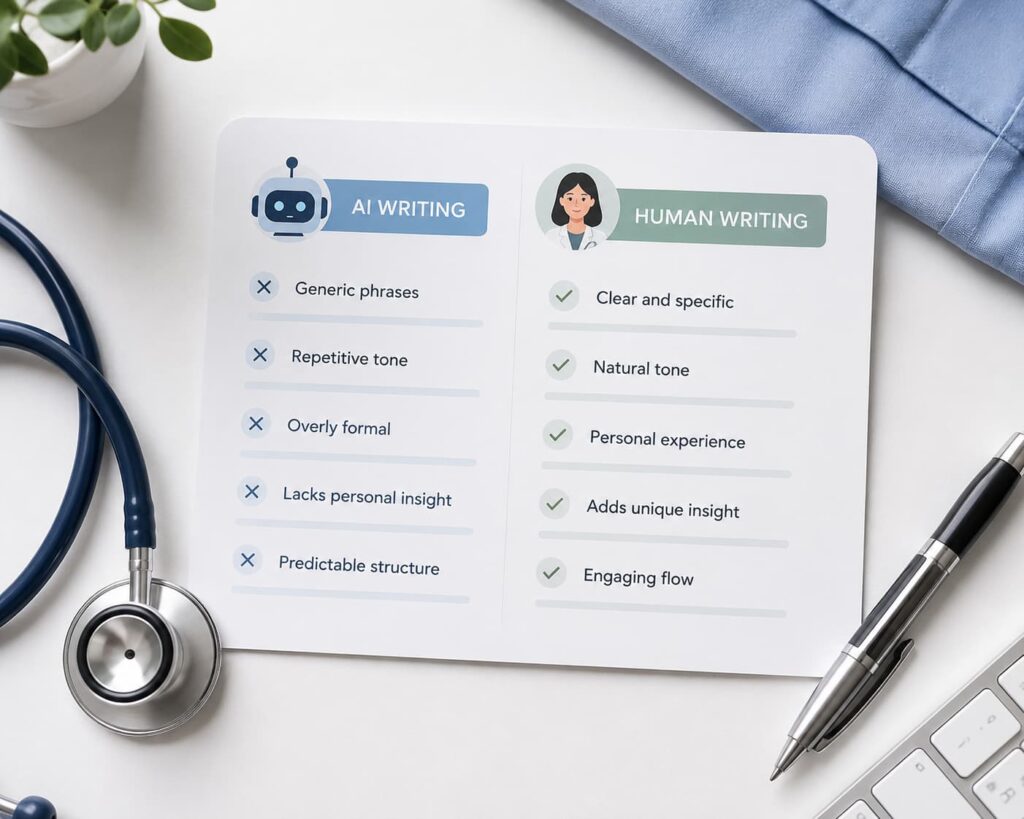
What AI-Sounding Clinic Copy Looks Like Next to the Human Version
Our compassionate team of board-certified physicians is committed to providing comprehensive, patient-centered care using state-of-the-art technology in a warm and welcoming environment.
Human-focusedDr. Patel has practiced family medicine in this neighborhood for 14 years. Same-day appointments are held open every weekday morning for patients who can’t wait a week to be seen.
We offer personalized, evidence-based treatment plans tailored to each patient’s unique needs, helping you achieve a pain-free, active lifestyle through our holistic approach to rehabilitation.
Human-focusedMost post-surgical knee patients start with two 45-minute sessions a week. We adjust the plan at the two-week mark based on your range of motion, not on a fixed template.
Dr. Reyes is a world-class cardiologist dedicated to delivering exceptional, innovative cardiac care with unwavering commitment to patient wellbeing.
Human-focusedDr. Reyes trained at Johns Hopkins and has performed over 1,200 catheterizations. She sees patients Tuesday through Friday and typically calls with test results herself rather than through staff.
The Pre-Publish Checklist RankVed Runs on Every Healthcare Page
- Named author with credentials. No “Admin” or “Our Team” bylines on medical content.
- Clinician review noted and dated. A visible “medically reviewed by” line, tied to a real name.
- Every superlative has a source. “Award-winning,” “#1 rated”: name the award, the year, the source.
- Every guarantee-style word is gone. Scan for cure, guaranteed, 100% safe, risk-free, pain-free.
- At least one real number per page. Recovery time, visit length, case volume, years in practice.
- First-person clinical voice appears at least once. “In our experience,” “we typically see.”
- Service pages don’t read like templates. Read two side by side: if only the condition name changed, rewrite one.
- External claims are cited by name, not “studies show” with nothing linked.
- Update date is visible and reflects an actual review, not just a re-publish.
- Read it aloud once before it goes live. If it sounds like a brochure, it needs another pass.
Why Most Agencies Can’t Fix This, and What RankVed Does Differently
Most healthcare marketing agencies pick one of two failure modes. Some mass-produce AI-drafted content for clinics, doctors and hospital groups with no clinician review layered on top, which is exactly the pattern this guide has been warning against. Others avoid AI entirely and hand-write everything, which is slower and often means service pages, doctor bios and blog content simply never get written or updated.
Sarthak Jain, founder of RankVed and an AI SEO specialist with a background in computer science, built the agency around a third option: use AI to move faster, but treat every clinical claim as something a named person has to own. He has personally guided over 110 clinics and hospitals through this process, with 57+ long-term managed partnerships in RankVed’s core portfolio.
That approach is formalized in what Jain calls the 3:3 Framework: a system built around the three paths patients actually use to find a doctor or clinic (Google Search, Google Maps and AI platforms like ChatGPT and Gemini), each paired with a corresponding trust-building layer of the website’s content. Content humanization, the focus of this guide, is one of those layers. It sits alongside technical structure and clinical credibility signals, not as a separate writing exercise handled after the fact.
The practical difference: a RankVed content review doesn’t just check whether a page reads well. It checks whether a named clinician would be comfortable putting their credential next to every claim on the page, for a doctor’s bio, a hospital department page, or a single clinic’s service listing alike.
Copy This Prompt to Keep Any Healthcare Draft Human and Compliant
Paste this in front of any healthcare content request in ChatGPT, Claude or Gemini. It applies the style fixes and the compliance rules from this guide in one pass.
Act as an experienced healthcare content editor. Rewrite the content I give you so it reads as human-written and stays compliant for a medical or clinic website. Follow these rules:

1. Remove generic marketing phrases (compassionate care, state-of-the-art, cutting-edge, world-class, comprehensive, holistic, seamless) unless they're followed by a specific, verifiable detail. If there's no detail to add, cut the phrase.

2. Remove or flag any absolute or guarantee-style claim: cure, guaranteed, 100% safe, risk-free, pain-free, no side effects, miracle, breakthrough, permanent solution, works for everyone. Do not soften these with a synonym. Remove them or ask me for a source.

3. Replace vague authority ("studies show", "many doctors recommend", "clinically proven") with a named source, or remove the claim if I haven't given you one.

4. Add at least one first-person clinical marker if the content is from a named clinician's perspective ("in our experience", "we typically start with").

5. Include at least one specific, real number where relevant: recovery time, visit length, case volume, or years in practice. Ask me for the number if it's missing. Do not invent one.

6. Vary sentence length. Do not let every sentence follow the same rhythm.

7. Do not write a "medically reviewed by" byline yourself. Flag where one should go and leave it for me to fill in with a real name and credential.

8. Keep the tone direct and specific rather than reassuring and vague. A reader should finish the page knowing a concrete fact, not just a feeling.

Now apply these rules to the following content:
What Doctors and Clinic Marketers Are Actually Asking About AI Content
Can Google tell if healthcare content was written by AI?
Not from word choice alone, but Google’s quality raters and ranking systems are trained to spot the pattern that AI drafting leaves behind: generic claims, no named author, no first-person clinical detail. The words are a symptom; the missing experience signal is the actual problem.
Is it against Google’s guidelines to use AI to write medical content?
No. Google’s own guidance focuses on whether content is helpful and accurate, not on which tool typed it. AI-assisted drafting is fine as a starting point. Publishing it unreviewed, on YMYL pages, is the part that creates risk.
Do I need a doctor to review AI-written health content before publishing?
For anything that makes a clinical claim (symptoms, treatments, outcomes, medication information), yes. A named clinician review is both a trust signal for readers and a basic safeguard against publishing something inaccurate.
What is YMYL content and why does it matter for my clinic?
YMYL stands for Your Money or Your Life: Google’s term for content that could affect someone’s health, safety or finances if it’s wrong. Nearly every page on a clinic or hospital site qualifies, which is why healthcare content gets held to a stricter bar than most other industries.
Will AI Overviews replace my clinic’s website traffic?
They’re changing where clicks come from, not eliminating them. Pages structured to answer a specific question clearly, with a named clinical source behind the answer, are the ones AI systems tend to cite and link back to.
What phrases should never appear on a medical website?
Absolute claims are the highest-risk category: guaranteed results, 100% safe, cure, pain-free, no side effects, risk-free. These read as unsubstantiated regardless of intent, and they’re the first thing a compliance review or a plaintiff’s attorney will flag.
How much of my content can be AI-assisted before it hurts rankings?
There’s no fixed percentage. What matters is whether a real person with relevant expertise reviewed, corrected and takes ownership of the final page. A heavily AI-drafted page that a clinician thoroughly edits can outperform a fully human first draft nobody fact-checked.
Does adding a “medically reviewed by” byline actually help rankings?
It helps trust, and trust is one of the four pillars Google evaluates for YMYL pages. On its own it won’t fix thin or generic content, but paired with specific, accurate information it’s one of the clearest experience signals a page can carry.
What’s the difference between AI-sounding and AI-generated content?
AI-generated just describes the drafting tool. AI-sounding describes the result: generic phrasing, no named source, no clinical specificity. Content can be AI-generated and not sound like it, or fully human-written and still sound like it, if the writer leans on the same stock phrases.
How often should healthcare content be updated to stay compliant and trusted?
Review high-traffic clinical pages at least twice a year, and any time a treatment, guideline or piece of equipment changes. A visible, honest update date is itself a trust and experience signal. Don’t refresh the date without actually reviewing the content.
Get This as a Free PDF Guide
Download “How to Write Human Content for Healthcare, Clinics, Doctors & Hospitals”: the full checklist, the 108-word bank and the compliance list in one PDF your team can share internally or hand to a new writer. Clinics that fix these patterns (named clinicians, specific numbers, no unsubstantiated claims) tend to become the pages AI search tools actually cite, instead of the ones it skips past.
Download the Free PDF GuideWant RankVed to run this process for you? See our healthcare SEO services.
Sources and Further Reading
This guide draws on current Google guidance, published SEO research and a peer-reviewed study on AI trust in medical contexts.
- Google Search Central. Creating Helpful, Reliable, People-First Content. Google’s own guidance on how content quality, including YMYL categories, is evaluated.
- Corso, A. (2026). How to Create Health & YMYL Content That Performs in AI Search. Search Engine Journal. Source of the ChatGPT health-query volume and AI Overview coverage figures cited above.
- Monahan, F. (2026). Google’s Search Quality Rater Guidelines and YMYL in the Age of AI Search. iPullRank. Analysis of E-E-A-T scrutiny for YMYL pages in AI search.
- Shekar, S., Pataranutaporn, P., Sarabu, C., Cecchi, G. & Maes, P. People Over-Trust AI-Generated Medical Responses and View Them to Be as Valid as Doctors, Despite Low Accuracy. MIT Media Lab research. Source of the trust-parity findings cited in Section 02.
Legal and compliance guidance in this article is general and not a substitute for review by your practice’s legal counsel or medical board requirements in your region.