

Have you ever read an article that looked perfectly written but still felt strangely familiar?
The grammar is correct. The structure is neat. The vocabulary sounds professional. Yet something about the writing feels repetitive or overly polished.
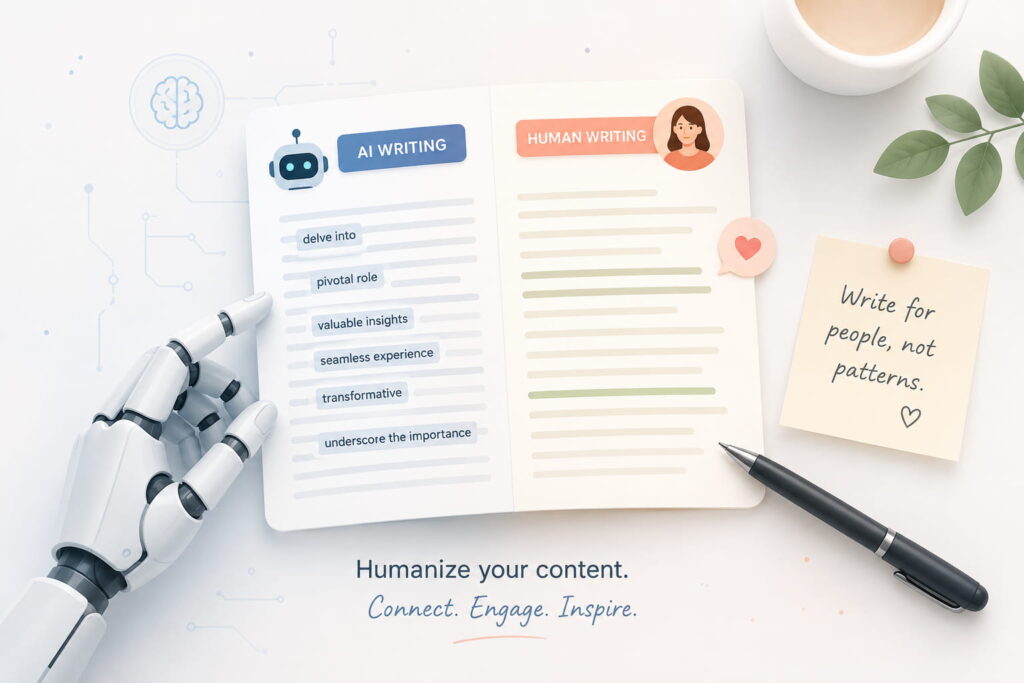
You may notice phrases such as “delve into,” “pivotal role,” “valuable insights,” “seamless experience,” “transformative,” or “underscore the importance”.
These words are not bad English. Human writers use them too. The more useful question is whether a piece of content repeatedly uses the same vocabulary, sentence structures, transitions and rhetorical habits.
The goal is not to remove every word associated with AI. The goal is to make writing clearer, more specific and more useful to the person reading it.
What Are AI Writing Words?
“AI writing words” is a casual term for words and phrases that appear frequently in AI-generated or AI-assisted content.
Some are formal words. Some are promotional. Some are metaphors. Others are ordinary words that become noticeable because AI uses them in predictable combinations.
Examples include:
| Type | Examples |
|---|---|
| Importance | crucial, pivotal, vital, paramount |
| Exploration | delve, explore, uncover, navigate |
| Improvement | enhance, elevate, optimize, bolster |
| Promotion | groundbreaking, innovative, transformative |
| Metaphors | tapestry, beacon, treasure trove, cornerstone |
| Scope | realm, landscape, broader context |
Is One AI Word Enough to Prove That Content Was Written by AI?
No.
This is one of the most important points in the entire topic.
A human writer can naturally use words such as crucial, unique, innovative, robust or delve.
Finding one of those words in an article does not tell you who wrote it.
What becomes more interesting is a repeated combination of signals. For example, an article may repeatedly use formal vocabulary, broad claims, decorative metaphors, predictable transitions, three-part descriptions and sentences ending in words such as highlighting, underscoring or showcasing.
03. The numbersOne word is rarely interesting. A repeated writing pattern is much more useful to examine.
What the Phrase Data Actually Tells Us
The supplied datasets make an important point.
The most common phrases are not necessarily unusual AI vocabulary. Many of the highest-frequency phrases are ordinary English constructions.
| Phrase | Recorded count |
|---|---|
| of the | 66,809 |
| in the | 47,133 |
| to the | 32,400 |
| is a | 27,969 |
| you can | 26,691 |
| such as | 24,345 |
That tells us something important.
You cannot build a useful AI-writing guide simply by collecting unusual words. Context matters.
A separate supplied dataset contains words that are more commonly associated with the style people notice in AI-assisted writing.
| Word | Recorded count |
|---|---|
| unique | 4,479 |
| additionally | 3,638 |
| finally | 3,103 |
| array | 2,589 |
| deep | 2,347 |
| conclusion | 1,841 |
| journey | 1,835 |
| crucial | 1,344 |
| navigate | 1,249 |
| dynamic | 950 |
Five Things to Look for Instead of One “AI Word”
A better way to review content is to look at five layers at the same time.
| Layer | What to look for | Example |
|---|---|---|
| Vocabulary | Formal, promotional or ornate language | pivotal, delve, tapestry |
| Phrases | Repeated stock expressions | in summary, on the other hand |
| Sentence structure | Repeated rhetorical formulas | not just X, but Y |
| Rhetoric | Broad significance and generic praise | underscoring its importance |
| Formatting | Very rigid presentation | many headings and symmetrical lists |
100+ AI-Associated Words, Grouped by Category
The following groups make the list easier to use. The alternative column is not a rule. It simply shows what a writer might consider when a word feels unnecessarily formal.
| Category | Words to watch | Possible simpler choices |
|---|---|---|
| Importance | crucial, pivotal, vital, paramount, imperative, essential, significant, noteworthy | important, major, necessary, useful |
| Exploration | delve, explore, uncover, navigate, discover, illuminate, elucidate | examine, explore, find, explain |
| Complexity | intricate, multifaceted, nuanced, systemic, inherent, manifold, disparate | complex, detailed, specific, different |
| Improvement | enhance, elevate, augment, optimize, bolster, refine, strengthen | improve, increase, strengthen, refine |
| Support | facilitate, foster, empower, cultivate, enable | help, support, allow, build |
| Usage | utilize, leverage, harness | use |
| Promotion | groundbreaking, innovative, cutting-edge, transformative, revolutionary | new, useful, effective, significant |
| Positive description | remarkable, exceptional, compelling, captivating, vibrant, dynamic | strong, useful, effective, interesting |
| Metaphors | tapestry, beacon, treasure trove, cornerstone, linchpin, gateway | collection, source, foundation, access |
| Scope | realm, landscape, broader context, evolving landscape | field, area, context, current situation |
| Professional tone | robust, tailored, seamless, holistic, comprehensive, sophisticated | strong, customized, simple, complete, advanced |
Common AI Phrases That Can Make Writing Feel Formulaic
These phrases are not wrong. The problem comes when they appear too often, especially when a more direct sentence would communicate the same idea.
| Phrase | Why it can feel repetitive | Consider instead |
|---|---|---|
| in summary | Common conclusion formula | State the conclusion directly |
| on the other hand | Can become a repeated transition | Use only when there is a genuine contrast |
| first and foremost | Adds ceremony to a simple first point | First |
| delve into | Formal exploration phrase | explore, examine, look at |
| plays a crucial role | Often gives a generic importance claim | Explain exactly what it does |
| treasure trove | Decorative metaphor | collection, source |
| in the world of | Broad introduction | Name the actual field |
| in this article | Common article template | Start with the actual information |
| is key to | Generic emphasis | Explain the reason |
| in a nutshell | Canned summary language | Give the short answer |
The Sentence Structures That Often Make AI Writing Noticeable
Sometimes the problem is not a particular word. It is the shape of the sentence.
Pattern 1: Not just X, but Y
This is not just a service. It is a transformative experience designed to empower patients.
More natural versionThe service gives patients a simpler way to manage their appointments.
Pattern 2: X serves as Y
The clinic serves as a beacon of excellence in modern fertility care.
More natural versionThe clinic provides fertility consultations, IVF and related treatments.
Pattern 3: Fact followed by an “ing” clause
The clinic introduced weekend appointments, enhancing accessibility and demonstrating its commitment to patient-centered care.
More natural versionThe clinic introduced Saturday appointments. Patients who work during the week can now book a visit on the weekend.
Pattern 4: The broader landscape sentence
The launch marks a pivotal moment in the evolving healthcare landscape.
More natural versionThe launch adds online appointments to the clinic’s existing booking system.
When an Ordinary Fact Starts Sounding Like a Historic Event
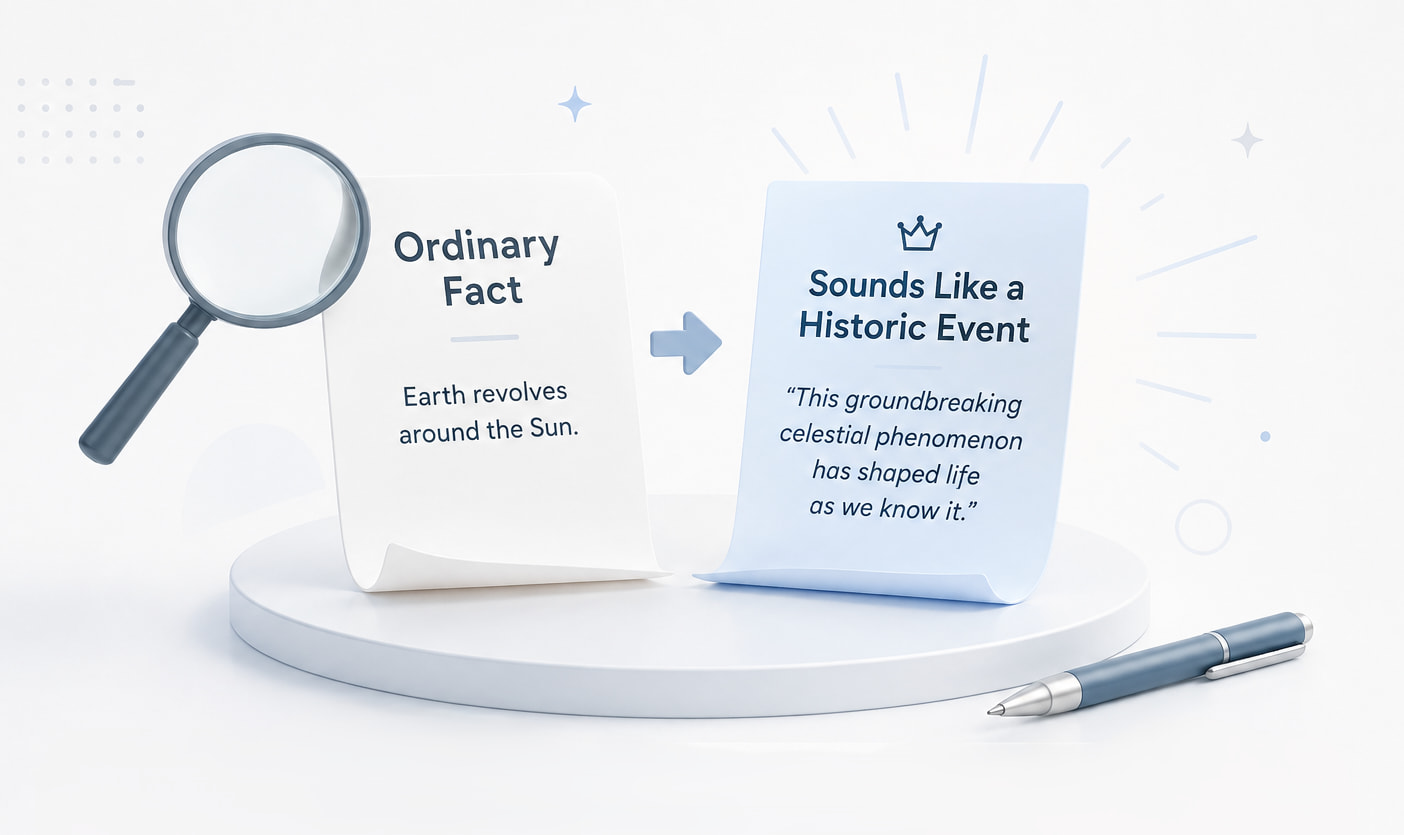
One of the strongest patterns described in the source material is the tendency to make ordinary information sound more significant than it needs to be.
Look for expressions such as:
marks a pivotal moment
represents a significant shift
serves as a testament
underscores its importance
reflects broader trends
sets the stage for
plays a crucial role
The source material describes this pattern as a way LLM-generated writing can connect a simple fact to a much broader story about history, society, an industry or the future.
The better approach is usually to tell the reader what actually happened.
09. Promotional languageWhy AI Content Can Sound Like a Press Release
Give an AI a company, product, clinic or service and it can quickly turn ordinary information into polished promotional copy.
Words such as groundbreaking, innovative, cutting-edge, transformative, world-class, unparalleled, dynamic, vibrant, compelling, seamless, tailored and robust are especially noticeable when several appear in the same paragraph.
Our groundbreaking platform delivers a seamless, personalized and transformative experience through innovative technology.
AfterThe platform lets customers compare plans, save their preferences and complete the application online.
The second version has fewer adjectives but gives the reader more useful information.
10. Decorative metaphorsTapestry, Treasure Trove, Beacon and Other Decorative Expressions
Metaphors can make good writing memorable. The problem starts when they are used simply because they sound impressive.
| Expression | More direct option |
|---|---|
| a tapestry of experiences | a range of experiences |
| a treasure trove of information | a collection of information |
| a beacon of hope | a source of support |
| a cornerstone of success | a foundation for success |
| embark on a journey | get started |
| gateway to | access to |
| evolving landscape | current situation or field |
| valuable insights | findings or practical information |
The Complete List: AI Sentence Starters, Filler Words and Frequency Words to Avoid
Individual words are one part of the pattern. The other part is how paragraphs open and how sentences pad themselves out. AI-assisted drafts tend to lean on the same handful of openers and the same vague quantity words, over and over, across an entire article. This section groups every category in one place so it can be used as a quick pre-publish scan.
Group 1: Paragraph and sentence openers to avoid
Watch for these at the start of a sentence or paragraph. One use is fine. Seeing the same one twice in an article is the signal to rewrite.
These are “hook” sentences. They sound like an opening line because they were trained to sound like one, not because they add information. A stronger opening states the actual fact, number or answer first.
Group 2: Vague frequency and quantity words
These words let a sentence sound backed by evidence without ever citing any. They are especially common as the very first word of a sentence.
Many clinics struggle with online visibility, and most patients frequently choose providers who rank higher in search results.
More natural versionA 2025 BrightEdge survey found that patients rarely scroll past the first page of search results when choosing a provider.
Group 3: Transition and filler overuse
Group 4: Closing and wrap-up clichés
Group 5: Hedge words and false authority
Quick rule: if a sentence starts with a vague quantity word (many, most, several) or a stock opener (in today’s world, when it comes to), stop and ask what the actual number, source or example is. Replace the opener with it.
Be Careful With “Experts Say”
Another recurring pattern is vague attribution.
AI-generated writing may say:
“Experts agree that this approach is highly effective.”
But which experts?
The same problem appears in phrases such as “industry reports suggest,” “observers have noted,” “studies show,” “widely regarded” and “many experts believe.”
If a source matters, name the source.
Experts agree that the treatment is highly effective.
BetterA 2025 study of 420 patients reported improved outcomes after the treatment.
Why AI Conclusions Often Sound the Same
Many AI-generated articles follow a very predictable structure.
Introduction, several neat sections, summary, positive conclusion.
Common phrases include in summary, in conclusion, overall, ultimately, taken together, at its core and in a nutshell.
These phrases are perfectly normal English. The problem is repetition.
In conclusion, choosing the right approach is crucial for achieving optimal results.
More usefulIf you’re comparing the two options, start with cost, recovery time and what your doctor recommends for your situation.
Could This Sentence Describe 500 Different Companies?
Here is a simple test that works surprisingly well.
“The company is committed to delivering innovative, customer-centric solutions that empower businesses to thrive in an ever-changing market.”
Could that sentence appear on the website of a software company? An accounting firm? A hospital? A marketing agency? An insurance company?
Probably.
Now compare it with:
“The platform automatically sends appointment reminders 24 hours before a patient’s visit.”
The second sentence contains a specific fact. It is harder to copy onto another website without changing its meaning.
Specific writing gives the reader something that generic language cannot.
AI-Style Writing Compared With Human-Focused Writing
The easiest way to understand the difference is to look at the same idea written in two different ways.
Our clinic offers a comprehensive and holistic approach, leveraging cutting-edge technology to deliver personalized care while empowering patients on their journey.
Human-focusedWe combine consultation, testing and treatment planning in one care pathway. Your doctor explains the options and what each step means before treatment begins.
This groundbreaking innovation represents a pivotal shift in modern healthcare, underscoring the importance of accessible solutions.
Human-focusedThe new system lets patients book appointments online instead of calling the clinic.
Whether you are embarking on your journey or looking to delve deeper into your options, our team is here to guide you every step of the way.
Human-focusedIf you’re comparing treatment options, we can explain what each one involves and what the next step would be.
How to Make AI-Assisted Content Sound More Human
You do not need to rewrite every AI-assisted article from the beginning. A careful editing pass can make a large difference.
- Circle abstract words. Look for words such as crucial, pivotal, transformative, landscape, realm, significance and journey.
- Question every adjective. If removing “groundbreaking” does not change the meaning, remove it.
- Prefer simple verbs when they are clearer. Use can often replace utilize. Help can often replace facilitate. Use can often replace leverage.
- Turn claims into facts. Instead of saying that an experience is seamless, explain what became easier.
- Replace generic praise with evidence. If something is highly effective, explain why.
- Check repeated “ing” endings. Look for highlighting, underscoring, showcasing, reflecting and reinforcing.
- Check contrast formulas. Look for not just, not only, rather than and instead of.
- Replace vague authority. If you write “experts say,” identify the source where possible.
- Read the article aloud. This can reveal repeated rhythms and phrases that are difficult to notice when reading silently.
- Fact-check important claims. Human-sounding writing is not a substitute for accurate information.
Do Not Try to Remove Every AI-Associated Word
Human writers use formal vocabulary.
Human writers use words such as crucial, unique, robust, innovative and even delve.
If you remove every word associated with AI, the result can become unnatural in a different way.
Instead, ask:
Does this word add information, or does it only make the sentence sound impressive?
If the word is accurate and useful, keep it.
If it is only decoration, replace it.
18. A useful writing frameworkThe Human Content Formula
| Instead of | Prefer |
|---|---|
| Sophisticated vocabulary | Clear vocabulary |
| Generic adjectives | Specific evidence |
| Abstract claims | Concrete examples |
| Generic praise | Specific benefits |
| Perfect symmetry | Natural variation |
| Broad statements | Relevant details |
| Polished filler | Useful information |
Specificity is better than sophistication.
Evidence is better than adjectives.
Examples are better than abstractions.
Voice is better than unnecessary polish.
Clarity is better than complexity.
Copy This Prompt to Stop AI Writing Patterns Before They Start
The editing checklist above works after a draft already exists. It is faster to prevent the patterns in the first place. Paste the prompt below in front of any writing request in ChatGPT, Claude or Gemini, and it will apply every rule covered in this guide automatically.
Act as an experienced human editor. Rewrite the content I give you so it does not read as AI-generated. Follow these rules:

1. Do not use these words unless there is no simpler option: delve, pivotal, crucial, paramount, intricate, multifaceted, robust, seamless, tailored, holistic, comprehensive, foster, facilitate, leverage, utilize, harness, groundbreaking, cutting-edge, transformative, revolutionary, unparalleled, tapestry, beacon, treasure trove, cornerstone, landscape, realm, journey, testament, underscore, showcase, elevate, embark, navigate, dynamic, vibrant, compelling.

2. Do not open a sentence or paragraph with: "In today's...", "In the world of...", "When it comes to...", "Ever wondered...", "Picture this...", "Let's dive in", "It's no secret that...", "Without a doubt", "Needless to say".

3. Do not open a sentence with a vague quantity word (many, most, several, numerous, countless, various, a myriad of) unless it is followed by a specific number, named source or concrete example.

4. Avoid the "not just X, but Y" structure and "X serves as Y" constructions.

5. Avoid ending a sentence with an "-ing" clause used to imply importance, such as "highlighting", "underscoring", "showcasing", or "demonstrating its commitment to".

6. Do not close with generic wrap-up language such as "in conclusion", "overall", "ultimately", or "in a nutshell". End with a specific, useful takeaway instead.

7. Replace vague attribution ("experts say", "studies show", "industry reports suggest") with a named source. If no source exists, remove the claim.

8. Replace generic praise and adjectives with specific facts, numbers or examples.

9. Vary sentence length naturally. Do not give every sentence the same rhythm or length.

10. Write the way a knowledgeable person would explain this to a colleague: plainly, directly, and only using words that add real information.

Now apply these rules to the following content:
Tip: paste your own draft after the last line before sending it. Save this prompt as a template so every writer on the team uses the same starting instructions.
20. SEO strategySEO Keywords for AI Writing and Human Content
If this article is intended to rank in search, the goal should not be keyword stuffing. The article should answer several related searches naturally.
Primary keyword
AI writing words
Secondary keywords
AI words to avoid, common AI phrases, ChatGPT words, common ChatGPT
phrases, AI-generated writing, AI writing patterns, AI writing style,
human-sounding content, human content writing, signs of AI writing,
AI vocabulary.
Long-tail keywords
words AI uses most, most common AI words and phrases, how to make AI
writing sound human, how to make content sound less AI-generated,
AI words to avoid in content, common ChatGPT phrases to avoid,
how to remove robotic language from content.
Click-Worthy Titles for This Topic
- AI Writing Words: 100+ Words and Phrases AI Uses and How to Make Your Content Sound Human
- Does Your Content Sound Like AI? 100+ AI Words, Phrases and Writing Patterns to Watch
- From “Delve” to “Pivotal”: The AI Words Making Content Sound Robotic
- AI Words to Avoid: Common ChatGPT Phrases That Can Make Writing Sound Robotic
- How to Make AI Writing Sound Human: Common Words, Phrases and Real Examples
AI Writing Patterns Are Not Proof of AI
This article should not be treated as a test for determining who wrote a piece of content.
A human writer can use the same words. A human editor can deliberately write in a formal style. Someone can also use AI and then substantially rewrite the result.
AI detection systems can also produce incorrect results. Style patterns are therefore better used as an editing tool than as definitive proof of authorship.
The purpose of this guide is much simpler. It is about helping writers create content that is specific, useful, credible and recognizably written for its audience.
23. Final checklistBefore You Publish, Check These 11 Things
| Check | Question |
|---|---|
| 01 | Did I use specific examples? |
| 02 | Did I remove unnecessary buzzwords? |
| 03 | Did I explain claims instead of decorating them? |
| 04 | Did I identify sources instead of saying “experts say”? |
| 05 | Did I vary sentence length naturally? |
| 06 | Did I check repeated “ing” clauses? |
| 07 | Did I overuse “not just X, but Y”? |
| 08 | Did I replace vague praise with evidence? |
| 09 | Does the article sound natural when read aloud? |
| 10 | Does the content contain details that are specific to this subject? |
| 11 | Did I fact-check important claims? |
110 AI Words and Phrases, and the Natural Alternative for Each
Every word and phrase covered in this guide, in one place. Each entry shows the AI-associated word or phrase on the left and a natural, specific alternative on the right. A few phrasal patterns are included too — not every version of them, just the ones worth watching for.
- Delve→explore
- Pivotal→major
- Crucial→important
- Paramount→top priority
- Imperative→necessary
- Essential→needed
- Significant→major
- Noteworthy→notable
- Explore→look at
- Uncover→find
- Navigate→handle
- Discover→find
- Illuminate→explain
- Elucidate→clarify
- Intricate→detailed
- Multifaceted→complex
- Nuanced→specific
- Systemic→built-in
- Inherent→built-in
- Manifold→many
- Disparate→different
- Enhance→improve
- Elevate→raise
- Augment→add to
- Optimize→improve
- Bolster→strengthen
- Refine→improve
- Strengthen→build up
- Facilitate→help
- Foster→support
- Empower→enable
- Cultivate→build
- Enable→allow
- Utilize→use
- Leverage→use
- Harness→use
- Groundbreaking→new
- Innovative→new
- Cutting-edge→advanced
- Transformative→effective
- Revolutionary→new
- Remarkable→notable
- Exceptional→strong
- Compelling→convincing
- Captivating→interesting
- Vibrant→lively
- Dynamic→active
- Tapestry→mix
- Beacon→source
- Treasure trove→collection
- Cornerstone→foundation
- Linchpin→key part
- Gateway→access point
- Realm→field
- Landscape→field
- Broader context→context
- Evolving landscape→current situation
- Robust→strong
- Tailored→customized
- Seamless→smooth
- Holistic→complete
- Comprehensive→thorough
- Sophisticated→advanced
- Unique→distinct
- Additionally→also
- Finally→last
- Array→range
- Deep→thorough
- Conclusion→result
- Journey→process
- Showcase→show
- Underscore→highlight
- Testament→proof
- Reflect→show
- Reinforce→support
- World-class→top-tier
- Unparalleled→unmatched
- State-of-the-art→advanced
- Paradigm shift→major change
- Game changer→important change
- Synergy→teamwork
- Embark→start
- In summary→in short
- On the other hand→by contrast
- First and foremost→first
- Delve into→explore
- Plays a crucial role→matters because…
- Treasure trove of→collection of
- In the world of→in
- In this article→(state the fact directly)
- Is key to→causes
- In a nutshell→in short
- Most people→(name a number or source)
- Many experts→(name the expert)
- Studies show→(name the study)
- It’s worth noting that→(state it directly)
- In today’s world→(remove entirely)
- When it comes to→for
- Ever wondered→(remove entirely)
- Needless to say→(remove entirely)
- Without a doubt→(remove entirely)
- In conclusion→(state the result directly)
- Furthermore→also
- Moreover→also
- That said→still
- Overall→(state the result directly)
- Ultimately→in the end
- At the end of the day→(remove entirely)
- All things considered→(remove entirely)
- Arguably→(name who argues it)
Download the Complete AI Writing Guide
Get the extended guide with AI vocabulary, common phrases, sentence patterns, before and after examples, editing tips, SEO keywords and a copy-ready human content editing prompt.
Download the PDF GuideSources and Further Reading
This guide was developed using the supplied word-frequency data, phrase-frequency data and research material about recurring patterns in AI-generated writing.
- Grammarly. Decoding AI Language: Common Words and Phrases in AI-Generated Content. Covers common AI vocabulary, phrases and writing patterns.
- Grammarly. How Do AI Detectors Work? Key Methods and Limitations. Covers detector limitations and the possibility of incorrect results.
- Juzek, T. & Ward, Z. (2025). Why Does ChatGPT “Delve” So Much? Exploring the Sources of Lexical Overrepresentation in Large Language Models. Research examining lexical overrepresentation in LLM-generated writing, including words such as “delve,” “intricate” and “underscore.”
- Wikipedia. Signs of AI Writing. Covers significance inflation, vague attribution, promotional language, superficial analysis, negative parallelism and avoidance of simple constructions.
- Supplied datasets. Word-frequency and phrase-frequency datasets used for the numerical examples in this guide.
Individual words and phrases are not reliable proof of AI authorship. They are best understood as recurring language patterns that can become noticeable when used repeatedly or together.