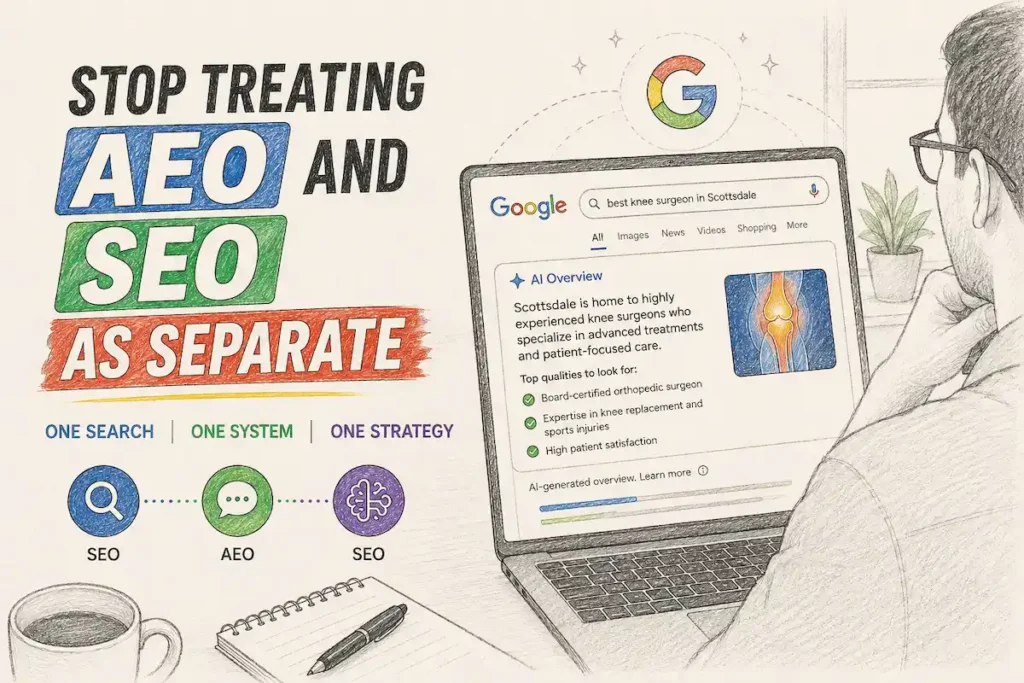


Your patients are not waiting anymore. They open Google, type a question, and get an AI-generated answer in seconds. If your clinic is not inside that answer – or at minimum on page one below it – another doctor gets the call. That is the reality of patient search in 2026, and it is why the role of a dedicated AI SEO expert for doctors in the USA has become one of the most important decisions a medical practice can make.
This article explains exactly what AI SEO for doctors means, what separates it from standard SEO, and how Sarthak Jain and the RankVed team have built a system that positions medical practices across the USA inside both traditional Google results and the AI platforms – ChatGPT, Gemini, Perplexity, and Google AI Overviews – where patients are increasingly making their decisions.
Why Doctors in the USA Cannot Afford to Ignore AI Search in 2026
A few years ago, ranking on page one of Google was the finish line. It is no longer enough. Google’s AI Overviews now occupy the top of the search results page before any organic link appears. ChatGPT processes hundreds of millions of queries per month. Perplexity is being used by a growing segment of patients who want sourced, direct answers instead of a list of links to scroll through.
When a patient in Dallas types “best orthopedic surgeon for knee replacement near me” into ChatGPT, the AI does not show a list of ten blue links. It gives a recommendation – usually two or three practices – backed by reasoning. If your practice has not been set up for AI citation, you will never appear in that response no matter how good your actual outcomes are.
This is the gap most agencies are not equipped to close. They build traffic. They do not build AI visibility. And for healthcare practices in the USA, those are two completely different problems requiring two completely different skill sets.
The Numbers That Should Concern Every US Doctor
- 77% of patients in the USA begin their healthcare journey with an online search before making any appointment decision.
- Google AI Overviews now appear for a significant share of health-related search queries, often above the first organic result.
- Patients who find a provider through AI recommendations convert at a higher rate because the AI has already done the trust-building work for them.
- Medical practices that rank in both traditional search and AI platforms see compounding visibility – each channel reinforces the other.
What Does an AI SEO Expert for Doctors Actually Do Differently?
This is the question most clinic owners ask when they hear the term for the first time. The honest answer is that it requires a fundamentally different understanding of how modern search systems work – not just Google’s ranking algorithm, but how large language models (LLMs) like ChatGPT and Gemini decide which medical providers to surface and recommend.
A standard SEO agency focuses on keywords, backlinks, and technical site performance. Those things still matter. But an AI SEO expert for doctors in the USA works on a layer above that – building the signals, entity relationships, and structured authority that cause AI systems to recognize a practice as trustworthy and cite-worthy.
The 5 Core Differences Between Standard SEO and Healthcare AI SEO
- Entity Building vs. Keyword Targeting – Standard SEO chases search terms. AI SEO builds a complete entity profile for your practice and your doctors across every platform where AI systems gather data: your website, Google Business Profile, medical directories, Google Scholar, ResearchGate, and third-party publications. AI systems cross-reference these sources to verify that a doctor is a real, credentialed expert.
- Answer-Optimized Content vs. Traffic-Optimized Content – AI platforms extract answers from content. If your service pages and blog posts are written to attract clicks rather than directly answer clinical questions, they will be ignored by LLMs. Healthcare AI SEO means structuring every key piece of content as a direct, authoritative answer that an AI can extract and cite with confidence.
- E-E-A-T Architecture vs. Surface-Level Content – Google’s guidelines for YMYL content – which covers every healthcare page on the internet – require demonstrable Experience, Expertise, Authoritativeness, and Trustworthiness. This means named physician authorship, clinical citations from sources like PubMed, “Medically Reviewed By” tags with verifiable credentials, and structured schema markup that communicates medical authority programmatically. Most agencies skip all of this.
- AI Platform Optimization vs. Google-Only Thinking – An AI SEO expert works across ChatGPT, Gemini, Perplexity, Google AI Overviews, and voice assistants simultaneously. Each platform has different data sources and different trust signals. A strategy that only targets Google will leave significant patient acquisition potential on the table.
- Patient Acquisition Tracking vs. Vanity Metrics – The only metrics that matter for a medical practice are actual patient inquiries: phone calls from search, appointment form completions, direction requests on Google Maps, and confirmed booking conversions. Healthcare AI SEO tracks all of these and attributes them to specific channels so you know exactly which search platform is sending patients through your door.
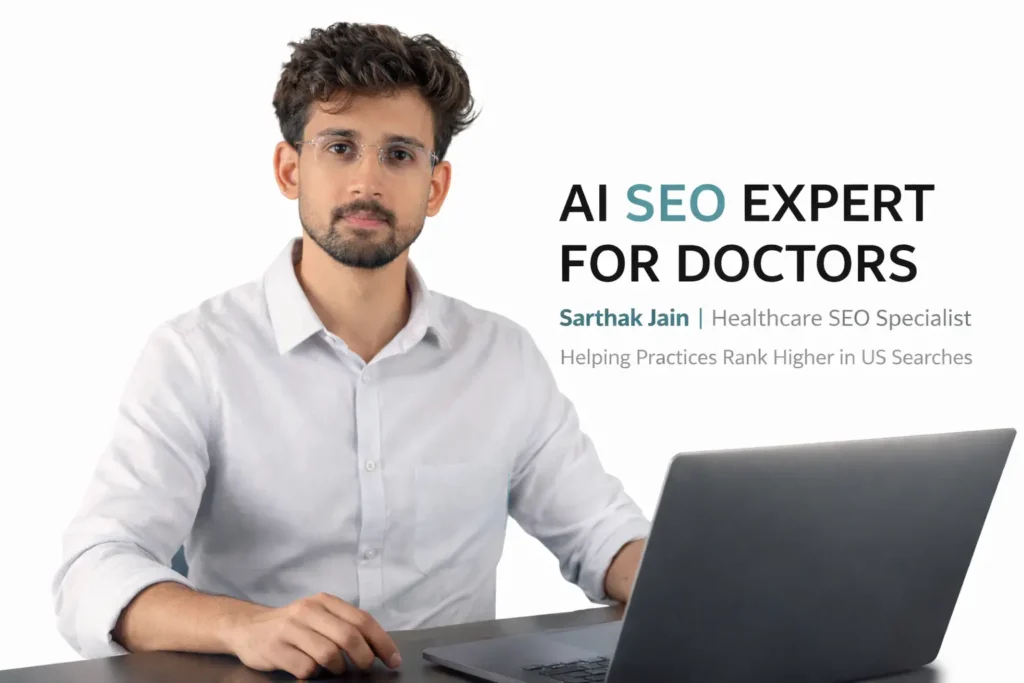
Sarthak Jain – AI SEO Expert for Doctors in the USA
Sarthak Jain is the founder of RankVed and one of the few practitioners in the world who specializes exclusively in healthcare AI SEO. He does not run a generalist digital marketing agency that has added a healthcare department. He built RankVed from the ground up around one specific problem: helping doctors and clinics get found by patients in an era where search is increasingly driven by AI systems, not just keyword matching.
“Modern visibility is not just about Google rankings anymore. Real growth now comes from being recommended by AI systems. Doctors who understand this shift early are the ones who will dominate patient acquisition over the next decade.” – Sarthak Jain, AI SEO Expert and Founder, RankVed
His approach combines deep technical SEO with a proprietary system he calls the 3:3 Framework – a patient discovery architecture built specifically for the healthcare sector. The framework works by controlling a practice’s visibility across the three primary paths patients now use to find doctors: Google Search, Google Maps, and AI platforms. Within each path, it aligns three layers of trust signals – content structure, credibility signals, and platform-specific alignment – so a practice does not just appear in results but gets chosen by patients who see it.
To date, Sarthak has directly strategized for over 110 small and mid-sized clinics and hospitals. He works ground-level with practice owners and hospital directors – not through junior account managers or templated packages – mapping each strategy to the clinic’s specialty, city, competitive landscape, and growth targets.
What Sarthak Has Built for Healthcare Practices
- Indore: Delivered measurable ranking results for Dr. Prince Uchadiya’s clinic within 30 days by publishing medically structured content aligned with both patient search intent and AI content selection signals.
- Panchkula: Improved search and AI visibility for Gulmohar IVF, positioning the clinic to appear when families actively search for trusted fertility treatment options in the region.
- Vapi: Structured Ishacare’s digital presence for AI-based recommendations across search and AI platforms where patients look for care information.
- Agra: Ranked Emotion of Life, an OCD ERP therapy centre, for competitive mental health queries – resulting in a 250% rise in organic traffic and consistent therapy client inquiries through online channels.
The same system – adapted for US market requirements, HIPAA compliance standards, and the specific competitive dynamics of American healthcare search – is what RankVed deploys for medical practices in the USA.
How AI Systems Actually Decide Which Doctors to Recommend
Most doctors assume AI recommendations work like Google rankings – whoever has the best website wins. That is not how it works. LLMs like ChatGPT are trained on vast amounts of data and continue to update their knowledge through indexed web content and retrieval systems. What they look for when deciding which healthcare providers to surface is fundamentally different from what Google’s ranking algorithm weighs.
The 7 Signals AI Uses to Recommend a Doctor or Clinic
- Entity Consistency – Your practice name, doctors’ names, addresses, and specialties must appear identically and consistently across your website, Google Business Profile, medical directories (Healthgrades, WebMD, Doximity, ZocDoc), and any publications or press mentions. Inconsistency confuses LLMs and reduces citation confidence.
- Physician Credentials Visibility – AI systems need to verify that a named doctor is a real, qualified professional. This means medical credentials, board certifications, education history, and areas of specialization must be clearly structured on your website and confirmed across third-party sources like medical boards and academic platforms.
- Topical Authority Depth – A single blog post about back pain does not establish authority. A connected cluster of content covering spinal anatomy, treatment options, surgical versus non-surgical approaches, recovery timelines, and patient FAQs tells AI systems that this practice genuinely understands the subject. Topic clusters drive LLM citation rates.
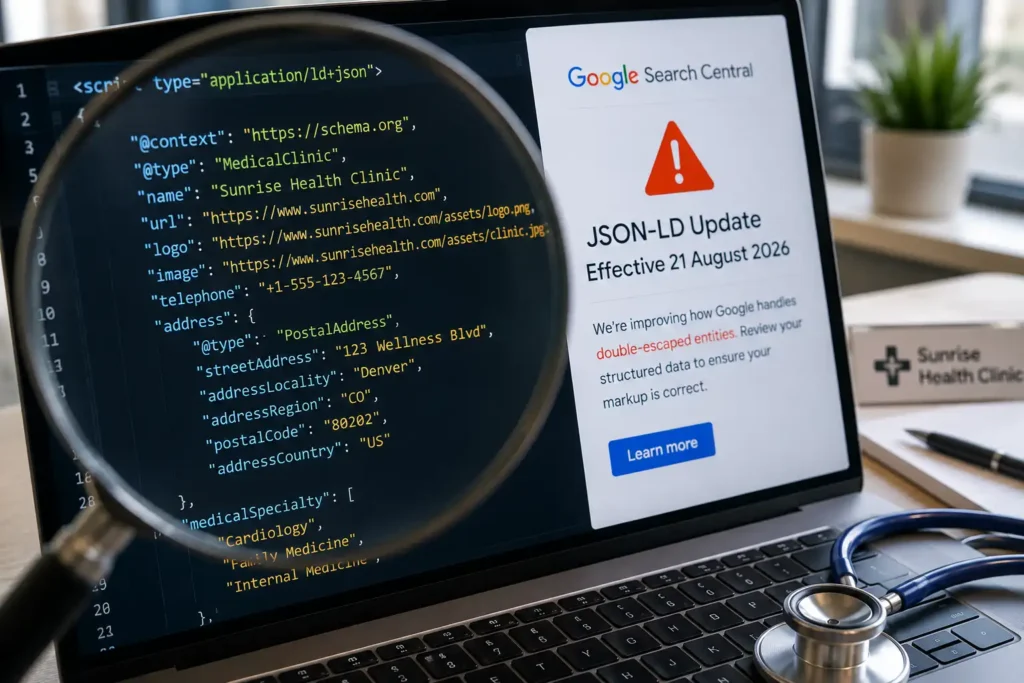
- Structured Data Markup – Medical schema markup – including Physician schema, MedicalOrganization schema, MedicalCondition schema, and MedicalProcedure schema – gives AI systems a machine-readable layer of information about your practice. Without it, AI platforms are guessing at your specialty, credentials, and services based on unstructured text.
- Third-Party Validation – AI systems are trained to treat information confirmed by multiple independent sources as more trustworthy than information that exists only on your own website. This is why earning mentions and backlinks from medical associations, health publications, hospital networks, and local news outlets is so important for AI visibility – not just for Google rankings.
- Review Signal Quality – Reviews are not just a Google Maps factor. Platforms like Healthgrades and ZocDoc feed data into the ecosystems that AI systems draw from. A practice with consistent, detailed, keyword-rich reviews on multiple platforms sends a stronger trust signal than one with 200 generic stars on a single directory.
- Answer-Ready Content Format – AI platforms prefer content that is structured as direct answers, not marketing copy. Using clear H2 and H3 headings that match actual patient questions, providing numbered frameworks, and including specific clinical details – not vague wellness language – increases the probability of AI extraction and citation significantly.
Why Most US Healthcare Agencies Are Not Equipped for This
The healthcare digital marketing industry in the USA is dominated by large generalist agencies that have added “healthcare” to their service list. They hire general content writers, use standard SEO tools, and apply the same keyword and link strategies they use for e-commerce and law firms. For a medical practice operating under YMYL scrutiny, that approach actively damages rankings.
Beyond the Google compliance problem, most agencies simply have not built the systems needed to optimize for AI platforms. They do not understand how LLMs evaluate medical authority. They do not know how to structure entity data for AI extraction. They do not track AI citation rates or measure how often a practice appears in ChatGPT or Gemini responses.
According to Google Search Central’s guidance on helpful content, medical pages must demonstrate first-hand expertise and direct clinical knowledge – not content written by generalist writers who researched the topic for an hour. This standard is enforced through algorithmic quality assessment that most agencies do not know how to satisfy.
What Sets RankVed Apart from Generic Healthcare SEO Agencies
| Factor | Generic Healthcare SEO Agency | RankVed – AI SEO Expert for Doctors |
|---|---|---|
| Content Approach | General writers, keyword targeting | Physician-attributed, E-E-A-T structured content |
| AI Platform Coverage | Google only | Google, ChatGPT, Gemini, Perplexity, AI Overviews |
| Schema Implementation | Basic LocalBusiness schema | Full medical schema: Physician, MedicalCondition, MedicalProcedure, FAQPage |
| Entity Building | Not considered | Structured across website, GBP, directories, Scholar, publications |
| HIPAA Compliance | Rarely addressed | Built into every content, technical, and tracking element |
| ROI Measurement | Traffic and rankings | Actual patient inquiries, calls, bookings, cost per acquisition |
| Specialization | Multi-industry generalist | Healthcare-only, across 25+ medical specialties |
The RankVed AI SEO System for US Medical Practices
RankVed does not sell monthly SEO packages with preset deliverables. Every engagement is built around a specific practice’s specialty, city, competitive landscape, and patient acquisition targets. The system covers seven interconnected pillars that work together – not independently.
Pillar 1 – Medical Keyword and Intent Mapping
The goal is not traffic – it is patients. RankVed researches bottom-of-funnel keywords specific to a practice’s specialty, city, and procedures. Think “best spine surgeon for L4 L5 herniated disc Chicago” rather than “back pain doctor.” Every keyword is mapped to a specific page on the website so the site architecture itself signals topical authority to both Google and AI systems.
What this includes in practice:
- Competitor keyword gap analysis – identifying what nearby practices rank for and building a plan to take those positions
- Symptom and condition keyword mapping for AI Overview targeting
- Procedure-specific long-tail keywords with high booking intent
- Location modifier strategy for multi-city or multi-location practices
Pillar 2 – E-E-A-T Content Architecture
Every clinical page and blog article is built to satisfy Google’s YMYL requirements and LLM citation standards simultaneously. This means named physician authorship with credentials displayed clearly, “Medically Reviewed By” attribution, citations from PubMed and peer-reviewed sources, and a content structure that answers patient questions in the exact format AI systems prefer for extraction.
Content elements that drive AI citation:
- Direct answer blocks at the top of key content sections
- Numbered frameworks for treatment options and processes
- Clinical statistics with sourced references
- Specific, non-vague medical language that signals genuine expertise
- Internal topic clusters that demonstrate comprehensive specialty coverage
Pillar 3 – Technical Healthcare SEO
Technical issues are invisible to practice owners but devastating to rankings. RankVed conducts a forensic audit covering Core Web Vitals scores, mobile performance, crawl errors, duplicate content, broken internal links, ADA accessibility compliance, XML sitemap structure, robots.txt configuration, and HIPAA-compliant form implementation. Every identified issue gets fixed – not documented in a report that sits in a folder.
Pillar 4 – Medical Schema and Structured Data
This is one of the most overlooked elements in healthcare SEO and one of the most important for AI visibility. RankVed implements the full medical schema stack: MedicalOrganization, Physician, MedicalCondition, MedicalProcedure, FAQPage, LocalBusiness with healthcare-specific properties, and BreadcrumbList for site hierarchy. This structured data gives Google and AI platforms a machine-readable map of your practice’s credentials, specialties, services, insurance, and location data.
Pillar 5 – Medical Authority Link Building
Link building in healthcare requires a completely different approach than in any other industry. One backlink from a medical association, a university health department, a hospital network, or a health journalism publication carries more authority than hundreds of links from generic blogs. RankVed earns placements from sources that actually move the needle for YMYL rankings – and that AI systems recognize as legitimate medical authority signals.
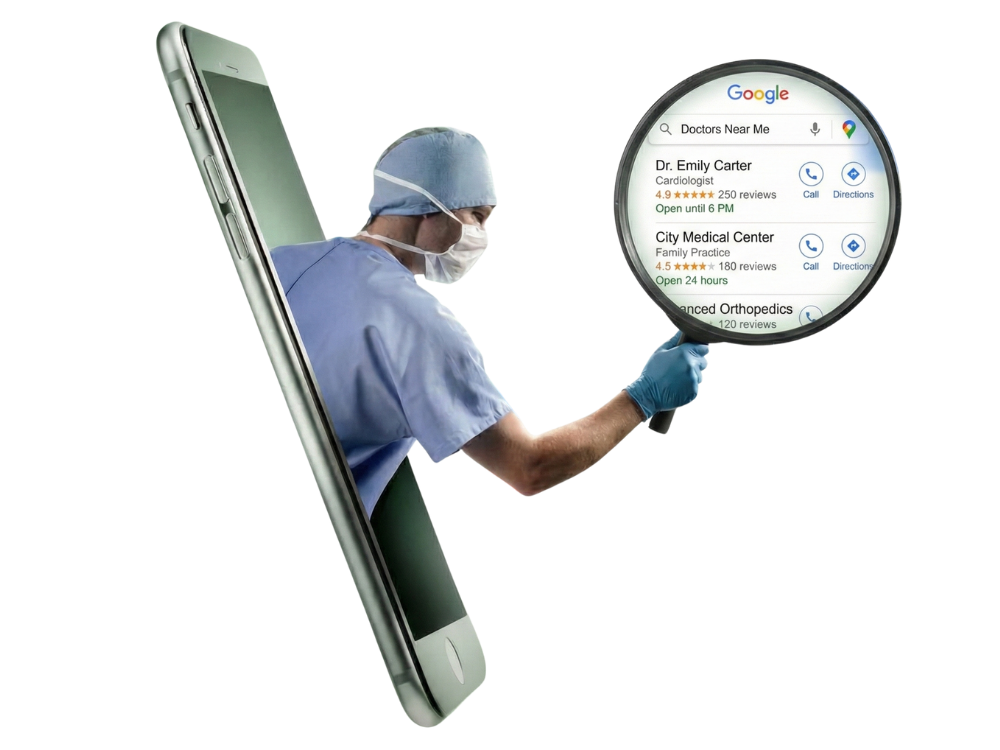
Pillar 6 – Google Business Profile Engineering
A complete GBP is not an optimized GBP. RankVed engineers every element: correct primary and secondary category selection aligned to the exact specialty, strategic service descriptions with patient intent keywords, geotagged facility photos, weekly Google Posts targeting symptom and treatment searches, a pre-populated Q&A section, and a HIPAA-compliant review generation system that produces keyword-rich reviews from actual patients.
Pillar 7 – AI Platform Optimization
This is the layer that most agencies do not offer. RankVed builds and aligns the entity signals, content structure, and external citations that cause ChatGPT, Gemini, Perplexity, and Google AI Overviews to recognize and recommend a practice. This includes optimizing for the specific way each platform retrieves and evaluates medical information – because they do not all work the same way.
AI SEO for Doctors USA: What Results Actually Look Like
Results vary by specialty, city, and competitive landscape. But the pattern across RankVed’s portfolio is consistent: practices that implement the full system see measurable growth in organic patient inquiries, not just rankings or traffic.
Documented outcomes across RankVed’s portfolio:
- A neurology practice reaching the first page for multiple high-value neurology keywords, resulting in a consistent 3x increase in patient inquiries and consistent AI platform visibility in both ChatGPT and Gemini responses
- An IVF and fertility clinic generating a 312% increase in organic traffic and ranking for 47 first-page keywords in their target market within six months
- An orthopedic practice group adding 80% more monthly leads and generating 89 new positive reviews that strengthened local authority
- A multi-location psychology practice reaching number one in the Google Maps Pack for their primary keyword across all three cities within four months, with a 428% increase in new patient inquiries
- An OCD therapy centre ranking first on Google for “OCD treatment in India without medicine” and achieving a 250% rise in organic traffic with consistent online client acquisition
Every one of these outcomes was achieved through the same core system – applied with the specificity each specialty and market required. No generic packages. No vanity metrics. Patient acquisition as the only measure that matters.
Is AI SEO for Doctors Different for the US Market Specifically?
Yes – significantly. The US healthcare search environment has specific characteristics that require a tailored approach compared to other markets.
Three ways the US market requires a different strategy:
- HIPAA Compliance Requirements – Every contact form, tracking pixel, booking system, and analytics implementation on a US medical website must meet HIPAA safeguards. This affects how conversion tracking works, what data can be retained, and which third-party tools can be legally deployed. An AI SEO expert working with US practices must build compliance into the technical strategy from the start – not retroactively.
- Insurance and Network Search Intent – US patients search differently than patients in other markets. “Cardiologist accepting Blue Cross near Houston” is a fundamentally different search than “best cardiologist Houston.” Content and GBP optimization must account for insurance-modified intent, which requires healthcare-specific keyword research that generalist agencies do not perform.
- Competitive Density and Specialty Variance – The competitive landscape for healthcare SEO in New York is completely different from Dallas, which is different from Phoenix. What it takes to rank a dermatologist in Miami is not the same as ranking a spine surgeon in Chicago. A US-focused AI SEO expert for doctors must analyze competitive density at the city-and-specialty level before building any strategy.
According to research published by Search Engine Land, healthcare queries represent one of the highest-volume and fastest-growing categories in local search. The combination of high volume and high YMYL scrutiny makes US healthcare SEO both high-opportunity and high-stakes – which is exactly why it requires a specialist, not a generalist.
How to Evaluate Any AI SEO Expert for Doctors Before You Hire Them
The healthcare SEO space is full of agencies that claim AI expertise but have never implemented a piece of medical schema markup or measured AI citation rates in their lives. Before engaging any consultant or agency, use this framework to separate genuine specialists from generalists with a healthcare page on their website.
5 questions every doctor should ask before hiring an AI SEO expert:
- Can you show me a medical practice you have ranked that is similar to my specialty and city? – Results in orthopaedics do not automatically transfer to oncology. Ask for specific case studies in comparable competitive environments.
- How do you optimize content for AI Overviews and LLM citation specifically? – If the answer is vague or involves only on-page keyword placement, you are talking to a standard SEO agency. A genuine AI SEO expert will discuss entity building, structured data, topical authority architecture, and answer-format content design.
- What medical schema types do you implement and how? – The correct answer involves Physician schema, MedicalOrganization schema, MedicalCondition and MedicalProcedure schema, and FAQPage schema at a minimum. If they mention only LocalBusiness schema, they are not working at the level required for healthcare AI SEO.
- How do you measure patient acquisition from organic search specifically? – Rankings and traffic are intermediate metrics. The final metric is new patients. Ask how they track calls, form submissions, and bookings back to specific search queries and platforms.
- How do you handle HIPAA compliance in your tracking and content strategy? – Any agency that hesitates or gives a vague answer on this question should be disqualified immediately. HIPAA compliance is not optional and compliance gaps create legal exposure for the practice.
How to Get Started with RankVed’s AI SEO System for Your Medical Practice
If you are a doctor, clinic owner, or hospital director in the USA who wants to stop losing patients to competitors who outrank you on Google and appear in AI search recommendations, the starting point is a clear picture of where your practice currently stands.
RankVed offers a proposal that covers your current search visibility gaps, your AI presence across platforms, your Google Business Profile performance, your technical site health, and a custom roadmap for your specialty and market. No obligations. No generic slide deck. A real analysis of your specific situation and what needs to change to generate consistent patient inquiries from search.
Sarthak Jain works directly with practice owners through this process – not through an account manager. The goal of the first conversation is to identify the two or three highest-impact changes that could move the needle fastest for your specific practice, and to determine whether a full engagement makes sense for both sides.
If you want your clinic recommended by ChatGPT, appearing in Google AI Overviews, and ranking on page one of Google for the keywords your patients actually use when they are ready to book – the system that does that exists. Learn more about RankVed’s healthcare SEO services for US medical practices and take the first step toward making your practice the one patients find first.