

Here is a scenario happening right now in your city.
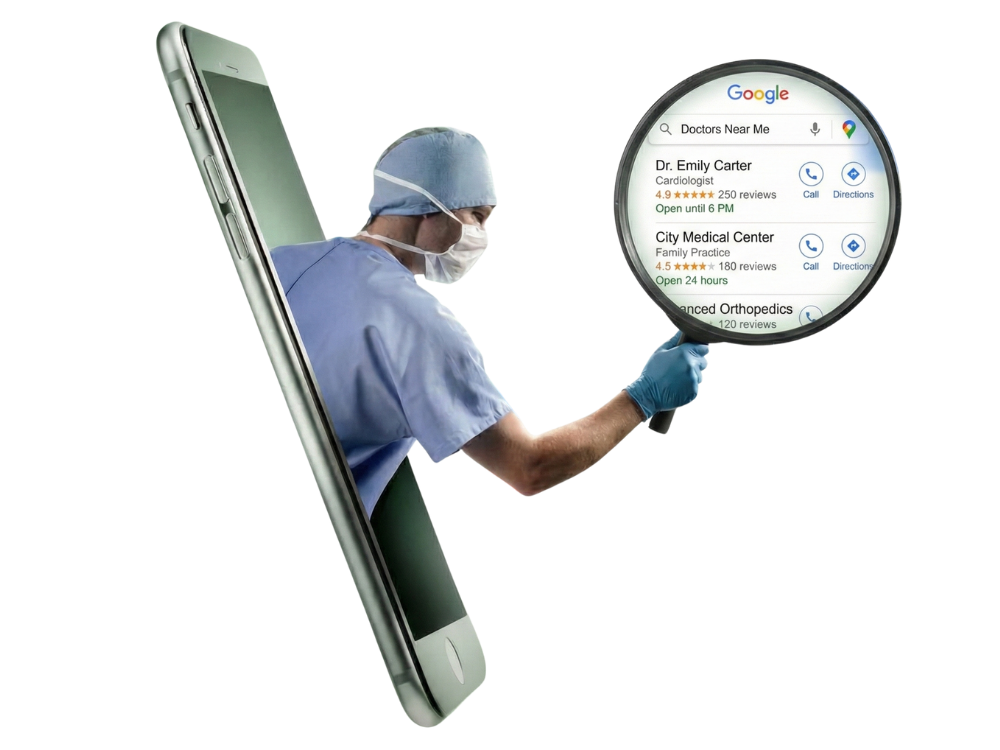
Someone woke up with knee pain this morning. They are not calling a friend. They are not asking their GP for a referral first. They picked up their phone and typed “best orthopedic surgeon near me” into Google.
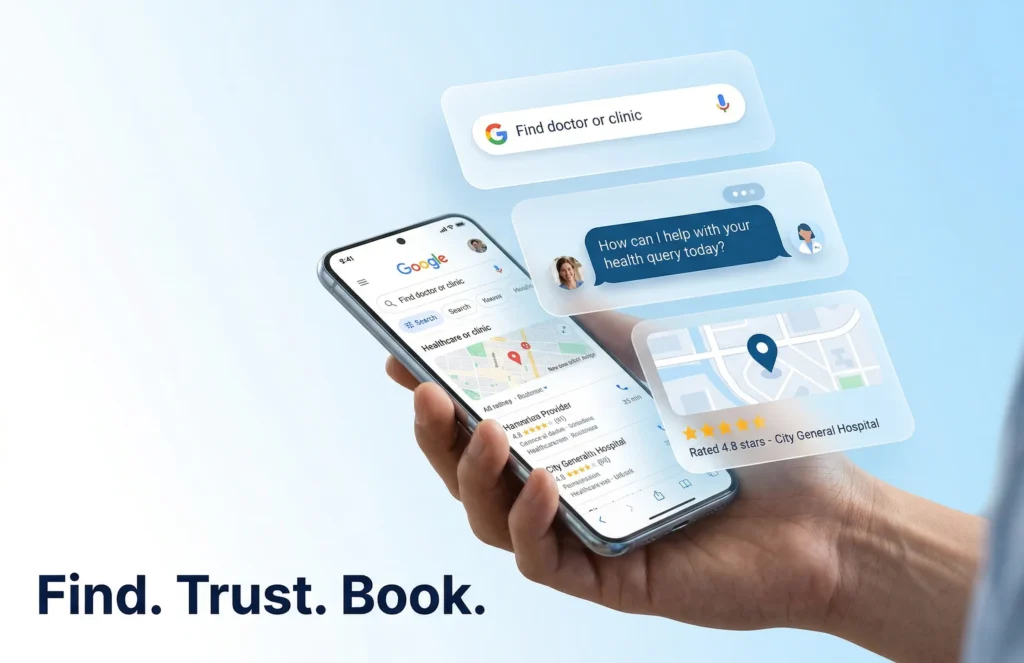
In the next 60 seconds, they saw three doctors in the Map Pack, two clinic websites in organic results, and an AI Overview that named a specialist they had never heard of. They picked one, booked an appointment, and moved on with their day.
That appointment could have been yours. But only if you showed up where they were looking.
This article breaks down exactly how patients discover and choose doctors in 2026 – the channels they use, the signals they trust, and what you need to do to show up on all three platforms that now control patient discovery.
The Patient Journey Has Changed Completely – Here Is the New Reality
Not long ago, patients found doctors through word of mouth. A neighbour recommended someone. A GP referred them. A family member passed on a name.
That era is over.
Today the patient journey starts online, almost every single time. The numbers are not subtle about this.
- 77% of patients use a search engine before booking a doctor appointment
- 73% of patients adopted new research behaviors in the past year alone – including AI chatbots, voice search, and social media
- 84% of patients checked online reviews before booking care
- Patients now view an average of 21 provider profiles before selecting a doctor
Source: rater8 Patient Choice Report 2025 and Zocdoc What Patients Want Report 2025
Think about that last stat. Twenty-one provider profiles before picking one. Patients are doing serious research before they ever call your front desk.
The question is simple: do you show up during that research, or does your competitor?
The 3:3 Framework – Why One Platform Is Never Enough
Most doctors make one of two mistakes.
Mistake one: they focus only on Google rankings and ignore Maps and AI search.
Mistake two: they invest in a great website but have no strategy for the other two channels patients use every day.
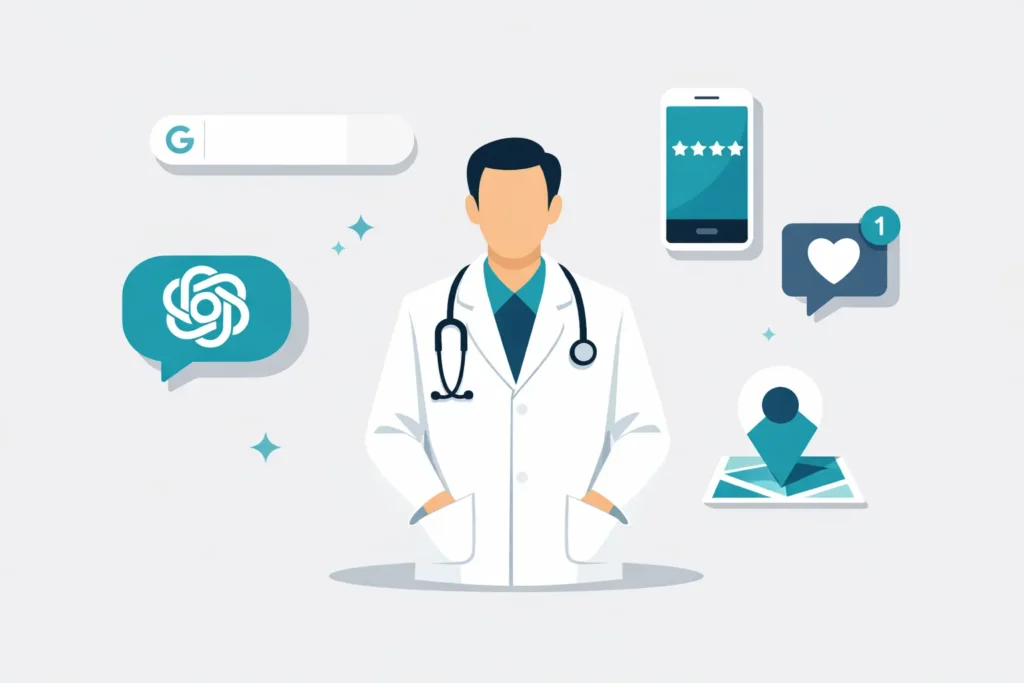
RankVed’s 3:3 Patient Referral Framework addresses this gap directly. The idea is straightforward. Patients now discover and choose doctors across three distinct platforms:
- Google Search Results – organic rankings for treatment and symptom keywords
- AI Search Platforms – ChatGPT, Gemini, Perplexity, and Google AI Overviews
- Google Maps and Local Pack – the three-listing map results for “near me” searches
If you are missing from even one of these three, you are handing patients to another doctor. It really is that simple.
Let’s go deeper on each one – how patients use it, what they look for, and what you need to do to win it.
“Practices that fail to meet patients across multiple channels risk becoming invisible in this next phase of healthcare search.” – rater8 Patient Choice Report
Platform 1: How Patients Use Google Search to Find Doctors
Google Search is still the starting gun of patient discovery. When someone has a health concern, Google is usually their first stop.
They type in things like:
- “best physiotherapist for lower back pain”
- “IVF specialist near me”
- “knee replacement surgeon in [city]”
- “what causes chest pain when breathing”
That last one is important. Patients often start with symptoms, not specialties. They search for answers to their health questions, then they look for someone who can help.
This means your content strategy matters as much as your service pages. Doctors who publish well-written answers to patient questions attract patients earlier in the discovery journey – before the patient has even decided they need a specialist.
What Patients Look for on Google Search Results
Once they are on the results page, patients are scanning fast. They notice:
- The page title – does this clinic treat what I have?
- The meta description – does this sound like a real expert or a corporate template?
- Whether it shows a real doctor’s name and credentials
- Whether the page looks current, not from 2017
Clinics that rank and convert have clear, specific pages for each treatment. Not one generic “Our Services” page. Think “Dr. Anand Mehta – Knee Replacement Specialist in Houston” not “Orthopedic Services.”
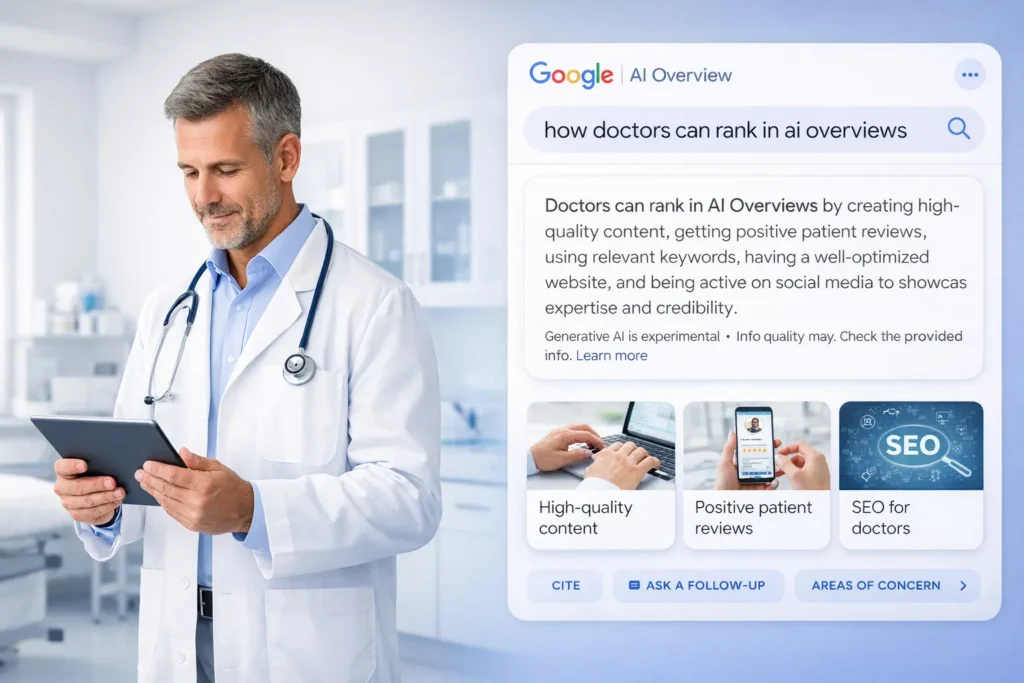
According to BrightEdge research, 89% of healthcare queries now trigger an AI Overview at the top of Google results. That means even if you rank organically, a generated AI answer sits above you and takes the attention.
Which brings us to platform two.
Platform 2: How Patients Now Use AI Search to Choose a Doctor
This is the channel most doctors are completely ignoring. And it is the one growing fastest.
By mid-2025, 26% of patients said AI tools directly influenced their choice of healthcare provider. That puts AI influence on par with primary care referrals. One in four patients is partly choosing their doctor based on what ChatGPT or Gemini told them.
Let that sink in for a second.
Patients are typing questions like these into ChatGPT or Gemini:
- “What should I look for in a good cardiologist?”
- “Which clinic in Dallas is best for diabetes management?”
- “Is Dr. [Name] a good doctor?”
- “What questions should I ask a fertility specialist?”
The AI pulls answers from websites it has been trained on or can access. If your website content is structured clearly, uses credible language, cites sources, and answers these kinds of questions directly – you have a chance of being referenced.
If your website is a brochure with three pages and a contact form, you will not.
What Gets a Doctor Recommended by AI Search Tools
There is no secret algorithm for this. But there are clear signals AI tools look for.
- Author credibility – content written by or attributed to a named, credentialed doctor performs better in AI extraction
- Structured Q&A content – FAQ sections written in direct question-and-answer format are easier for AI to pull and cite
- External citations – pages that link to PubMed studies, WHO guidelines, or government data are seen as more trustworthy by AI systems
- Consistent brand mentions – when your clinic name, doctor name, or specialty appears across multiple credible websites, AI tools build a stronger picture of your authority
- LLM.txt file – a simple but often missed technical file that tells AI crawlers what to index from your website
RankVed covers the technical side of AI search optimisation in detail – including the often-missed llm.txt setup – in the guide to getting ChatGPT to notice your website.
AI search is also where the 3:3 framework connects everything. A clinic that shows up in Google organic results, is mentioned in AI answers, and appears in the Map Pack has a compounding advantage. Each platform reinforces the others.
Platform 3: How Patients Use Google Maps to Select a Doctor
Here is a stat that will make you sit up straight.
The top three Google Maps listings capture approximately 70% of clicks for local medical searches. Not the top ten – the top three.
And roughly 60% of those searches end without anyone visiting a website. Patients make their decision right there on the Maps listing. They see your name, your rating, your photos, your hours. They call or book without ever clicking through to your site.
Google Maps is not a “nice to have.” For local doctors and clinics, it is one of the highest-converting patient acquisition channels that exists.
What Patients Check on Your Google Business Profile
When a patient lands on your Maps listing, they are checking these things in order:
- Star rating – anything below 4.2 and many patients move on without reading further
- Number of reviews – a 4.8 star rating with 12 reviews feels less safe than a 4.5 rating with 340 reviews
- Most recent review date – reviews from two years ago signal that the clinic may have changed or declined
- Photo quality – real clinic photos, real staff, real equipment. Stock images feel dishonest and patients know the difference
- Response to negative reviews – how you handle criticism tells patients more about you than the criticism itself
- Business hours and appointment links – friction kills conversions. If booking is easy, patients book.
The Zocdoc 2025 report found that patients view an average of 21 providers before selecting one. Many of those 21 are being viewed right inside Google Maps, not on individual clinic websites.
The Exact Patient Decision-Making Process – Step by Step
Now let’s put all three platforms together and walk through what a typical patient actually does when choosing a doctor.
This is the patient journey from the moment pain or concern appears to the moment they book:
- Symptom search on Google – “why does my lower back hurt when I sit” – finds articles, starts understanding their condition
- Specialist search on Google – “best physiotherapist for lower back pain near me” – organic results and Map Pack appear
- AI search for validation – asks ChatGPT or Gemini “what should I look for in a good physio?” – AI recommends characteristics or sometimes clinics by name
- Comparison on Maps – checks 4-6 clinic profiles, reads reviews, checks photos and hours
- Website visit (sometimes) – clicks through to shortlisted clinics to check credentials, photos of the doctor, treatment details
- Review reading – more than half of patients read at least six reviews before booking
- Booking decision – books with whoever feels most trustworthy and most convenient
Notice something? The patient passes through all three platforms before making a decision. A clinic that shows up on only one or two of those stages loses out to the one that is present at every step.
What Patients Actually Care About When Choosing a Doctor
Beyond the search platforms, what actually tips the decision?
The Zocdoc 2025 report gave a clear answer. Patients ranked “positive connection” as the single most important factor in choosing a doctor – above ratings, above office location, above everything else.
That tells you something important. Patients are not just looking for the highest-rated doctor. They are looking for someone they feel they can trust before they have even met them. Your digital presence is doing the emotional work of a first impression.
The Top Factors Patients Use to Choose a Doctor
| Factor | Why It Matters | Where It Shows Up |
|---|---|---|
| Positive connection / warmth | #1 driver according to Zocdoc | Doctor bio, photo, video, review language |
| Online reviews and star rating | 84% check reviews before booking | Google Maps, Healthgrades, Zocdoc |
| AI tool recommendation | 26% influenced by AI | ChatGPT, Gemini, Google AI Overviews |
| Insurance acceptance | Top qualifier for insured patients | Website service page, Google profile |
| Appointment availability | 35% booked within 48 hours on Zocdoc | Online booking integration |
| Location / convenience | Strong preference for nearby options | Google Maps distance filter |
| Doctor credentials | Patients check qualifications | Website bio, schema markup |
| Social media presence | 35% chose a doctor based on social | Instagram, Facebook, YouTube |
Source: rater8 Patient Choice Evolution Report
Why Doctors with Identical Qualifications Get Totally Different Patient Numbers
Two orthopedic surgeons in the same city. Same qualifications. Same experience. Same treatment outcomes.
One sees 40 new patients a month. The other sees 8.
The difference is almost always digital visibility – not clinical skill.
The doctor seeing 40 new patients ranks on Google for five relevant treatment keywords. They appear in ChatGPT answers when patients ask about knee surgery. They have 280 Google reviews averaging 4.7 stars. Their Google Business Profile has real photos, accurate hours, and an online booking link.
The doctor seeing 8 new patients has a website from 2019. No reviews in the last six months. No presence in AI search results. Maps listing with a blurry front-door photo taken on a Nokia.
This is not about who is the better surgeon. It is about who is the more visible surgeon.
The Role of Online Reviews in the Doctor Selection Process
Reviews deserve their own section because they are doing more work than most doctors realise.
Patients are not just reading reviews to check quality. They are reading them to check fit. They want to know if this doctor listens. If the staff are friendly. If the wait times are reasonable. If the doctor explains things clearly.
The most common words in 5-star healthcare reviews include: “comfortable,” “safe,” “listens carefully,” “like family,” and “exceptional care.”
None of those words are clinical. They are relational.
When your reviews use that kind of language, patients feel something before they have met you. That emotional signal is what tips the decision.
Meanwhile, 57% of patients say they rarely or never leave reviews. This means practices that actively ask for feedback after appointments build a significant advantage over those that do not.
Three Ways to Get More Patient Reviews Without Feeling Awkward
- Send an automated SMS or email review request 2-4 hours after an appointment – this is when motivation is highest
- Add a simple “Leave us a Google review” QR code at your front desk and on appointment summary printouts
- Train your front desk staff to verbally remind patients who express satisfaction – something as simple as “We’d love it if you left us a quick Google review”
How to Win All Three Platforms – A Practical Checklist for Doctors
You do not need to do everything at once. But you do need a strategy that covers all three platforms.
Here is where to start:
Google Search – What to Fix First
- Create individual service pages for each treatment you offer – not one generic page
- Write a blog article answering the top 5 questions your patients ask most often
- Add your doctor’s name, credentials, and a photo to every page – this signals authorship to Google
- Make sure your website loads in under 3 seconds on mobile – Google penalises slow sites heavily in healthcare rankings
- Add schema markup for MedicalOrganization, Physician, and FAQ – this helps Google understand what your clinic does
AI Search – What to Do Right Now
- Add an FAQ section to your key service pages – write each question exactly as a patient would ask it
- Make sure your content cites credible medical sources like PubMed or official health guidelines
- Create or claim a presence on health directories like Healthgrades, Zocdoc, and WebMD – AI tools pull from these
- Add an llm.txt file to your website root directory – this signals to AI crawlers what is authoritative on your site
- Get your clinic mentioned on other credible websites through PR or medical association listings
Google Maps – What Separates the Top 3 from Everyone Else
- Claim and fully complete your Google Business Profile – every field, not just name and address
- Upload at least 15 high-quality photos – the clinic exterior, reception, treatment rooms, and the doctor
- Build a review generation strategy and aim for a minimum of 50 recent reviews
- Post to your Google Business Profile weekly – clinics that post regularly get higher placement in Maps results
- Respond to every review, positive and negative – Google treats this as an engagement signal
The full technical breakdown of how to rank across all three channels is covered in depth in RankVed’s complete healthcare SEO guide for doctors and clinics.
Why Being Invisible on Even One Platform Costs You Real Patients
Here is the math that puts this in perspective.
If your clinic is in a city of 200,000 people, and 1,000 people search for your specialty every month, and you capture 5% of that search traffic through Google alone – that is 50 potential patients a month.
Now add Maps. If the top 3 Maps results get 70% of local clicks, and you are in that top 3, you pick up another channel of patient discovery running alongside your organic traffic.
Now add AI search. 26% of patients are already letting AI influence their provider choice. That percentage is rising every quarter.
Miss Google – you lose organic discovery.
Miss Maps – you lose local discovery.
Miss AI – you lose the fastest-growing discovery channel in healthcare.
None of these platforms overlap perfectly. Each one catches different patients at different moments in their decision. You need all three.
The Future of How Patients Discover and Choose Doctors
The trajectory is clear and it is accelerating.
According to rater8’s June 2025 data, one-third of patients now trust AI-generated search results as much as traditional Google results. Nearly one in five trust AI more.
Zocdoc’s CEO predicted that by 2026, AI will become the primary tool patients use for pre-care tasks including symptom checks, finding providers, and navigating insurance.
Voice search is also growing. A quarter of patients used voice assistants to find physicians in 2025- mainly for practical information like directions and hours. That percentage will grow as voice search improves.
The practices that prepare now – that build their presence across Google Search, AI platforms, and Maps today – will have a compounding advantage as these behaviors become the norm rather than the trend.
The ones that wait will spend 2027 trying to catch up.
How to Start Getting Found by Patients Across All Three Platforms
The 3:3 framework is not theory. It is a practical growth system for clinics that want to stop relying on referrals and start owning their patient acquisition.
If you are a doctor or clinic owner reading this, the starting point is understanding where you currently stand. Do you rank on Google for your key treatments? Does your clinic appear in ChatGPT answers? Are you in the top 3 on Google Maps?
Most clinics have gaps in at least two of the three. That gap is where patients are going to competitors right now.
The good news is that each platform is fixable. And fixing all three at once – with a coordinated strategy – is exactly what produces the kind of patient growth numbers that make referring doctors stop and ask “how are you doing that?”
Whether you want to improve how patients discover and choose doctors for your practice, or you are starting from scratch, the key is a strategy built for all three platforms – not just the one your web developer thought to set up in 2018.
Explore RankVed’s full range of healthcare SEO services for doctors and clinics and find out what a 3-platform patient acquisition system looks like for your specialty and city.