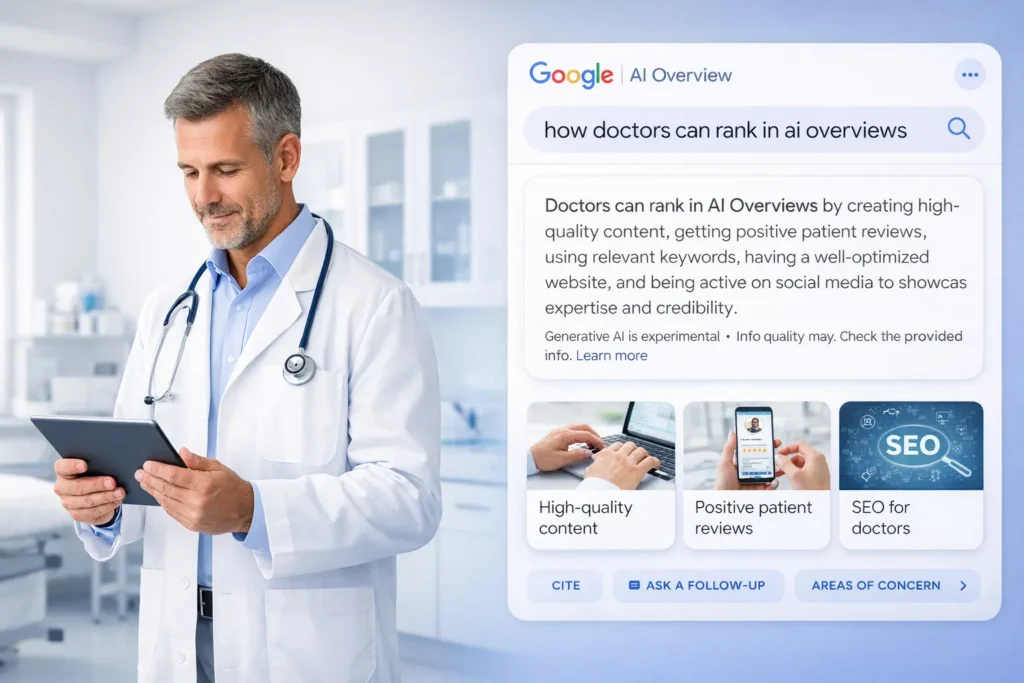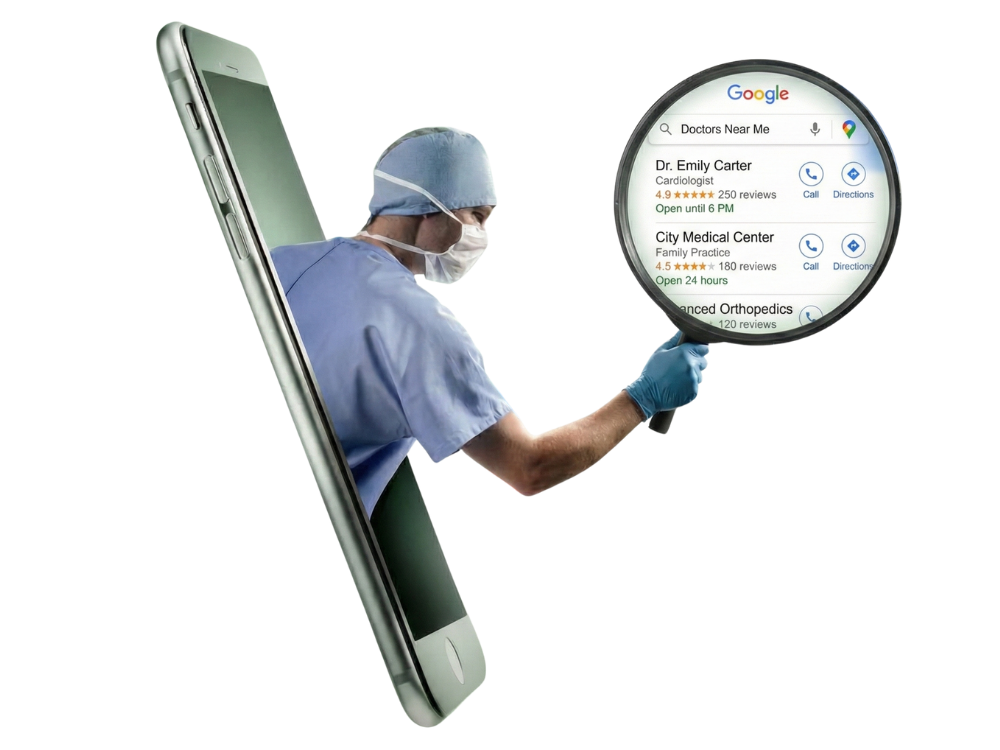


A 45 year old father wakes up at 2 AM with sharp chest pain. His first instinct is not to call a doctor. He grabs his phone and types “causes of chest pain” into Google.
In that moment, Google has to make a decision that could affect this man’s life. Should it show him a random blog post written by someone with zero medical training? Or should it surface accurate, clinically reviewed content from a board certified cardiologist?
Google’s answer to this question has a name. It is called YMYL. And if you are a doctor, clinic owner, or hospital administrator wondering why your website is not ranking, understanding YMYL in healthcare SEO is the single most important thing you can do in 2026.
This is not another surface level explainer. We are going to get into the real details. What changed after Google’s December 2025 update. Why AI search platforms like ChatGPT and Perplexity now apply YMYL rules too. And the exact playbook your practice needs to follow.
Let us get into it.
What Exactly Is YMYL and Why Should Healthcare Providers Care?
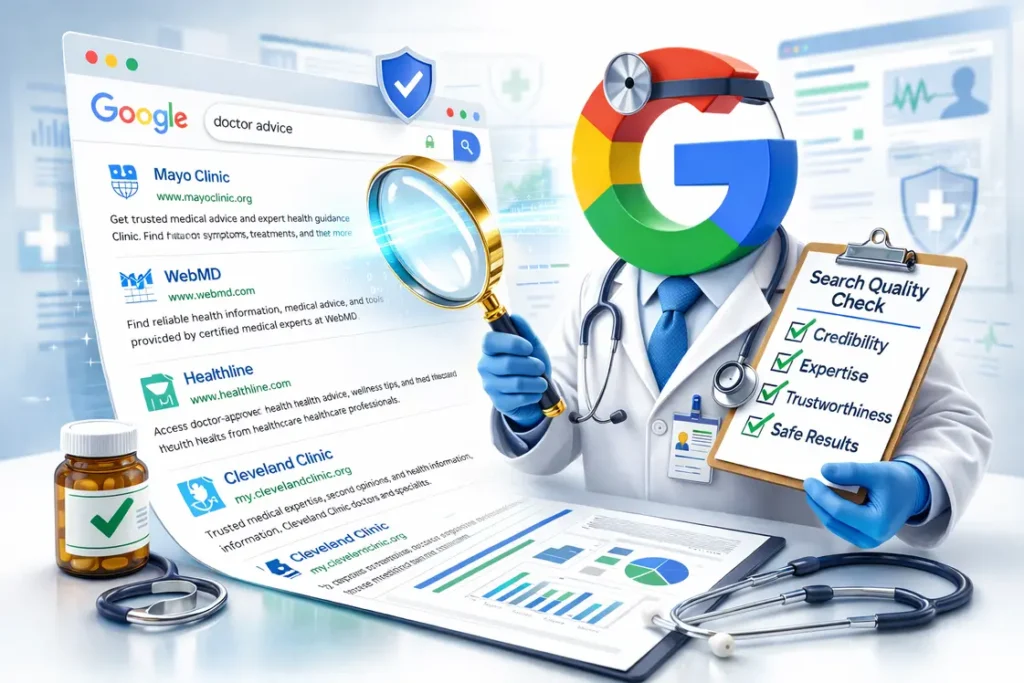
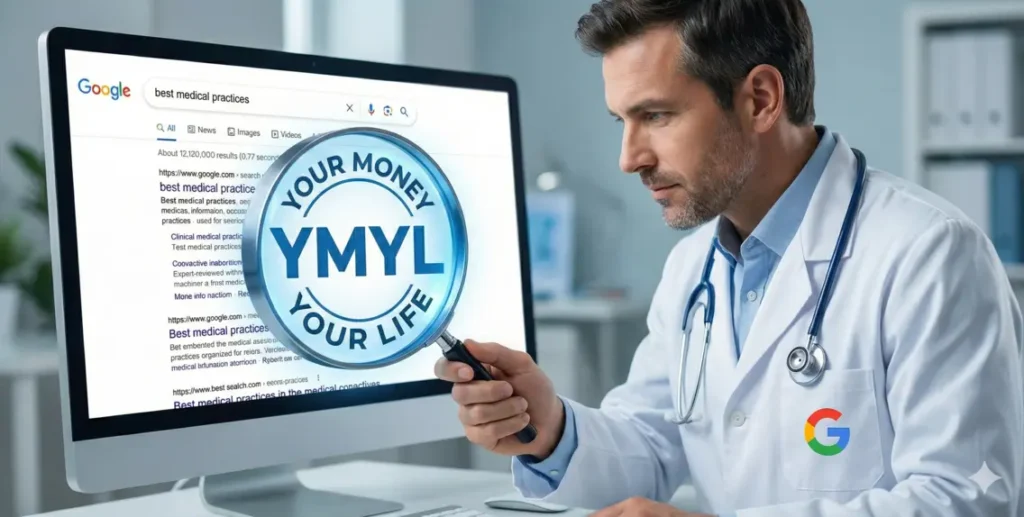
YMYL stands for “Your Money or Your Life.” Google created this term back in 2013 inside its Search Quality Rater Guidelines to flag content that could significantly impact someone’s health, finances, safety, or overall well being.
Healthcare is right at the center of YMYL. Think about it. When a patient searches for drug interactions, cancer treatment options, or mental health crisis support, bad information does not just waste their time. It can lead to delayed treatment, dangerous self medication, or real physical harm.
This is why Google holds medical content to a much higher standard than, say, a blog post about the best hiking trails or smartphone reviews.
“For pages about clear YMYL topics, we have very high Page Quality rating standards because low quality pages on such topics could potentially negatively impact a person’s health, financial stability, or safety.” — Google Search Quality Rater Guidelines, September 2025
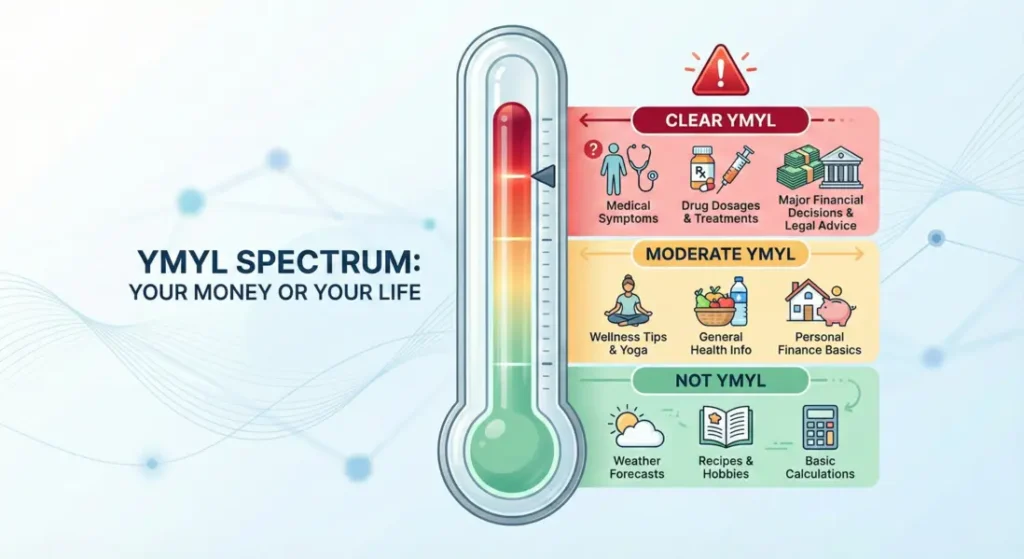
Here is the part most healthcare marketers miss. Google does not treat YMYL as a simple yes or no label. It evaluates YMYL on a spectrum. And this changes everything about how you should plan your content.
The YMYL Spectrum: Not All Medical Content Faces the Same Scrutiny
| YMYL Level | Healthcare Content Examples | What Google Expects |
|---|---|---|
| Clear YMYL (Highest Scrutiny) | Heart attack symptoms, chemotherapy protocols, drug dosages, emergency procedures, suicide prevention | Only the most authoritative medical sources rank. Expert authorship is mandatory. |
| High YMYL | Treatment comparisons, surgical procedure guides, chronic disease management, medication side effects | Strong E-E-A-T signals required. Physician review needed. |
| Moderate YMYL | General wellness advice, basic nutrition, exercise tips, preventive care | Expertise valued but everyday experience also counts. |
| Low YMYL | Hospital parking info, visiting hours, clinic location details | Standard quality expectations. Basic accuracy is enough. |
Why this matters for your practice: You do not need the authority of Mayo Clinic to rank for every single healthcare keyword. By understanding where your content sits on this spectrum, you can target keywords that match your current authority level and build up from there.
How Google Evaluates YMYL Healthcare Content: The E-E-A-T Framework
So Google has flagged your content as YMYL. Now what? How does it decide whether your page deserves to rank?
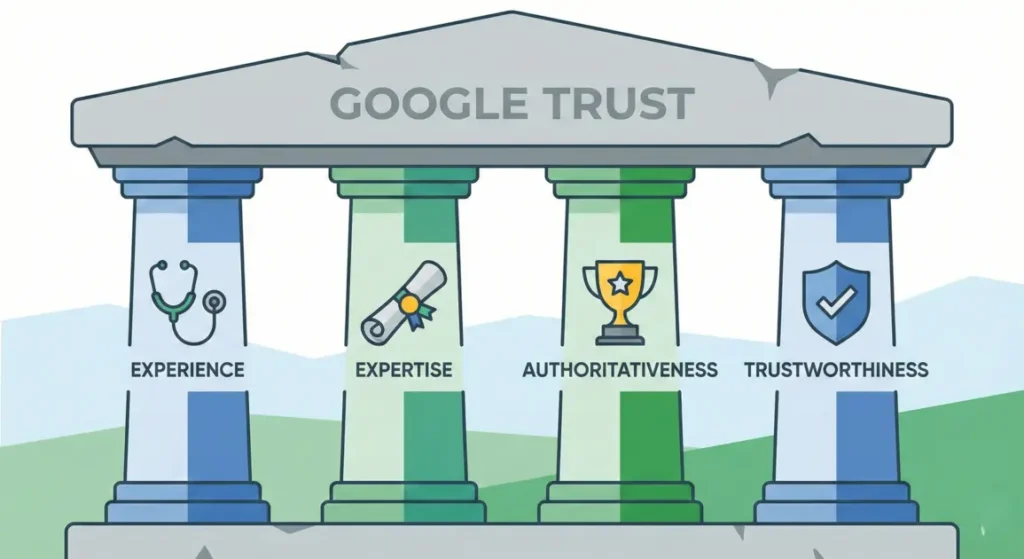
The answer is E-E-A-T. It stands for Experience, Expertise, Authoritativeness, and Trustworthiness. Think of it this way. YMYL is the classification (“this page could affect someone’s health”). E-E-A-T is the exam (“does this page meet the quality standards for that level of impact?”).
Google’s documentation on E-E-A-T makes it clear that these signals matter most for YMYL topics like healthcare.
Let us break down each component and what it means specifically for medical websites.
1. Experience: Show That Your Doctors Treat Real Patients
Google added “Experience” to its framework in December 2022, and it has become increasingly important for healthcare content. Google wants proof that the person behind the content has genuine, firsthand involvement in patient care.
How to demonstrate experience on your healthcare website:
- Write clinical content in the first person from the physician’s perspective. Instead of “Patients with knee osteoarthritis may benefit from physical therapy,” write something like “In my 15 years treating knee osteoarthritis, physical therapy has consistently produced the best long term outcomes when started within the first three months.”
- Include anonymized case studies that show real clinical decision making.
- Share practical observations that only come from hands on patient care. Things like common patient questions, realistic recovery timelines, and what to actually expect after a procedure.
- Feature video content where your doctors explain procedures or answer patient concerns directly.
2. Expertise: Make Your Credentials Impossible to Miss
For healthcare YMYL content, expertise means verified medical qualifications. There is no way around this.
Every clinical article on your website should display:
- The author’s full name, medical degree, and board certification
- Their specialty and years of practice
- Institutional affiliations (hospital, university, research groups)
- Professional association memberships (AMA, AHA, or specialty specific organizations)
- A dedicated author bio page with a detailed CV
- A visible “Medically Reviewed By” tag linking to the reviewer’s full credentials
“Google strongly urges healthcare businesses to have doctors and physicians write medical content if at all possible.” — John Mueller, Google Search Advocate
3. Authoritativeness: What Others Say About You Matters More Than What You Say About Yourself
Authority is not built on your own website alone. Google looks at external signals to determine whether the medical community and the broader internet recognize you as a credible source.
Strategies that build genuine healthcare authority:
- Create topic clusters, not random blog posts. Cover your core specialties through interconnected, in depth content. A cardiology practice could build a comprehensive hub around “Heart Health” linking to articles on specific conditions, treatments, prevention, and patient guides.
- Earn backlinks from medical institutions. Links from universities, hospitals, professional associations, and peer reviewed journals carry massive weight for YMYL content. One link from a medical school website is worth more than 100 links from generic directories.
- Get your physicians published. Expert commentary in health publications, conference presentations, and media interviews all build authority signals that Google tracks.
- Build entity recognition. Getting your practice and physicians into Google’s Knowledge Graph through consistent data, proper schema markup, and mentions across trusted platforms strengthens your presence in AI powered search.
4. Trustworthiness: The One Signal Google Says Matters Most
Google has explicitly confirmed that trust is the most important component of E-E-A-T. A page can show experience, expertise, and authority, but if Google does not trust it, nothing else matters.
Non negotiable trust signals for healthcare websites:
- HTTPS security on every page (this is mandatory, not optional)
- HIPAA compliance statements visible on relevant pages
- Medical disclaimers on all clinical content
- “Last Updated” dates on every article with real, substantive updates
- Direct citations to primary sources like PubMed studies, WHO guidelines, and CDC data
- Transparent contact information including a real physical address and phone number
- A detailed “About Us” page with practice history, licenses, and accreditations
- Real photos of your team and facility, not stock images
- Verified patient reviews displayed with proper schema markup
- A clear, accessible privacy policy
Why YMYL in Healthcare SEO Matters More in 2026 Than Ever Before
If you have been doing healthcare SEO for a while, you might think YMYL is old news. It has been around since 2013, right? Here is why 2026 is fundamentally different.
Three major shifts have converged to make YMYL compliance the defining factor in healthcare digital visibility.
Shift 1: The December 2025 Core Update Hit Healthcare the Hardest
Google’s December 2025 Core Update was the biggest algorithm shake up of the year. SEO tracking tools recorded ranking volatility of 8.7 out of 10, the highest score of 2025. And healthcare was right in the crosshairs. Roughly 67% of health related websites experienced significant ranking changes.
The update specifically cracked down on:
- AI generated content published without expert medical oversight
- Generic “SEO content” written for keywords instead of patients
- Thin articles that offered no original clinical insights
- Websites with weak or missing E-E-A-T signals
The recovery timeline for healthcare sites? Six to twelve months. That is significantly longer than other industries. If your site got hit, there are no quick fixes.
Shift 2: AI Overviews Are Eating Healthcare Traffic Alive
This is the shift that most healthcare marketers are still not talking about seriously enough.
Google AI Overviews now appear on roughly 89% of healthcare related queries, according to BrightEdge research data from late 2025. And when an AI Overview shows up, organic click through rates drop by an estimated 61%.
Let us put that in real numbers:
| Metric | Before AI Overviews | After AI Overviews |
|---|---|---|
| Monthly visits from treatment keywords | 10,000 | 3,000 to 4,000 |
| Click through rate on clinical queries | ~8% average | ~3% average |
| Percentage of health queries triggering AI Overviews | 0% | 89% |
Major health publishers like Healthline, Medical News Today, and WebMD all saw steep visibility drops after the December 2025 update. These are sites that dominated healthcare search for years.
“Really wild to see authoritative health publishers who have dominated in SEO for many years get hit so hard by this last core update.” — Lily Ray, SEO Strategist, January 2026
Shift 3: YMYL Is No Longer Just a Google Thing
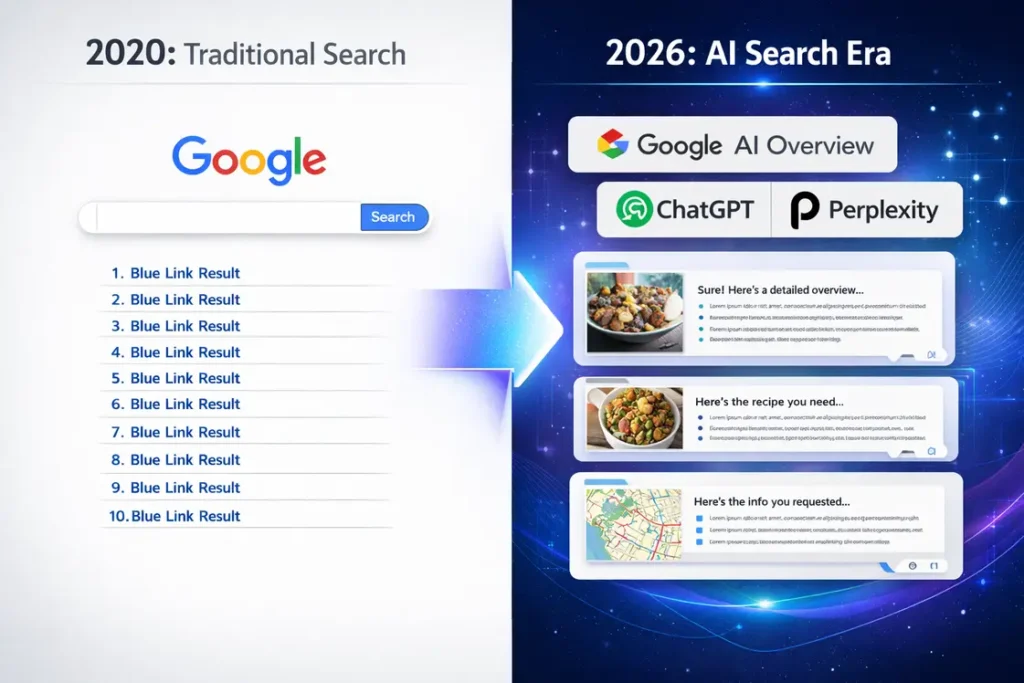
Here is something none of the other guides out there are covering properly. YMYL has expanded beyond Google. Every major AI platform now applies its own version of YMYL evaluation to healthcare content.
- ChatGPT processes all healthcare queries through its Constitutional AI safety framework before generating responses.
- Perplexity cites an average of 21 or more sources per medical answer, heavily favoring clinically authoritative content.
- Google AI Overviews use E-E-A-T signals to decide which sources get featured in AI generated health summaries.
The bottom line is clear. Your healthcare content now needs to pass YMYL quality standards not just for Google, but for an entire ecosystem of AI powered platforms.
A Practical YMYL Content Strategy for Healthcare Websites
Theory is great. But what do you actually do with all of this? Here is a step by step strategy that works for medical practices of any size.
Step 1: Identify Your YMYL Range Through Keyword Research
Before you write a single word of content, you need to understand where your practice sits on the YMYL spectrum for your target keywords.
Here is how to do it:
- Search for your target keywords on Google.
- Look at who is ranking on page one. Are they government health agencies (CDC, NIH, WHO)? Major medical institutions (Mayo Clinic, Cleveland Clinic)? Or are there smaller practices and clinics ranking too?
- If the top results are dominated by sites with Domain Authority above 75, you are looking at a high YMYL keyword. Start with less competitive terms and build authority over time.
- Use tools like Ahrefs or SEMrush to find keywords where sites with a similar authority level to yours are already ranking.
Step 2: Build Your E-E-A-T Foundation Before Publishing
Do not start publishing content until these elements are in place on your website:
- Detailed physician profile pages with credentials, photos, and external links to medical board profiles, Doximity, and LinkedIn
- An “About Us” page with your practice’s history, accreditations, and licenses
- HIPAA compliance and privacy policy pages
- Medical disclaimer template ready to add to every clinical article
- A documented editorial process where a licensed physician reviews every piece of clinical content before it goes live
Step 3: Create Content That Matches Your Authority Level
This is where most healthcare websites go wrong. They see a high volume keyword like “diabetes symptoms” and go after it immediately, even though they have zero topical authority and are competing against WebMD and the CDC.
A smarter approach:
- Start with long tail, lower competition keywords that match your specialty. For example, instead of “diabetes symptoms,” try “how to manage type 2 diabetes with diet changes” or “best exercises for diabetic patients over 50.”
- Build topic clusters around your core specialties. Create a comprehensive pillar page on a broad topic and link it to 10 to 15 supporting articles that cover specific subtopics.
- As you build authority and earn backlinks, gradually move toward more competitive, higher YMYL keywords.
- Always target keywords where your physicians can speak from genuine clinical experience.
Step 4: Structure Every Article for Both Patients and Search Engines
Here is a content template that works for healthcare YMYL content:
- Start with the patient’s concern. Open with the question or worry that brought them to Google.
- Provide a direct answer early. Do not bury the lead. Answer their question in the first few paragraphs.
- Go deep with expert detail. Cover the topic thoroughly with clinical accuracy.
- Cite your sources. Link to PubMed studies, clinical guidelines, and authoritative medical organizations.
- Include a clear medical disclaimer. Remind readers to consult their healthcare provider.
- Display author credentials prominently. Show the physician’s name, qualifications, and photo.
- Add structured data markup. Use MedicalWebPage, Article, and FAQPage schema where appropriate.
- End with a call to action. Guide patients toward booking an appointment or contacting your practice.
YMYL Content Strategy by Healthcare Specialty
Different medical specialties face different YMYL challenges. Here is how to tailor your approach.
Primary Care and Family Medicine
Your YMYL range is broad, spanning from low (general wellness tips) to high (symptom evaluation, medication guidance). Use this to your advantage. Build wide topical coverage across many health categories. Focus on preventive care content and patient education. Target “what to do when” and “when to see a doctor for” type queries.
Surgical Specialties (Orthopedics, Cardiothoracic, Neurosurgery)
Your content falls mostly in the high to clear YMYL range. Procedure explanations and outcome data get maximum scrutiny. Invest heavily in surgeon authored content with detailed case studies. Showcase your surgical volume and outcomes. Build content around the full patient journey from pre surgical evaluation through recovery.
Mental Health and Behavioral Health
This is one of the highest scrutiny YMYL categories. Google is extremely careful with mental health content because of the potential for harm. Always include crisis resources like the 988 Suicide and Crisis Lifeline. Ensure a licensed mental health professional reviews every piece of content. Never create content that could be interpreted as self diagnosis.
Oncology and Cancer Centers
Cancer content sits at the absolute peak of the YMYL spectrum. Every treatment discussion should reference current NCCN guidelines and clinical trial data. Author attribution from board certified oncologists is essential. Content must address both clinical and emotional dimensions.
The Healthcare YMYL Compliance Checklist
Use this to audit your website today.
Content Quality
- [ ] Every clinical article is authored or reviewed by a licensed healthcare professional
- [ ] Medical claims cite primary sources (PubMed, clinical guidelines, WHO, CDC)
- [ ] Content is updated regularly with documented revision dates
- [ ] Medical disclaimers appear on all clinical content pages
- [ ] Content answers real patient questions, not just keyword targets
- [ ] No content encourages self diagnosis over professional consultation
E-E-A-T Signals
- [ ] Detailed author pages exist for every physician contributor
- [ ] Credentials include degrees, board certifications, and affiliations
- [ ] “Medically Reviewed By” tags appear on clinical content with linked profiles
- [ ] Author pages link to external validation (Doximity, PubMed, LinkedIn)
- [ ] Patient reviews and testimonials use proper schema markup
- [ ] “About Us” page includes practice history, licenses, and accreditations
Technical SEO
- [ ] MedicalOrganization and Physician schema markup implemented
- [ ] HTTPS active with current SSL certificate
- [ ] Core Web Vitals passing on mobile and desktop
- [ ] HIPAA compliance statement visible
- [ ] Privacy policy current and accessible
- [ ] NAP (Name, Address, Phone) consistent across all platforms
- [ ] Mobile responsive with easy appointment booking
AI Search Readiness
- [ ] Content structured for featured snippet and AI Overview extraction
- [ ] FAQ sections use FAQPage schema markup
- [ ] Physician profiles include structured data for AI verification
- [ ] Content includes concise, direct answers to common patient questions
- [ ] Practice appears in AI generated responses for target keywords
Common YMYL Mistakes That Kill Healthcare Rankings
After working exclusively with healthcare clients, these are the errors we see again and again.
1. Publishing medical content without any physician attribution. Blog posts written by marketing teams with no doctor review will not rank for YMYL queries. Full stop. Every clinical article needs a named, credentialed medical professional attached to it.
2. Letting content go stale. Medical information changes constantly. An article about diabetes management from 2021 with no updates tells Google your site might contain outdated, potentially harmful information. Update clinical content at least once a year and display the revision date clearly.
3. Writing for Google instead of patients. Content that reads like a keyword stuffing exercise will be penalized under YMYL standards. Write for the worried parent searching at midnight, not for a search engine crawler.
4. Ignoring trust signals. Many practices invest in physician authored content but forget the basics. Missing privacy policies, no medical disclaimers, outdated copyright dates, or broken contact forms all destroy trust in Google’s eyes.
5. Treating all healthcare content the same. A blog about healthy smoothie recipes and a page about chemotherapy side effects need very different levels of E-E-A-T investment. Match your clinical review, citations, and expert attribution to the YMYL level of each piece.
YMYL in Healthcare SEO and the AI Search Era: What to Do Right Now
The rise of AI search has changed what YMYL compliance actually means in practice. Here is what healthcare providers should focus on immediately.
Optimize for AI citations, not just rankings. Being cited as a source in an AI generated answer is now as valuable as ranking on page one. To earn AI citations, your content needs clear and concise answers to specific medical questions, expert attribution with verifiable credentials, cited clinical evidence with direct links, and structured data that machines can read and verify.
Build clinical authority infrastructure. AI platforms do not just look at individual pages. They evaluate your entire digital entity. This means your physicians’ credentials need to be verifiable across your website, PubMed, LinkedIn, Doximity, and medical board registries. Everything connected, everything consistent.
Protect your traffic from AI Overview erosion. Focus more on local patient intent keywords because these are largely shielded from AI Overviews. Create content that needs nuance and personalization that AI cannot replicate. Build brand recognition so patients search for you by name. Invest in Generative Engine Optimization to get your content cited in AI summaries.
Monitor your AI visibility. Start tracking whether your practice appears in AI generated responses across Google AI Overviews, ChatGPT, Perplexity, and Gemini. This should be part of your monthly SEO reporting alongside traditional rank tracking.
The Bottom Line: YMYL in Healthcare SEO Is Your Biggest Competitive Advantage
Here is the perspective shift that separates healthcare practices thriving online from those struggling to get any visibility.
YMYL standards are not obstacles standing in your way. They are your moat.
Random bloggers, affiliate websites, and AI content farms cannot replicate the genuine medical expertise, clinical experience, institutional credentials, and patient trust that your practice naturally has. Every time Google raises the bar for healthcare content quality, it is actually clearing the field for legitimate medical practices to win.
The practices that invest in YMYL compliant content today, built on real clinical expertise, transparent trust signals, and proper technical implementation, will own the healthcare search landscape for years. Not just on Google. Across every AI platform patients use to find care.
Your patients are already searching online. The only question is whether they will find you or someone far less qualified.
Want a YMYL compliant healthcare SEO strategy built specifically for your practice? RankVed is India’s first healthcare focused AI SEO agency. We work exclusively with doctors, clinics, and hospitals across India, UAE, and the United States. Contact us for a free healthcare SEO audit.