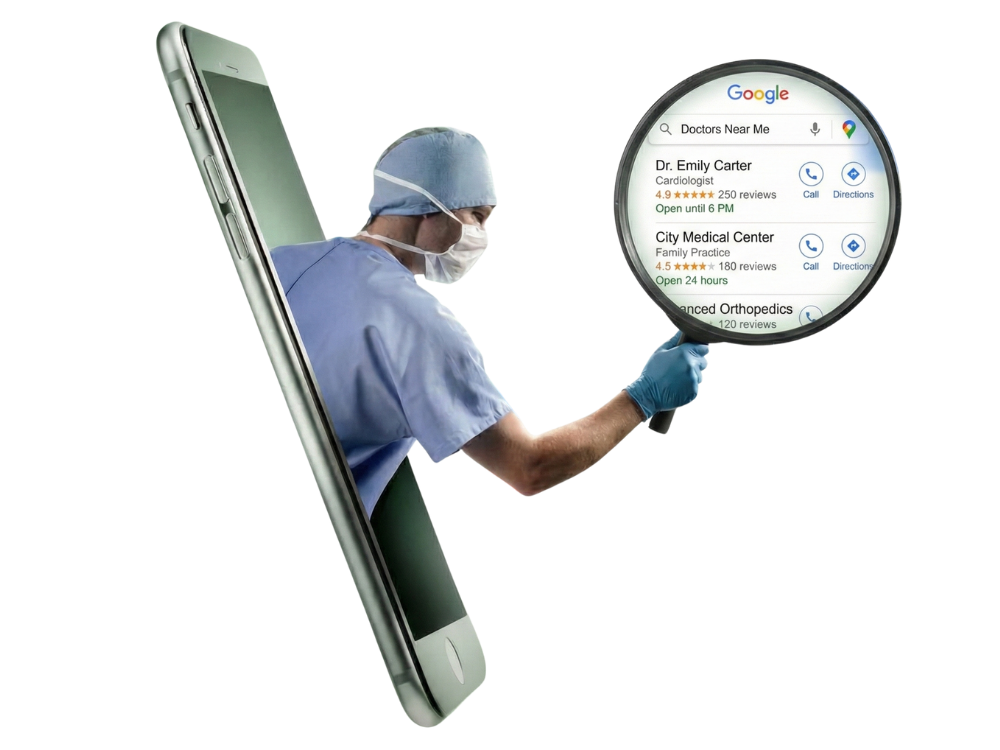



Still, most doctors treat digital marketing as a side activity or a “nice-to-have” add-on instead of a core growth engine. But the ground reality has changed. From 2025 onward, we have seen a drastic shift in how patients discover and choose doctors. The flow of patients entering clinics and hospitals has completely transformed in the last two years, and the reasons are clear:
1.Word-of-Mouth Has Reduced in Impact:
People are busier, social circles are smaller, and most interactions have shifted to mobile screens. Traditional referrals happen, but digital verification decides the final choice.
2.The rise of ChatGPT & Gemini:
Patients are now asking AI directly “Who is the best doctor for this condition near me?” If you are not visible online, AI cannot recommend you.
3.The Gen-Z and Mobile-First Generation:
Younger patients don’t know the specialist 100 meters from their home. They only know who appears on Google when they search.
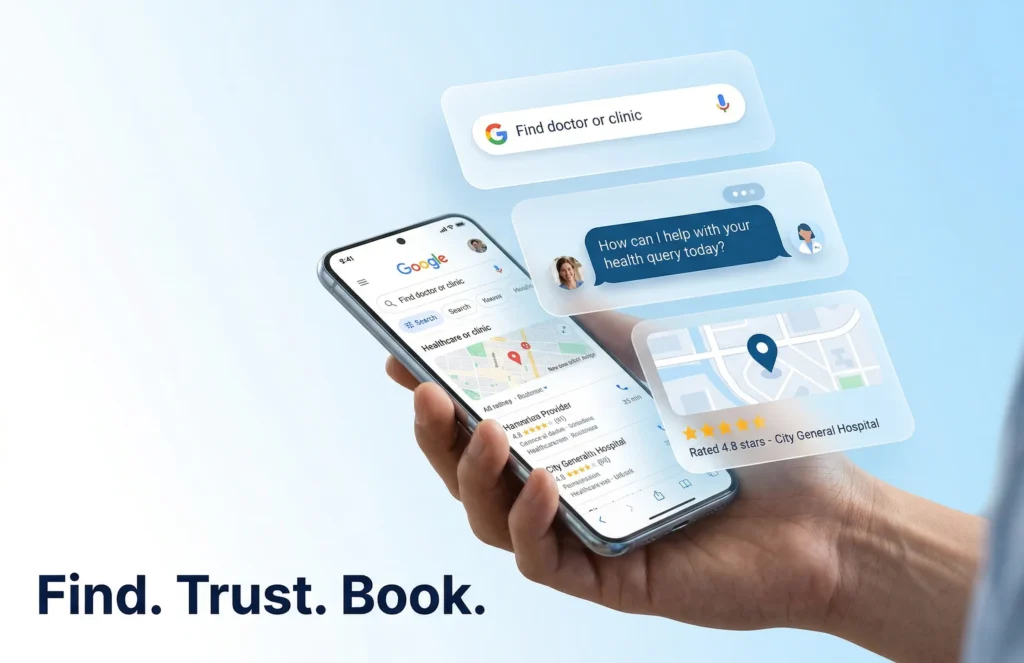
4.Reviews Have Become the First Filter:
Before calling, patients check your Google Business Profile for reviews, photos, timings, credibility, and recent activity. This single profile is now your first impression.
Patients decide before they visit. Your online identity decides for you.
5.And before we go further, take a moment to breathe.
You are not late. You are not behind. You are exactly at the point where the healthcare industry is shifting and this guide is built to help you step into that shift with clarity.
From here onward, you will see the reality of what is changing, what is at risk, and what actually works. Every strategy shared below is based on practical execution, the kind that has been tested across 110+ clinics and hospitals in the last two years. No exaggerated promises. No dramatic claims. Just a clear path that has already worked on the ground.
A small but important note:
Commit to this framework for one consistent year. Do not stop midway, do not reset every 2 months, and do not dismantle things when results begin. If you stay with the process, then 12 months from now, the situation reverses, not where you search for patients, but where patients search for you.
This is not a checklist.
This is the order in which digital growth stabilizes for a clinic or hospital.
Every clinic we have scaled, whether it was a single-room OPD or a multi-specialty setup, followed this sequence. When doctors break the sequence, the system fails. When they follow it for 12 months, results arrive. Now let’s begin sure shot steps to win the healthcare marketing industry:
Step 1- NAP Consistency : The Foundation Most Clinics Don’t Even Know Is Broken
Before we talk about marketing, ads, SEO, AI, or social media, we need to talk about something far more basic, and far more important thing which is identity.
During audits across 110+ clinics and hospitals, we repeatedly find the same issues:
- WhatsApp, website, and GMB have three different contact numbers
- The clinic name is spelled differently on different platforms
- Old phone numbers from previous staff or locations are still online
- Previous rented clinic addresses are still live on 3rd party websites
- Assistants or receptionists unknowingly create duplicate listings
- Social media pages show different timings than Google Business Profile
Example
Let’s assume a clinic named: Anand Eye & Retina Centre
Phone: +91 9823456710
Location: Sector 15, Gurgaon
But online, it appears like this across these platforms:
- On Google Business: Anand Eye & Retina Centre, +91 98234 56710
- On Facebook Page: Anand Eye Clinic Gurgaon, +91 98234 56711 (different number)
- On Old Practo listing: Dr. Anand Eye Hospital, Sector 10, Gurgaon (old address)
- On WhatsApp Profile: Anand Retina Clinic, +91 98234 56710
- On Justdial listing made by staff: Anand Eye & Laser Centre (third variation of name)
To a patient seeing the variation, this isn’t a small mistake, it creates immediate confusion. While to Google, it’s not a coincidence; it looks like inconsistent information and weak credibility. And to AI tools like ChatGPT and Gemini, it appears as unreliable data, which means they won’t confidently mention you.
All of this triggers one simple reaction which is a doubt. And in healthcare, doubt is enough to make someone look elsewhere. When this happens, Google won’t rank your profile strongly, it won’t trust your business details, and your website won’t gain authority. Even if you are the better doctor, the system will not treat you like one if your identity isn’t clear.
Step 2 – Google Business Profile: Optimise What You Already Have
Optimise the Google Business Profile by fixing the identity first: one clinic name, one number, one address, and no duplicate listings. Rewrite the profile text with a clear specialty focus and organise services as separate entries. Replace outdated photos with recent ones of the entrance, reception, OPD, and equipment. Keep timings, contact details, and platform information aligned with the website and WhatsApp. Maintain basic activity with short updates and responses to reviews so the profile stays current and credible.
Why This Is Important
Because Google, AI platforms, and patients all use your Google Business Profile as the first source of confirmation. If the identity, details, and activity look unclear or outdated, the system doesn’t trust you — and when the system doesn’t trust you, it doesn’t show you. A profile that is optimised, consistent, and active becomes proof of legitimacy, which directly supports visibility, ranking, and patient decision-making.
Step 3- Website: Your Second Most Important Asset After Google Business Profile
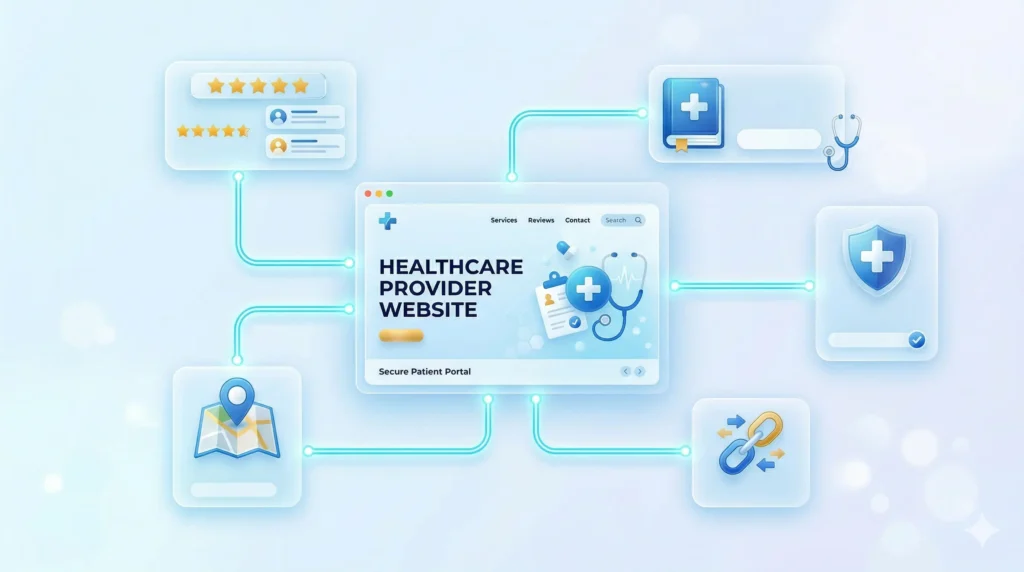
A website is the second most important digital asset after your Google Business Profile. Patients first find you on Google, but they understand you through the website. This is the place where they see who you are, what you treat, and whether you feel trustworthy enough to contact. Think of it as a digital reception desk where patients enter to know you better before deciding to visit. A website is not decoration. It is the confirmation stage where interest becomes action.
What the Website Should Establish
• Your exact specialty and medical focus, not generic labels
• A proper list of services or treatments in a clear structure
• A professional first impression that matches your real standard
• Contact, WhatsApp, and booking options placed clearly and visibly
• The same name, number, and address shown on Google Business Profile
Why It Is Important
• Patients confirm their decision here after checking your Google profile
• It reduces hesitation and answers doubts before they call
• It builds authority and seriousness about your practice
• Google checks the website to verify identity before ranking you higher
• It supports SEO, AI visibility, and long term digital trust
Google gives visibility. Your website converts it into patients.
Step 4: SEO: Get Discovered When Patients Are Actively Searching
After optimising Google Business Profile and setting up a proper website, this is the stage where most clinics go wrong. Almost 80% of doctors, hospitals, and clinics stop here and expect results. This is where the real action should begin. Once you have a website, you have information. But without SEO, that information does not reach anyone. If your services, treatments, and specialty pages are not ranking when patients search, the website cannot perform its purpose. A website without SEO is like having an OPD where no one enters. The structure exists but the flow does not.
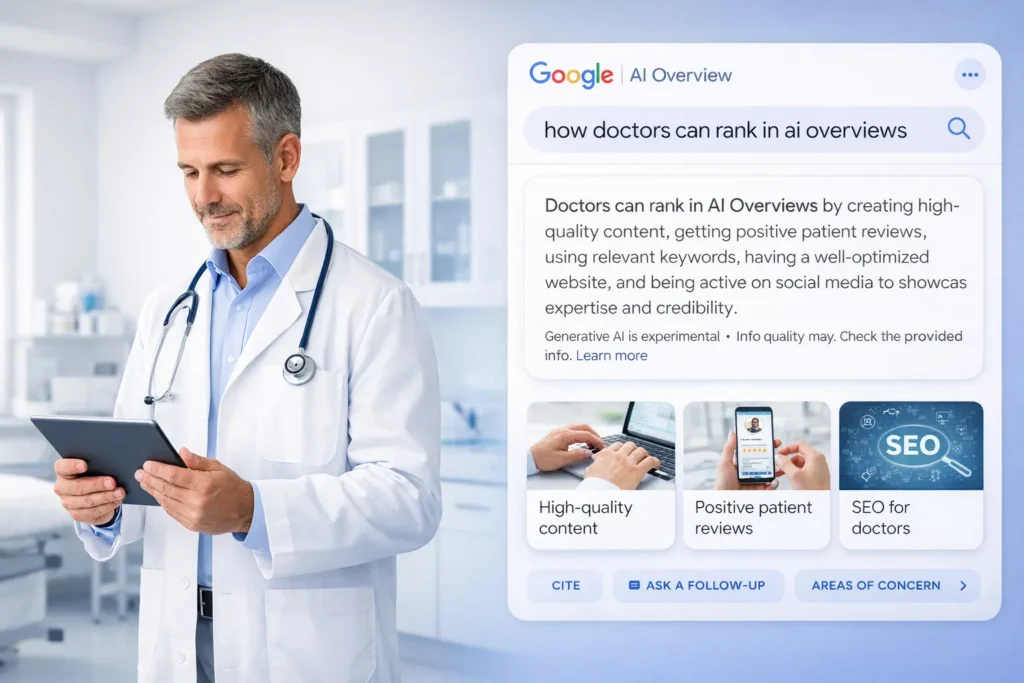
Step 5: LLM SEO: Getting Recommended Inside ChatGPT, Gemini and AI Results
Now that the Google Business Profile is optimised and the website is in place with proper SEO, the next layer is LLM SEO. This is the part most clinics are not even aware of yet. People are now asking AI instead of Google. They open ChatGPT or Gemini and type real questions like, “Suggest me the best doctor for migraine near me,” or “I have these symptoms, which specialist should I talk to,” or “Who is the right doctor for spine surgery in my city.” When these questions are asked, AI tools search for clear identity, verified information, and structured content. If your website and SEO are weak, AI cannot read you, cannot understand you, and cannot recommend you.
LLM SEO is not separate from your website. It sits on top of it. It uses the same website content, the same pages, the same identity, but structured in a way that AI can recognise. This is why website and SEO were emphasised earlier. Without them, LLM SEO has nothing to connect to. Each step builds the next one and establishes the ecosystem: GBP for discovery, website for confirmation, SEO for ranking, and LLM SEO for recommendation inside AI platforms.
If someone asks AI to suggest a doctor and your name does not appear, it is not about skill or experience. It is about digital clarity. LLM SEO is what makes your name stand a chance inside ChatGPT, Gemini, and other AI systems.
LLM SEO is what gives you a shot at being recommended inside ChatGPT and Gemini. Website and SEO give LLM SEO something to read. GBP gives it the authority to trust.
Step 6: The Ecosystem: The Four Pillars That Build Your Online Presence
This is the stage where everything connects. You do not need advanced marketing tricks or external experts. These four pillars alone form the base that top clinics rely on. When they work together, discovery, trust, and bookings start building naturally. Nothing fancy. Just structure.
The Four Core Pillars
• Google Business Profile creates the first point of discovery.
• Website becomes the confirmation point where decisions form.
• SEO gives search visibility when patients actively look for treatment.
• LLM SEO prepares your identity for AI platforms like ChatGPT and Gemini so you can be recommended when someone asks for a doctor.
Step 7: ROI and Time Period: What to Expect and How Long It Really Takes
Once the four pillars are in place, the results do not appear instantly. Digital growth for clinics does not work like running an ad and waiting for calls the next morning. It is a compounding system. In the initial months, it feels slow because the structure is building silently in the background. Google starts recognising your identity, the website begins gaining stability, and your pages slowly enter the search ecosystem. This is normal. This is how healthcare growth actually works online.
Do not switch strategies in the first two months. Do not change the content direction every week. Do not expect a heavy flow of patient queries immediately. The first phase is visibility. The second phase is trust. The third phase is response. If you break the process in the visibility phase, the trust phase never starts. If you break it in the trust phase, the response never comes.
Time Frame to Follow
- First 3 months: foundation stabilisation and identity recognition
- 4 to 6 months: ranking signals begin to form and early visibility improves
- 6 to 9 months: inquiries and appointment flow start becoming consistent
- 9 to 12 months: authority compounds and returns become visible
This is the realistic cycle. Not 7 days. Not 30 days.
How to Approach the Duration
- Commit to one full year of consistent execution
- Do not restart or delete what was built every two months
- Do not chase instant results and panic-edit the structure
- Let the ecosystem settle and improve with time
- Allow Google and AI to read you repeatedly until you become the stable choice
Simple Understanding
If you follow the process sincerely for 9 months, results start.If you continue for 12 months, the system stabilises. If you stay consistent beyond that, it compound.
Step 8: Your Next Action From Here
You now have a step-by-step structure that most clinics never get access to. These are the same fundamentals that clinics usually pay lakhs of rupees to learn, and you have them in one place.
If you want to implement everything yourself and understand each layer in more detail, you can get our 2026 Healthcare Growth Guide for just ₹500. It takes you deeper into GBP optimisation, website structuring, SEO planning, and LLM SEO setup so you can run everything confidently on your own terms.
If you do not want to handle this workload internally, or you feel your team does not have the bandwidth to manage consistency for 9 to 12 months, we can execute everything for you. We have already done this for more than 110 clinics and hospitals, from single-specialty practices to multi-department setups. You can book a strategy call with Sarthak Jain to begin the process and build this ecosystem without confusion or trial and error.
We are not just a marketing agency. We are a healthcare growth partner. We study patient behaviour, referral psychology, digital proof, and decision patterns in the healthcare context, not generic industries. If you want to continue learning at your own speed, subscribe to the blog. If you want execution support, book the call. Either way, you move forward.