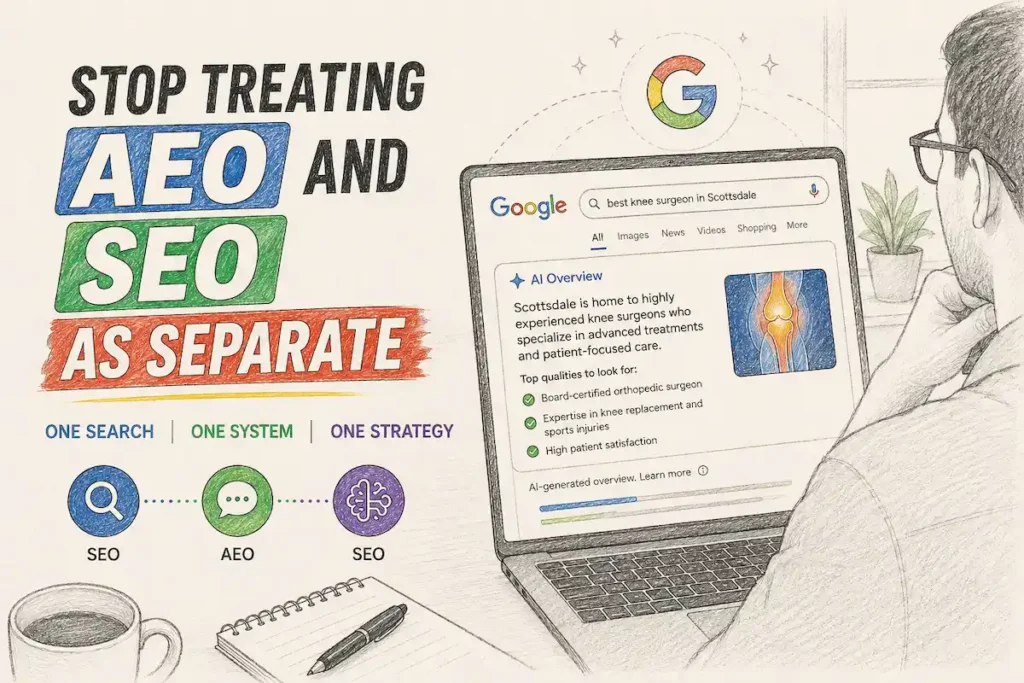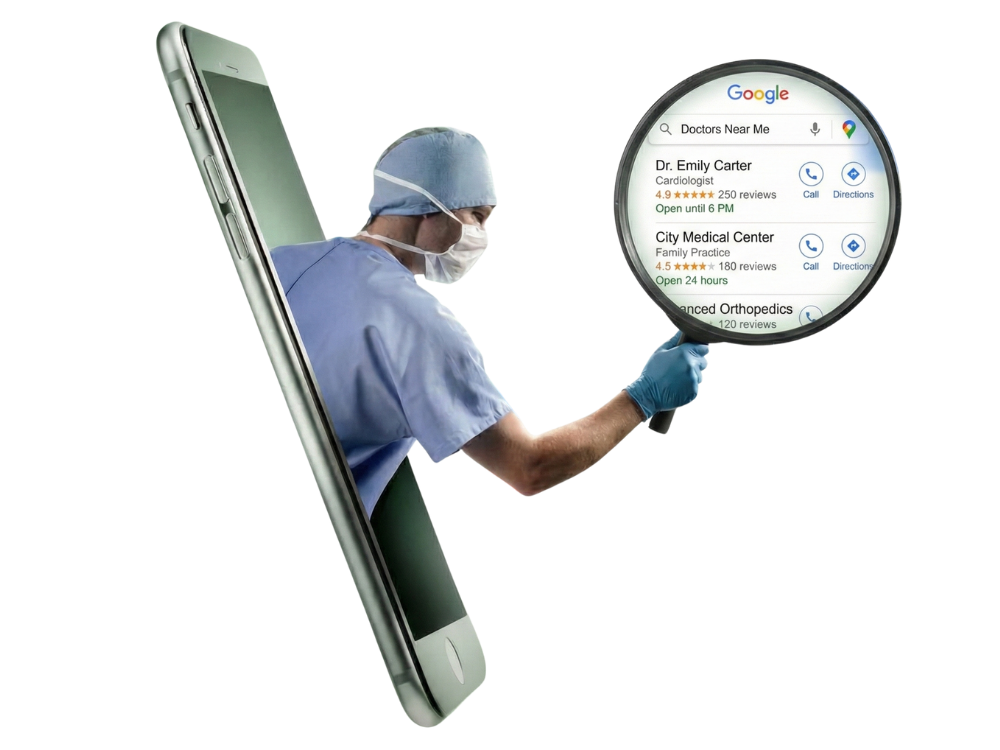



A patient is searching for you right now. Can they find you?
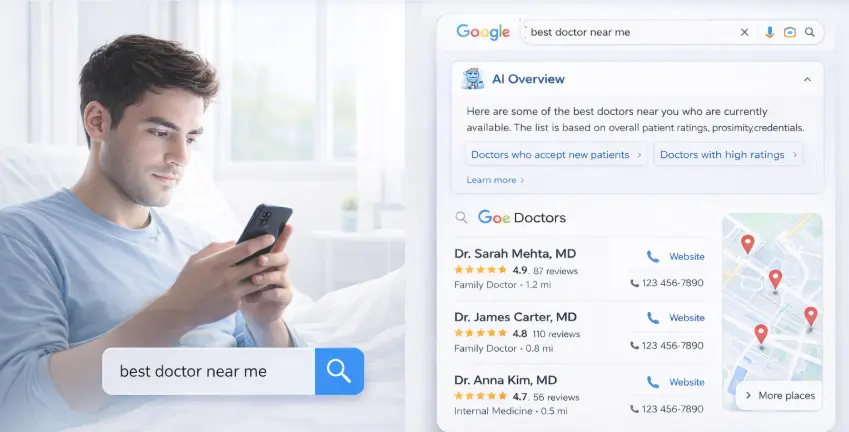
It is 11:47 PM. A 34 year old woman in Phoenix, Arizona is sitting on her couch, scrolling through her phone. Her lower back has been hurting for three weeks. Physical therapy did not help. She types into Google:
“Best spine specialist near me.”
Google shows her three doctors in the Local Pack, two hospital websites in organic results, and an AI Overview that recommends a clinic she has never heard of.
Your practice is not on that list. Not in the map. Not in the search results. Not in the AI answer.
That patient just became someone else’s patient.
This is exactly why healthcare SEO matters. Not as a marketing buzzword. Not as something your website developer mentioned once. But as the single most important factor that decides whether patients find you or find your competitor.
This guide breaks down everything. No jargon. No filler. Just the exact steps that help doctors, clinics, and hospitals show up on Google, build trust online, and turn search traffic into booked appointments.
Let’s get into it.
What Is Healthcare SEO (And Why Is It Different From Regular SEO)?
Healthcare SEO is the process of optimizing a medical website so it ranks higher on Google when patients search for doctors, treatments, symptoms, or clinics.
Sounds simple. It is not.
Here is why healthcare SEO is a completely different game from regular SEO:
Google treats your website differently. Medical websites fall under what Google calls YMYL, which stands for “Your Money or Your Life.” According to Google’s Search Quality Rater Guidelines, YMYL pages are those that “could significantly impact the health, financial stability, or safety of people.” This means Google applies its strictest evaluation standards to healthcare content.
You are not just competing with other doctors. You are competing with WebMD, Healthline, Mayo Clinic, Cleveland Clinic, and every hospital chain with a $500,000 content budget. These sites have domain authority scores above 90. Your clinic website might be at 15.
One wrong piece of medical advice can hurt people. Google knows this. That is why healthcare websites need to demonstrate something called E-E-A-T: Experience, Expertise, Authoritativeness, and Trustworthiness. Google’s Search Central documentation makes this clear. Without strong E-E-A-T signals, your medical content simply will not rank.
The bottom line: Regular SEO gets you traffic. Healthcare SEO gets you patients. And the rules for getting healthcare content to rank are significantly stricter than for any other industry.
Healthcare SEO by the Numbers: Why You Cannot Ignore This
Before we get into strategy, look at what the data says:
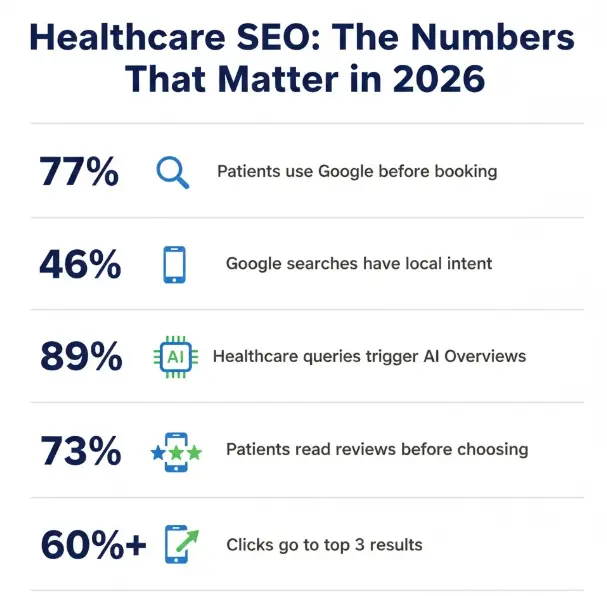
- 77% of patients use a search engine before booking a doctor appointment
- 46% of all Google searches have local intent, and healthcare is one of the top categories
- 89% of healthcare related queries now trigger AI Overviews at the top of search results (Source: BrightEdge Research, 2025)
- 72% of patients read online reviews before choosing a healthcare provider
- 63% of healthcare searches happen on mobile devices
- The top 3 organic results get over 60% of all clicks on Google
If your website is not showing up in those top positions, you are invisible to the majority of patients who are actively looking for care.
The 7 Pillars of Healthcare SEO Strategy
Healthcare SEO is not one thing. It is seven things working together. Miss one pillar and the whole structure wobbles. Here is each one, explained with what to actually do.
Pillar 1: Local SEO for Healthcare (This Is Where You Win)
For most doctors and clinics, local SEO is the fastest path to more patients. Why? Because when someone searches “cardiologist near me” or “pediatrician in Dubai,” Google shows a map with three listings at the very top of the page. This is called the Local Pack, and it gets more clicks than any organic result below it.
What you need to do right now:
- Claim and fully optimize your Google Business Profile. Fill out every single field. Business name, address, phone number, website, hours, services, appointment link, photos. Do not leave anything blank.
- Choose the right categories. Google lets you pick a primary category and secondary categories. If you are a dermatologist, your primary should be “Dermatologist.” Secondary categories might include “Skin Care Clinic” and “Cosmetic Dermatologist.” This matters more than people think.
- Get reviews. Lots of them. Ask every happy patient to leave a Google review. Make it easy. Send a direct link via SMS or email after their visit. Aim for 50+ reviews with a 4.5 star average minimum.
- Respond to every review. Every single one, good and bad. For negative reviews, be professional. Never mention patient details (HIPAA compliance). Show that you care.
- NAP consistency across the internet. Your Name, Address, and Phone number must be exactly the same on Google, your website, Healthgrades, Practo, Zocdoc, Yelp, and every other directory. Even small differences (like “St.” vs “Street”) can confuse Google.
Quick win: If you do nothing else from this entire guide, optimize your Google Business Profile today. It is free and can start driving patient calls within weeks.
Pillar 2: On-Page SEO for Medical Websites
On-page SEO means optimizing the actual pages on your website so Google understands what each page is about and ranks it for the right searches.
Here is what to focus on:
Title tags and meta descriptions. Every page on your website needs a unique title tag (under 60 characters) that includes your target keyword. Your meta description (under 155 characters) should tell the patient exactly what they will find on the page and make them want to click.
Example for a cardiology page:
- Title: “Cardiology Services in Phoenix | Heart Care Specialists”
- Meta: “Expert heart care in Phoenix. Our board-certified cardiologists treat heart disease, arrhythmia, and heart failure. Accepting new patients.”
Header structure matters. Use one H1 per page (your main topic), then H2s for major sections, and H3s for subsections. Google reads this hierarchy to understand your content.
Write for patients, not for doctors. Patients search “what causes chest pain” not “etiology of thoracic discomfort.” Match the language your patients actually use. Medical jargon kills your rankings.
Internal linking. Link your service pages to related blog posts. Link your blog posts back to service pages. Link your doctor profile pages to the services they offer. This web of links helps Google understand the relationship between your pages and distributes ranking power across your site.
Page speed. Your website needs to load in under 3 seconds on mobile. Use Google’s PageSpeed Insights tool to check. Compress images, minimize code, and use a fast hosting provider. A slow website is a patient lost.
Pillar 3: Content Strategy for Healthcare Websites
Content is the engine of healthcare SEO. Without it, you have nothing for Google to rank.
But not just any content. Healthcare content must be:
- Medically accurate (reviewed by a licensed professional)
- Written in plain language (patients are not medical students)
- Comprehensive (answer the full question, not just part of it)
- Fresh (updated regularly with current medical guidelines)
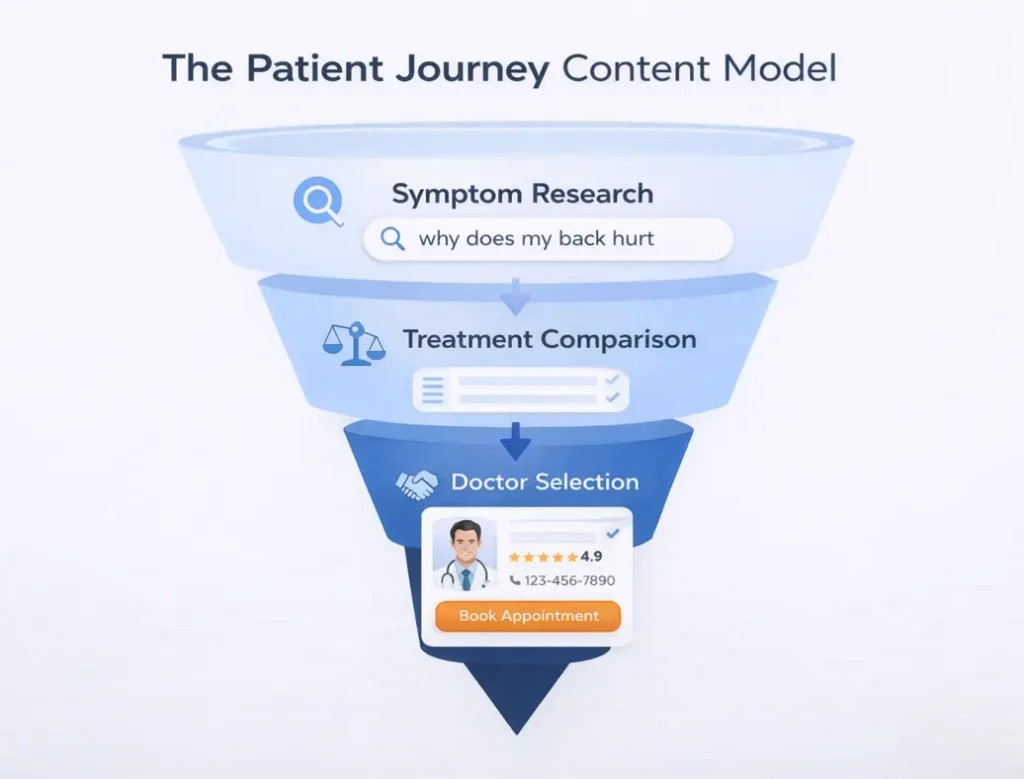
The patient journey content model:
Think of your content as matching three stages of what a patient goes through:
Stage 1: “What is wrong with me?” Patients are googling symptoms. Create blog posts that answer symptom-based questions:
- “What causes sharp pain in the left side of my chest?”
- “Why does my knee hurt when I climb stairs?”
Stage 2: “What are my options?” Patients are comparing treatments. Create detailed service pages and comparison guides:
- “ACL Surgery vs Physical Therapy: Which Is Right for You?”
- “Types of Knee Replacement Surgery Explained”
Stage 3: “Who should I trust?” Patients are choosing a doctor. Create physician profile pages, patient testimonials, and trust-building content:
- Doctor bio pages with credentials, experience, and a professional photo
- Video introductions from doctors
- Before and after galleries (with patient consent, HIPAA compliant)
Content types that perform best for healthcare SEO:
- Condition pages (one page per condition you treat)
- Treatment/procedure pages (one page per service you offer)
- Doctor profile pages (one page per physician)
- Blog posts answering patient questions (aim for 2-4 per month)
- FAQ pages (these are gold for featured snippets and AI Overviews)
Pillar 4: E-E-A-T Compliance (This Is Non-Negotiable for Medical Websites)
E-E-A-T stands for Experience, Expertise, Authoritativeness, and Trustworthiness. Google added the extra “E” for Experience in December 2022, and for healthcare websites, it is the most important ranking factor.
Here is exactly what Google’s quality raters look for on medical websites:
Experience: Does the content creator have real, firsthand experience with the topic? For healthcare, this means content should be written or reviewed by doctors who actually treat patients, not by marketing copywriters alone.
Expertise: Are the authors qualified? Every clinical article on your website needs an author byline with credentials (MD, DO, MBBS, RN). Create detailed author bio pages that link to medical licenses, hospital affiliations, and published research on PubMed.
Authoritativeness: Is your website recognized as a trusted source? This comes from backlinks from medical associations, hospital directories, health publications, and government health websites. It also comes from consistent NAP citations across the web.
Trustworthiness: Is your website safe, transparent, and honest? This includes HTTPS encryption, clear privacy policies, visible contact information, no misleading claims, and citations to peer-reviewed medical sources.
Your E-E-A-T checklist:
- [ ] Every clinical page has a physician author byline
- [ ] Author bio pages exist with credentials, photo, and affiliations
- [ ] Medical claims cite peer-reviewed sources (PubMed, WHO, CDC, NIH)
- [ ] “Last medically reviewed” date visible on every clinical page
- [ ] HTTPS active across entire website
- [ ] Privacy policy and HIPAA compliance statement accessible
- [ ] Contact page with physical address, phone number, and email
- [ ] No medical claims without evidence
- [ ] Medical disclaimer on clinical content pages
Pillar 5: Technical SEO for Healthcare Websites
Technical SEO is the behind-the-scenes work that makes sure Google can actually find, crawl, and understand your website. If the technical foundation is broken, nothing else matters.
The essentials:
Mobile responsiveness. Your website MUST work flawlessly on mobile. 63% of healthcare searches happen on phones. If your site is hard to navigate on a small screen, patients will leave and Google will penalize you.
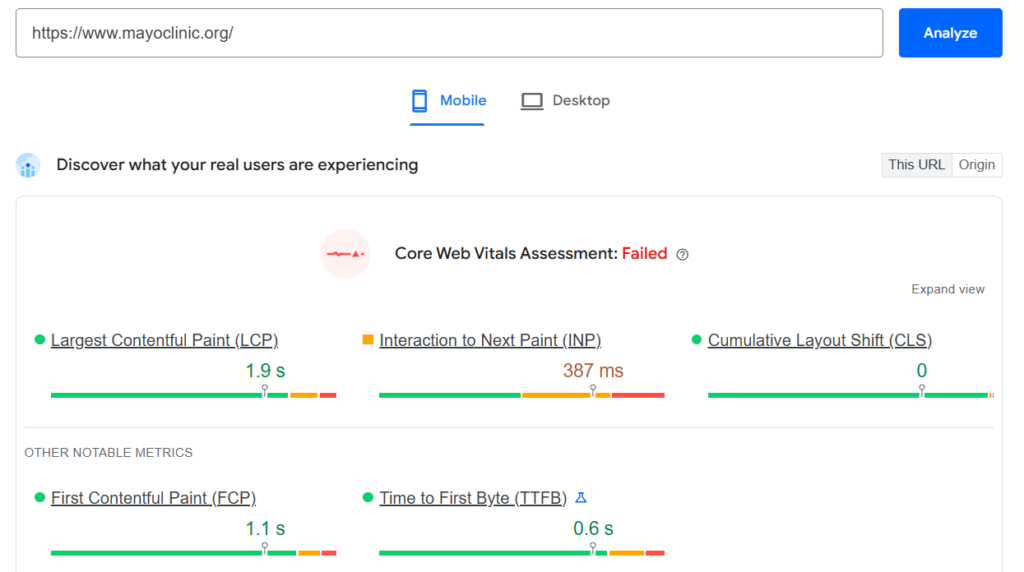
Core Web Vitals. Google measures three performance metrics:
- LCP (Largest Contentful Paint): Main content should load in under 2.5 seconds
- INP (Interaction to Next Paint): Page should respond to taps in under 200ms
- CLS (Cumulative Layout Shift): Page elements should not jump around as the page loads (keep under 0.1)
Site architecture. Organize your website in a logical hierarchy:
yourwebsite.com
├── /services/
│   ├── /cardiology/
│   ├── /orthopedics/
│   └── /dermatology/
├── /doctors/
│   ├── /dr-smith/
│   └── /dr-patel/
├── /locations/
│   ├── /phoenix/
│   └── /dubai/
├── /blog/
│   ├── /what-causes-back-pain/
│   └── /knee-replacement-recovery/
└── /contact/
XML sitemap and robots.txt. Submit your sitemap to Google Search Console. Make sure your robots.txt file is not accidentally blocking important pages.
HTTPS everywhere. This is not optional for healthcare websites that handle any patient information. Google has confirmed HTTPS is a ranking signal.
Pillar 6: Schema Markup for Healthcare (The Hidden Advantage)
Schema markup is structured data code you add to your website that helps Google understand your content better. Most healthcare websites do not use it. This is your advantage.
The healthcare schema types you need:
1. MedicalOrganization (for your clinic or hospital)
{
  "@context": "https://schema.org",
  "@type": "MedicalOrganization",
  "name": "Phoenix Heart & Spine Center",
  "url": "https://www.phoenixheartspine.com",
  "telephone": "+1-480-555-0123",
  "address": {
    "@type": "PostalAddress",
    "streetAddress": "456 Medical Plaza",
    "addressLocality": "Phoenix",
    "addressRegion": "AZ",
    "postalCode": "85004"
  },
  "medicalSpecialty": ["Cardiology", "Orthopedic Surgery"]
}
2. Physician (for each doctor)
{
  "@context": "https://schema.org",
  "@type": "Physician",
  "name": "Dr. Sarah Mitchell",
  "medicalSpecialty": "Cardiology",
  "alumniOf": "Johns Hopkins School of Medicine",
  "affiliation": {
    "@type": "MedicalOrganization",
    "name": "Phoenix Heart & Spine Center"
  }
}
3. FAQPage (for FAQ sections)
{
  "@context": "https://schema.org",
  "@type": "FAQPage",
  "mainEntity": [{
    "@type": "Question",
    "name": "How long does healthcare SEO take to show results?",
    "acceptedAnswer": {
      "@type": "Answer",
      "text": "Healthcare SEO typically shows initial improvements in 3-6 months, with significant results in 6-12 months."
    }
  }]
}
4. MedicalWebPage (for all clinical content pages)
5. LocalBusiness (for multi-location practices)
You can validate your schema markup using Google’s Rich Results Test and Schema.org’s documentation.
Pillar 7: AI Search Optimization (The New Frontier of Healthcare SEO)
This is what separates 2026 healthcare SEO from everything that came before.
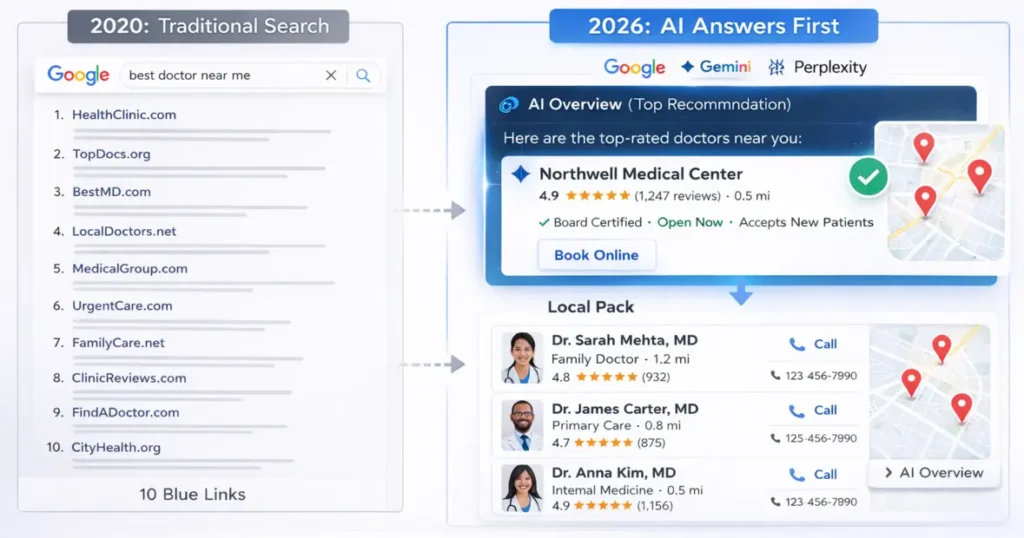
Patients are no longer just using Google. They are asking ChatGPT, Perplexity, Google Gemini, and other AI tools questions like “Who is the best orthopedic surgeon in Dubai?” or “What is the best treatment for chronic migraines?”
According to BrightEdge research, 89% of healthcare related queries now trigger AI Overviews in Google search results. That means even if you rank #1 organically, an AI generated answer might sit above you and steal your clicks.
How to optimize for AI search:
- Structure content with clear question-and-answer formatting. AI tools pull answers from content that directly answers questions. Use H2 headings as questions. Answer in the first 40-60 words below the heading.
- Cite credible sources. AI models prefer content that references authoritative sources. Link to PubMed studies, WHO guidelines, and government health data.
- Build your entity footprint. Get your doctors mentioned on multiple authoritative platforms: Google Scholar, hospital directories, medical associations, LinkedIn, Healthgrades, Practo, and Zocdoc.
- Implement comprehensive schema markup. AI models use structured data to verify facts about your practice.
- Keep content factually precise. AI models are trained to filter out vague or unverifiable claims. Use specific numbers, specific credentials, and specific outcomes.
- Monitor your AI visibility. Regularly search for your practice and doctors on ChatGPT, Perplexity, and Google AI Mode. If you do not show up, your competitors do.
Healthcare SEO for Different Practice Types
Healthcare SEO is not one-size-fits-all. What works for a solo dermatologist is different from what works for a 200-bed hospital. Here is how to adjust your strategy:
Solo Practitioners and Small Clinics
- Focus on local SEO first (Google Business Profile, reviews, local citations)
- Create 5-10 core service pages targeting your specialty + location
- Write 2 blog posts per month answering patient questions
- Build your personal brand as the doctor (physician profile page with strong E-E-A-T)
Multi-Location Practices
- Create unique location pages for each office (never duplicate content across locations)
- Each location needs its own Google Business Profile
- Localize content for each area (mention neighborhoods, landmarks, local health stats)
- Build an internal linking structure that connects services to locations
Hospitals and Health Systems
- Create service line hubs (cardiology hub linking to conditions, treatments, doctors)
- Physician directory with individual profile pages (these rank for long-tail searches)
- Invest in technical SEO to manage large sites with hundreds of pages
- Hire a healthcare SEO team or agency with hospital-specific experience
Common Healthcare SEO Mistakes (And How to Fix Them)
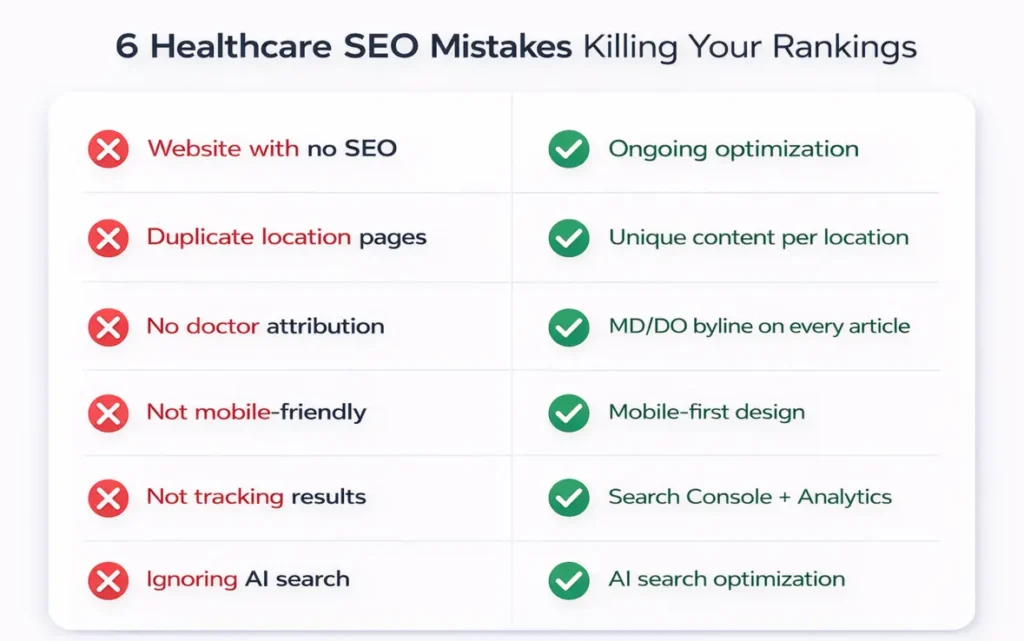
After working with healthcare clients, these are the mistakes we see over and over again:
Mistake 1: “We built a website, so we are done.” A website without SEO is like a clinic with no signboard. Nobody knows it exists. SEO is ongoing, not a one-time project.
Mistake 2: Using the same content across multiple location pages. Google calls this duplicate content. It hurts your rankings. Each location page needs unique content about that specific area.
Mistake 3: No physician attribution on medical content. Blog posts about health conditions signed by “Admin” or “Marketing Team” will never rank. Google needs to see a real doctor’s name and credentials.
Mistake 4: Ignoring mobile users. If your appointment booking form does not work on a phone, you are losing patients every single day.
Mistake 5: Not tracking results. If you are not measuring organic traffic, keyword rankings, and patient inquiries from search, you have no idea if your SEO is working. Set up Google Search Console and Google Analytics from day one.
Mistake 6: Focusing only on Google, ignoring AI search. In 2026, patients are asking ChatGPT and Perplexity for doctor recommendations. If your practice is not optimized for AI search, you are missing an entirely new patient acquisition channel.
How Long Does Healthcare SEO Take? (Honest Answer)
Let’s be real. SEO is not a magic pill. Here is what to genuinely expect:
| Timeframe | What You Should See |
|---|---|
| Month 1-2 | Technical fixes done, Google Business Profile optimized, content plan in place |
| Month 3-4 | New pages indexed, local rankings start improving, review count growing |
| Month 5-6 | Blog posts gaining traction, organic traffic increasing 20-40%, first patient inquiries from search |
| Month 7-9 | Service pages ranking on page 1 for local terms, phone calls increasing |
| Month 10-12 | Established organic presence, consistent patient flow from search, compounding growth |
The honest truth: If someone promises you page 1 rankings in 30 days for competitive medical keywords, they are lying. Healthcare SEO is a 6-12 month commitment. But once it works, it keeps working without paying per click.
Your Next Step
Healthcare SEO is not about gaming an algorithm. It is about making sure patients who need you can actually find you.
Every day your practice is not optimized for search, patients are choosing your competitors. Not because your competitors are better doctors. But because they showed up on Google and you did not.
The best time to start healthcare SEO was a year ago. The second best time is today.
About RankVed Healthcare Martech
RankVed is India’s first healthcare-focused AI SEO agency, specializing in Generative Engine Optimization for doctors, clinics, and hospitals. We serve healthcare clients across India, UAE, United States, and United Kingdom with services including medical website design, healthcare SEO, Google Maps optimization, and AI search optimization for platforms like ChatGPT and Google AI Overviews.
Ready to get found by patients who are searching for you right now? Contact RankVed for a free healthcare SEO audit.