



Summary: Hipaa Compliance for Medical Websites
Most websites are made to collect inquiries, not to protect sensitive medical details. When a patient fills out a form, their information may travel through several tools without strong privacy controls. A HIPAA-compliant medical website is built with patient confidentiality in mind from the start. It limits who can see the data, secures how it moves, and prevents unwanted access. This keeps personal health information private and shared only with the clinic.
Why HIPAA Compliance Is a Big Deal for Medical Website

If you run a medical practice in the United States, you have probably heard the word HIPAA thrown around like it is just more paperwork. But when it comes to your website, HIPAA is not a boring legal term. It directly affects how patients see and trust you online. An unsecured website sends a silent message that patient privacy is not taken seriously. In today’s digital world, that can damage your reputation faster than a bad review.
HIPAA is not just a legal checkbox. For a medical website, it directly impacts trust, safety, and credibility.
What patients subconsciously expect when they visit a healthcare website:
- Their information will not be misused
- Their symptoms or contact details will stay private
- The clinic takes confidentiality seriously, online and offline
“Patients may never ask about HIPAA, but they judge you by it silently.”
A non-compliant website does not look risky on the surface, but behind the scenes, it can quietly expose sensitive data.
Why HIPAA Was Created: The Original Problem It Solved
HIPAA was never meant to make doctors’ lives harder. It was created to solve real problems.
In 1996, the US government noticed two major issues:
- People were losing health insurance when switching jobs
- Healthcare fraud and data misuse were rising
So HIPAA was introduced to focus on:
- Portability – allowing people to keep insurance while changing jobs
- Accountability – standardizing how medical information is handled
At that time, websites were barely a thing. Paper files ruled everything.
How HIPAA Changed When Healthcare Went Digital
Once hospitals and clinics moved from files to computers, new risks appeared.
That led to two major additions:
- Privacy Rule (2003) – who is allowed to see patient data
- Security Rule (2005) – how digital patient data must be protected
This is where websites entered the picture.
Any place where patient data is:
- Typed
- Submitted
- Stored
- Sent
falls under HIPAA. That includes contact forms, appointment booking, live chat, and patient portals.
Who Must Follow HIPAA (Most People Get This Wrong)
HIPAA is a US federal law, but its reach is wider than geography.
You must follow HIPAA if:
- You are a doctor or clinic in the United States
- You run a hospital, lab, or healthcare organization in the US
- You are a web designer, developer, or agency building a site for a US clinic
It does not matter where the website developer is located.
“If the patient is in the US, HIPAA applies. No exceptions.”
HIPAA vs Other Medical Privacy Laws (Quick Comparison)
| Region | Law | Applies to US Patients |
|---|---|---|
| United States | HIPAA | Yes |
| UK | GDPR + NHS rules | No |
| Canada | PIPEDA | No |
| European Union | GDPR | No |
If your website serves American patients, HIPAA compliance for medical websites is the only standard that matters.
What Happens If Your Website Is Not HIPAA Compliant

The risks are not theoretical. They are very real.
Non-compliance can lead to:
- Heavy financial penalties (often reaching millions)
- Legal action and audits
- Loss of patient trust
- Damage to your clinic’s reputation
A HIPAA-compliant web design prevents these issues by securing patient data from the moment it enters your website.
This is not something you “fix later.”
HIPAA compliance must be built into your website from day one.
HIPAA and Medical Web Design: Why Looks Alone Are Not Enough
When it comes to medical websites, design is about much more than colors, fonts, or a clean layout. HIPAA changes the entire purpose of your site. It shifts the focus from how good the website looks to how responsibly it handles patient information. This is not about legal theory or paperwork. It is about what happens the moment a patient types something personal into your website and clicks submit.
Think of your website as your digital front desk. In a real clinic, you would never leave patient files out in the waiting area for anyone to see. Yet many websites do exactly that online without realizing it. A HIPAA-compliant medical website works differently. It behaves like a private consultation room, where the door stays closed, access is controlled, and patient information is shared only with the people who truly need it.
How Different People Interact With Your Website (And Why It Matters)
To understand why HIPAA compliance matters so much, let’s look at the three types of people using your site every day.
1. The Patient
Sarah visits your website late at night because she is worried about a health issue. She fills out a form with her name, phone number, and symptoms.
- On a normal site, this data may travel through plain email or third-party tools
- On a HIPAA-compliant medical website, her information is encrypted the moment she clicks submit
It is like sealing her message in a locked container before it moves anywhere.
2. The Front Desk or Admin
Mike manages appointments. He needs access to patient requests, but only through a secure system.
- Patient data should never land in personal email inboxes
- Access should be logged, restricted, and protected
Every action should leave a trail, just like a medical record system.
3. The Doctor
You need to review patient information without worrying about data leaks.
- No unsecured downloads
- No exposed uploads
- No background tracking
A proper medical website keeps threats out while letting you work smoothly.
How to Design a HIPAA-Compliant Medical Website (Practical Checklist)

Building a medical website is very different from building a restaurant or retail site. You cannot rely on looks alone. You need structure and safeguards.
Core HIPAA Design Requirements:
- SSL Everywhere
The lock icon in the browser is the starting point, not a bonus. Every page must run on secure HTTPS so data is never transmitted in plain text. - Encrypted Forms and Storage
Contact forms must store data inside secure, encrypted systems. If your form sends patient details directly to email, that is a violation waiting to happen. - Business Associate Agreements (BAAs)
Any service that touches patient data mdust sign a BAA. This includes:- Hosting providers
- Form tools
- Email systems
If they refuse to sign, they are not HIPAA-safe.
- No Ad or Social Tracking
Standard Facebook Pixel or Google remarketing tools are not allowed on pages that collect patient information. Using them can expose sensitive data.
Is Your Medical Website Actually HIPAA Compliant? A Quick Self-Check
Most medical websites look professional on the surface. The problems usually live underneath.
Try These Tests:
- The Email Test
Submit your own contact form. If patient details appear in plain email, the site is not compliant. - The Hosting Test
Cheap shared hosting plans are risky. Medical websites require secure hosting with encryption and a signed BAA. - The Agency Test
Ask your developer one question:
“Do you have a signed BAA with our hosting and form providers?”
If they hesitate or seem confused, that is a red flag.
Choosing the Right Approach: Regular Agencies vs RankVed
You have two realistic options.
Option 1:
Work with a general web agency and try to monitor HIPAA compliance yourself. This often leads to gaps, mistakes, and stress.
Option 2:
Work with a team that builds HIPAA compliance into the foundation.
At RankVed, we do not just design medical websites. We build secure digital systems for doctors. From encrypted hosting and secure forms to BAAs and compliance-ready infrastructure, everything is handled from day one. The goal is simple: protect patient privacy and protect your practice from risk.
In the end, HIPAA-compliant medical web design is not about fear. It is about doing online what you already do offline every day, keeping patient trust intact.
The Roadblocks: Where HIPAA Violations Usually Happen
Most HIPAA violations do not come from hackers in dark rooms. They come from normal people making small, avoidable mistakes. In the digital world, one careless setup or wrong tool can quietly turn into a serious compliance issue. If you really want to understand what a HIPAA violation looks like in real life, these common examples reveal where clinics and medical websites usually slip up.
What Is a HIPAA Violation? Common Mistakes Clinics Still Make
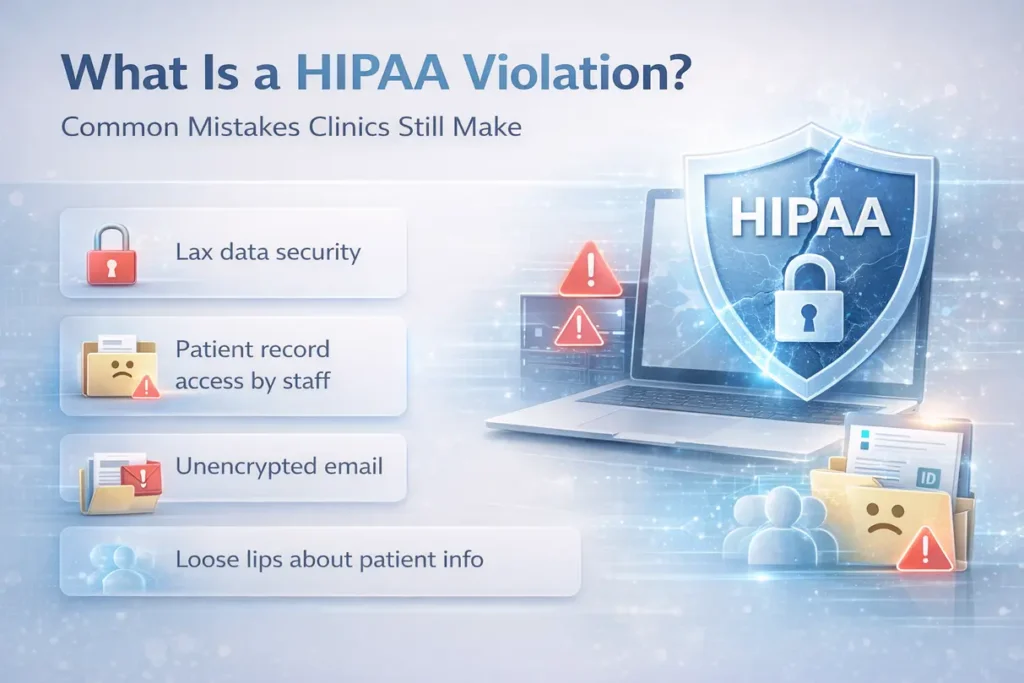
Most HIPAA violations happen because of simple oversights, not bad intent. Using regular email for patient details, working with vendors who have not signed a Business Associate Agreement, or allowing shared logins inside the clinic are some of the most common problems. Lost or stolen unencrypted devices, careless social media posts, and improper data deletion also regularly lead to breaches. Many clinics also unknowingly violate HIPAA by using marketing pixels or non-secure chat tools on appointment pages.
The Biggest HIPAA Myths That Put Clinics at Risk
There is a lot of misinformation around HIPAA, and believing the wrong thing can be costly. Small clinics are not “too small” to be noticed. SSL alone does not make a website compliant. HIPAA applies even if you do not accept insurance. General IT support is not the same as HIPAA expertise, and free tools like standard Google Forms or FaceTime are usually not compliant. Compliance is not a one-time task either. It requires regular reviews and updates.
Why Rankved Is the Safe Choice for HIPAA-Compliant Medical Websites
You can spend nights reading regulations, testing plugins, and guessing whether your setup is safe. Or you can work with people who already know where things break.
At Rankved, we have seen these violations happen in real clinics, not just theory. We do not just design medical websites. We build secure digital systems where compliance is part of the foundation. From hosting and forms to access control and data flow, everything is planned around HIPAA compliance from day one.
You can try to manage this yourself. Or you can let Rankved healthcare marketing agency handle it properly the first time. Either way, the goal stays the same: protect your patients, protect your practice, and never worry about a compliance letter landing in your inbox.
The Must-Haves: 10 HIPAA Compliance Essentials for Healthcare 2025
As we cruise into 2026, the goalposts for security haven’t just movedth, tey’ve been reinforced with steel. If you’re still using the same security setup from three years ago, you’re basically driving a car with no brakes. To keep your hipaa compliance for medical websites on point, you need to nail these ten essentials. This is the stuff that keeps the feds away and your patients’ trust through the roof.
- Mandatory Multi-Factor Authentication (MFA): “Password123” just doesn’t cut it anymore. For any access to patient data, you now need MFA. This means a password plus a code on your phone or a fingerprint. It’s a literal life-saver for your data.
- Signed Business Associate Agreements (BAAs): If a vendor touches your data, be it your host, your form tool, or your CRM, they must sign a BAA. No BAA, no compliance. It’s the law.
- End-to-End Encryption: Your data needs to be scrambled both while it’s sitting on the server (at rest) and while it’s traveling to your inbox (in transit). We’re talking AES-256 bit encryption levels here.
- Automatic Session Timeouts: If an admin leaves their computer to grab a coffee, the site should automatically log them out after 2-3 minutes. You can’t leave a “digital window” open for someone to peek through.
- Strict Audit Logging: You need a “receipt” for every single person who looks at a patient file. If something goes wrong, you need to be able to go back and see exactly who was in the system and what they did.
- Annual Risk Assessments: This isn’t a “set it and forget it” deal. You need a deep-dive security checkup every year to find new holes before the hackers do.
- Specialized Healthcare Hosting: Standard $10/month hosting is a trap. You need a provider that specializes in healthcare and will sign that all-important BAA.
- De-identified Analytics: Standard Google Analytics tracks too much personal info. You need to “strip” the patient IDs before the data leaves your site so you aren’t accidentally sharing secrets with tech giants.
- Breach Notification Plan: If the worst happens, you need a playbook. Who do you call? When do you tell the patients? You have 60 days to report a breach, and every second counts.
- Encrypted Cloud Backups: Your backups need to be just as secure as your live site. If your backup isn’t encrypted, it’s just a giant “steal me” sign for your data.
How to Spot a Fake: Vetting Your Web Agency
A lot of agencies claim they do “medical web design.” But here’s the tea: most of them are just skinning a WordPress site and hoping for the best. To protect your practice, you need to be a bit of a detective.
When you’re looking at an agency, don’t just look at their portfolio. Ask the hard questions. If they don’t mention a BAA within the first five minutes, that’s a red flag. If they suggest using a standard “Contact Us” form that sends a regular email to your receptionist, run for the hills.
Checklist for vetting an agency:
- Do they have a dedicated security officer?
- Can they show you a sample BAA?
- Do they use encrypted form providers like Jotform Enterprise or Formstack?
- Do they understand the difference between a “Required” and “Addressable” standard?
Why Rankved is the Real Deal
You could spend months trying to become a security expert, or you could just approach Rankved. We don’t just build “pretty” sites; we build high-security digital environments for providers. We know the USA market, we know the federal laws, and we know exactly how to rank your site while keeping it a fortress.
At Rankved, we handle the technical headaches so you can focus on your patients. Whether you want to use the tips in this guide to build your own team or you want the peace of mind that comes with a pro, we’ve got your back. We make sites fully compliant from the first line of code to the final launch.
Wrapping It All Up: Your Next Steps Toward a Secure Future
Building a medical practice is about more than just your skills in the exam room; it’s about the trust you build with people before they even walk through your front door. In 2026, that trust starts on your website. If a patient feels like their data is just another number, they’ll find someone who treats it like gold. Following the 10 HIPAA Compliance Essentials for Healthcare 2025 isn’t just a legal chore, it’s a competitive advantage that tells your patients, “I’ve got your back.”
Final Checklist: Are You Ready to Go Live?
Before you hit that “Publish” button, take one last look at your digital house. A truly hipaa compliant web design isn’t finished until you can check off these final boxes:
- The Paper Trail: Do you have a folder (digital or physical) with all your signed BAAs from your host, your email provider, and your web agency?
- The “Secret” Test: Have you double-checked that no PHI is being stored in your website’s database longer than necessary?
- The Training Day: Has everyone in your office who touches the website’s backend had a 15-minute training on how to handle secure data?
Don’t Do It Alone: Join Hand with some
Look, we get it. You went to medical school to save lives, not to become a cybersecurity expert. The world of hipaa compliance for medical websites is deep, technical, and full of legal “gotchas” that can trip up even the smartest office managers.
You have a choice. You can use the knowledge in this article to try and piece together a secure site yourself, which is totally doable if you have the time or you can approach Rankved. We’ve built a reputation for turning complex healthcare regulations into simple, beautiful, and bulletproof websites.
Whether you’re a specialist or running a large multi-physician clinic, we make sure your digital presence is as professional and secure as your actual practice. We handle the technical “under-the-hood” stuff so you can get back to what matters most: your patients.