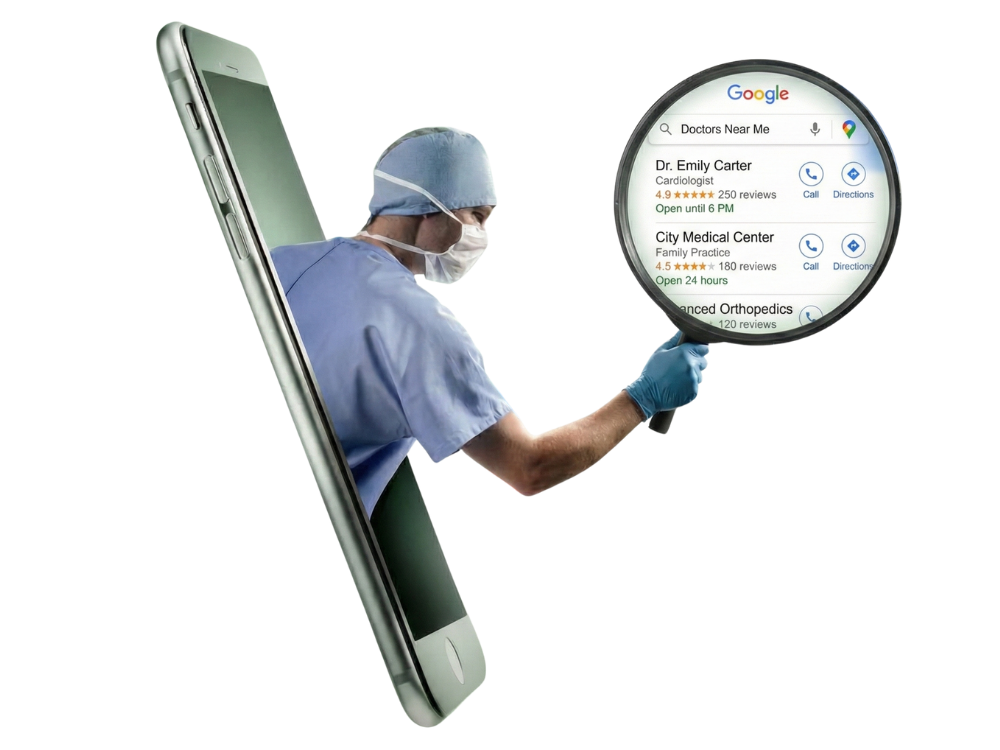


Something strange is happening right now in healthcare.
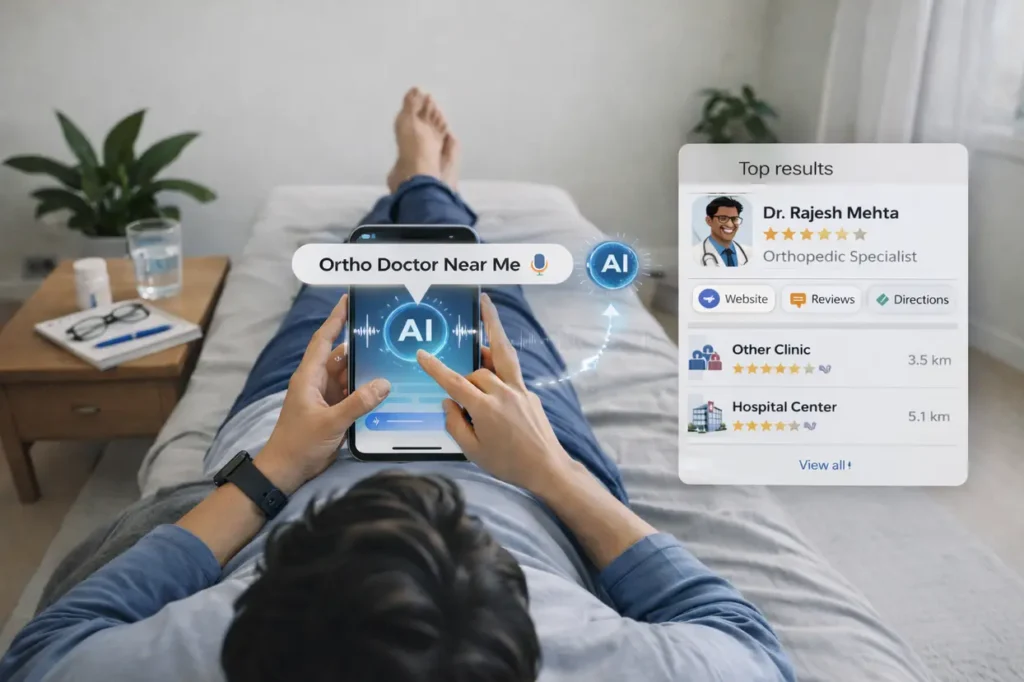
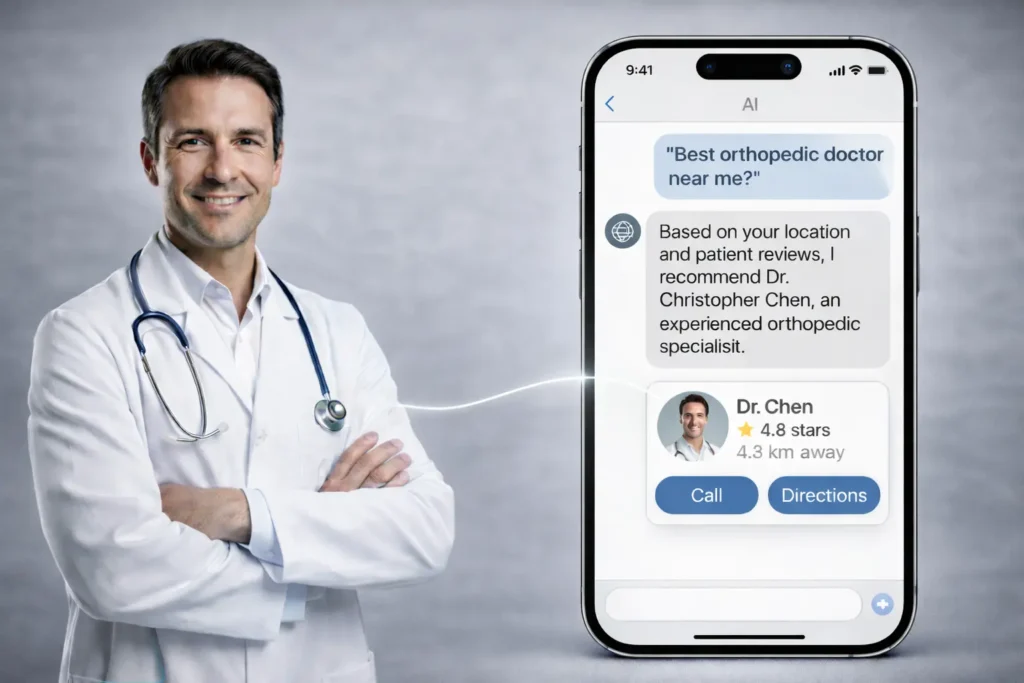
A patient sits on their couch, opens ChatGPT on their phone, and types: “Who is the best orthopedic surgeon near me for knee replacement?”
ChatGPT responds with three names. Three clinics. Three recommendations.
Your practice is not one of them.
This is not a hypothetical situation. This is already happening millions of times a day. And if your clinic, hospital, or medical practice is not showing up in these AI generated answers, you are losing patients to competitors who figured this out before you did.
Welcome to the new reality of AI search optimization for doctors. This guide will show you exactly how it works, why it matters, and the precise steps you need to take so that AI platforms start recommending your practice.
No fluff. No jargon. Just the stuff that actually works.
Patients Are Not Just Googling Anymore. They Are Asking AI.
Let us start with the numbers because they tell the whole story.
According to recent research, 68% of patients have already used AI tools like ChatGPT to search for health information. One in four adults under 30 use AI regularly for health queries. And Google AI Overviews now appear on roughly 89% of all healthcare related searches.
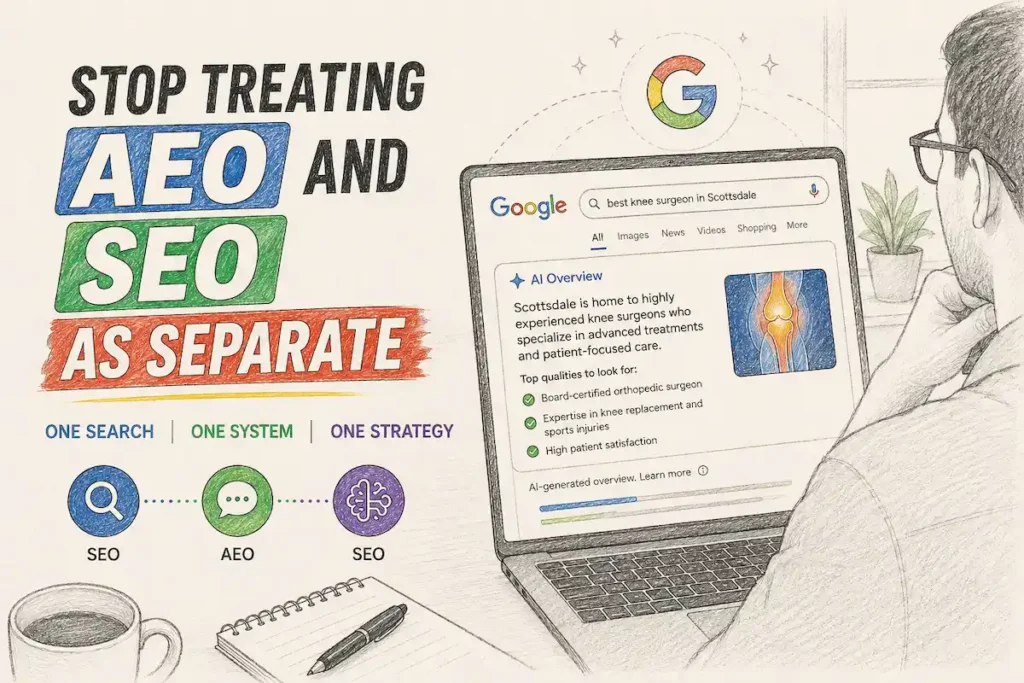
That last stat deserves a pause. Almost 9 out of 10 health searches on Google now show an AI generated summary at the very top of the page, before any website link.
Here is what this means for your practice:
- Patients are asking ChatGPT “best cardiologist in Phoenix” and getting direct recommendations
- They are asking Perplexity “which hospital has the best cancer treatment near me” and getting cited answers
- They are searching Google and seeing AI Overviews that summarize everything without needing to click on your website
If your practice is not optimized for these AI platforms, you are invisible to a growing chunk of your potential patients. Traditional SEO alone is no longer enough. You need AI search optimization for doctors built into your digital strategy.
How Does AI Search Actually Pick Which Doctors to Recommend?
This is the question every healthcare provider should be asking. And the answer is simpler than you think.
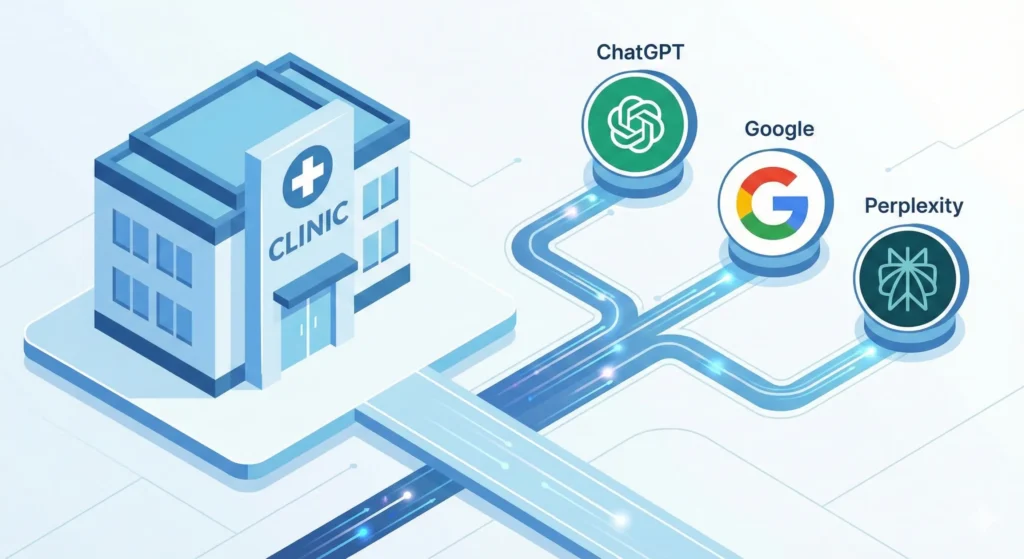
AI platforms like ChatGPT, Google AI Overviews, and Perplexity do not have a secret list of preferred doctors. They generate answers by scanning the internet in real time (or from their training data) and evaluating which sources are the most trustworthy, credible, and relevant.
Here is what they look for:
The Trust Signals AI Platforms Evaluate
- Verifiable physician credentials. Can the AI confirm that Dr. Smith is actually a board certified orthopedic surgeon? Is that information structured in a way machines can read?
- Consistent information across the web. Does your practice name, address, phone number, and specialty match across your website, Google Business Profile, Healthgrades, Doximity, and medical directories?
- Clinical authority signals. Does your website cite real medical research? Do your articles reference PubMed studies and clinical guidelines? Is content authored by named physicians?
- Patient reviews and reputation. What are real patients saying about you on Google, Healthgrades, and other platforms? Volume and recency of reviews matter.
- Structured data your website sends to machines. This is the technical piece most practices miss entirely. More on this below.
- Content depth and accuracy. Does your website thoroughly cover the conditions and treatments you specialize in? Or is it a thin brochure site with five pages?
“AI platforms do not reward volume. They reward authority, structure, consistency, and trust signals.”
The key insight here is that AI search optimization for doctors is not about gaming an algorithm. It is about making your real world medical expertise digitally verifiable and machine readable.
If you are a great doctor with amazing credentials but your digital presence is messy, incomplete, or unstructured, AI will never know you exist.
Traditional SEO vs AI Search Optimization: What Is Different?
Before we get into the steps, let us clear up a common confusion. AI search optimization does not replace traditional SEO. It builds on top of it.
Here is how they compare:
| Factor | Traditional SEO | AI Search Optimization |
|---|---|---|
| Goal | Rank on page one of Google | Get cited or recommended in AI generated answers |
| Success metric | Keyword rankings and organic traffic | Citation frequency and AI mention rate |
| Content focus | Keywords and search intent | Structured answers, clinical accuracy, expert attribution |
| Technical focus | Site speed, mobile, meta tags | Schema markup, structured data, entity recognition |
| Trust signals | Backlinks and domain authority | Verifiable credentials, cross platform consistency, reviews |
| Visibility | Blue links on search results page | Inside AI summaries, chat responses, and voice answers |
Think of it this way. Traditional SEO gets you into the library. AI search optimization gets you quoted by the professor teaching the class.
You need both. But if you only focus on traditional SEO in 2026, you are leaving a massive patient acquisition channel on the table.
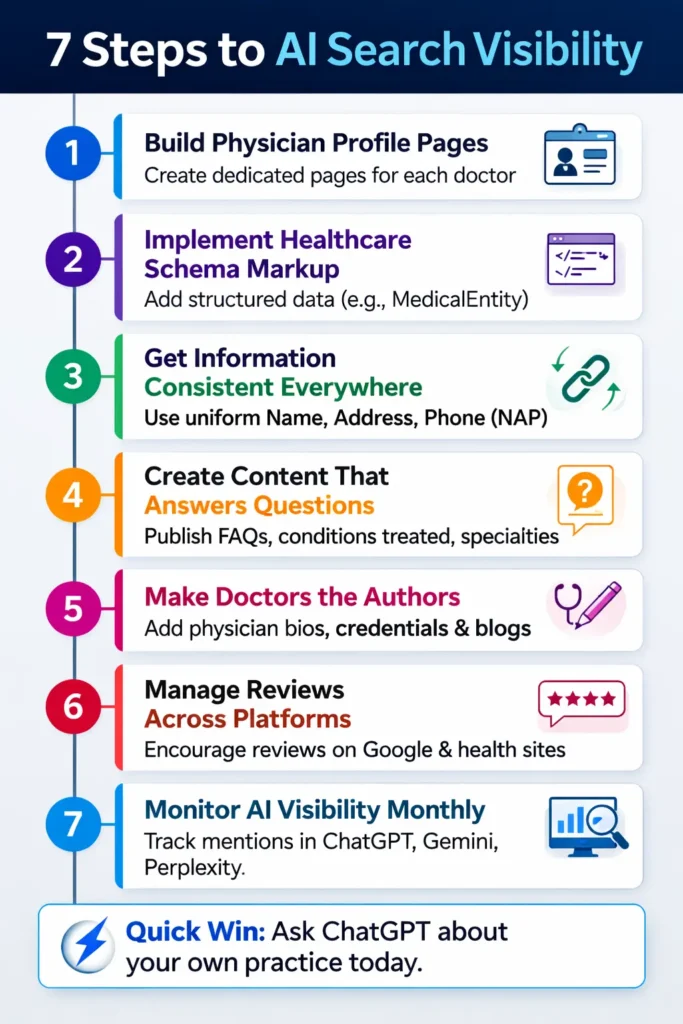
7 Steps to Get Your Medical Practice Recommended by AI
Here is the practical playbook. These are the exact steps that work right now.
Step 1: Build Physician Profile Pages That Machines Can Verify
Every doctor in your practice needs a dedicated profile page on your website. And it needs to be much more than a photo and a paragraph.
Each physician page should include:
- Full name with medical degree and board certification
- Specialty and sub specialty
- Years of practice and clinical experience
- Hospital and institutional affiliations
- Medical school and residency details
- Professional association memberships
- Links to external profiles (Doximity, LinkedIn, PubMed publications)
- A professional headshot (real photo, not stock)
This is not just for patients browsing your site. It is for AI systems that need to verify whether Dr. Smith is actually qualified to speak on knee replacements before recommending your practice.
Step 2: Implement Healthcare Schema Markup
This is the single most technical step, and also the one with the biggest impact on AI visibility.
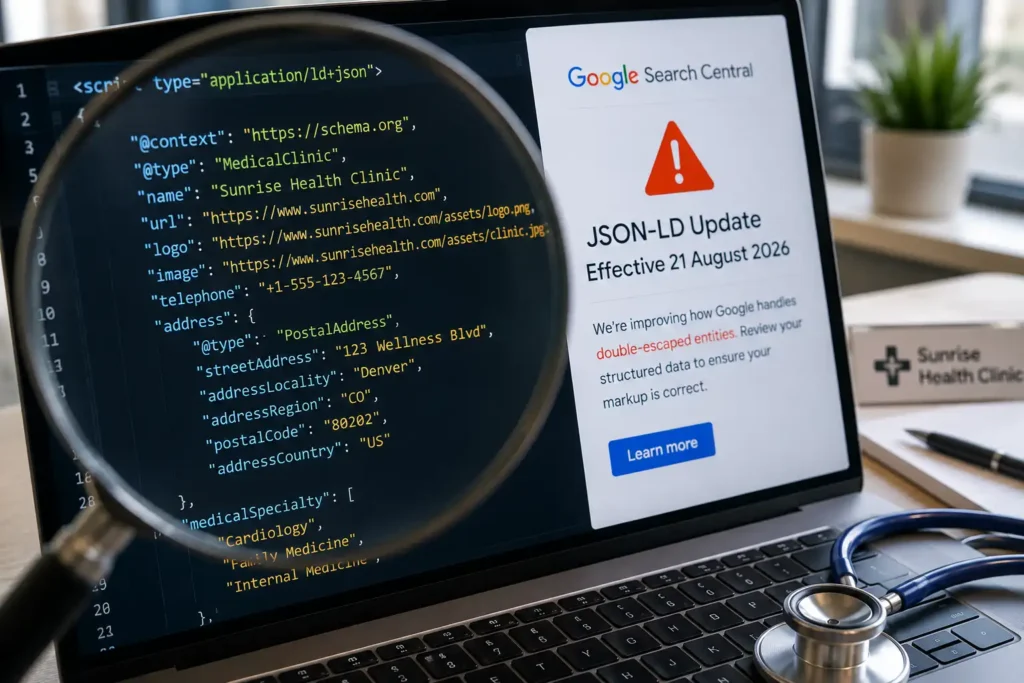
Schema markup is structured data code you add to your website that helps machines understand exactly what your content is about. It is like a digital ID card for your practice that AI platforms can instantly read and trust.
The schema types every healthcare website needs:
- Physician schema on every doctor profile page (with NPI number, credentials, specialty)
- MedicalOrganization schema on your main practice page
- MedicalWebPage schema on clinical content pages
- FAQPage schema on FAQ sections
- LocalBusiness schema with accurate hours, address, and service areas
- Article schema with author and reviewedBy properties on blog posts
Most medical websites have zero schema markup. This alone puts you ahead of 90% of competitors when AI platforms evaluate your content.
Step 3: Get Your Information Consistent Everywhere
AI platforms cross reference your practice information across dozens of sources. If your website says “Smith Orthopedics” but Google Business Profile says “Smith Orthopaedic Center” and Healthgrades says “Dr. Smith Orthopedics LLC,” the AI gets confused. And confused AI does not recommend you.
Run a consistency audit across:
- Your website
- Google Business Profile
- Healthgrades, Zocdoc, Vitals, WebMD
- Doximity and medical board registry
- Yelp, Facebook, and social profiles
- Apple Maps and Bing Places
Everything should match. Exactly. Same name. Same address format. Same phone number. Same specialty descriptions.
Step 4: Create Content That Directly Answers Patient Questions
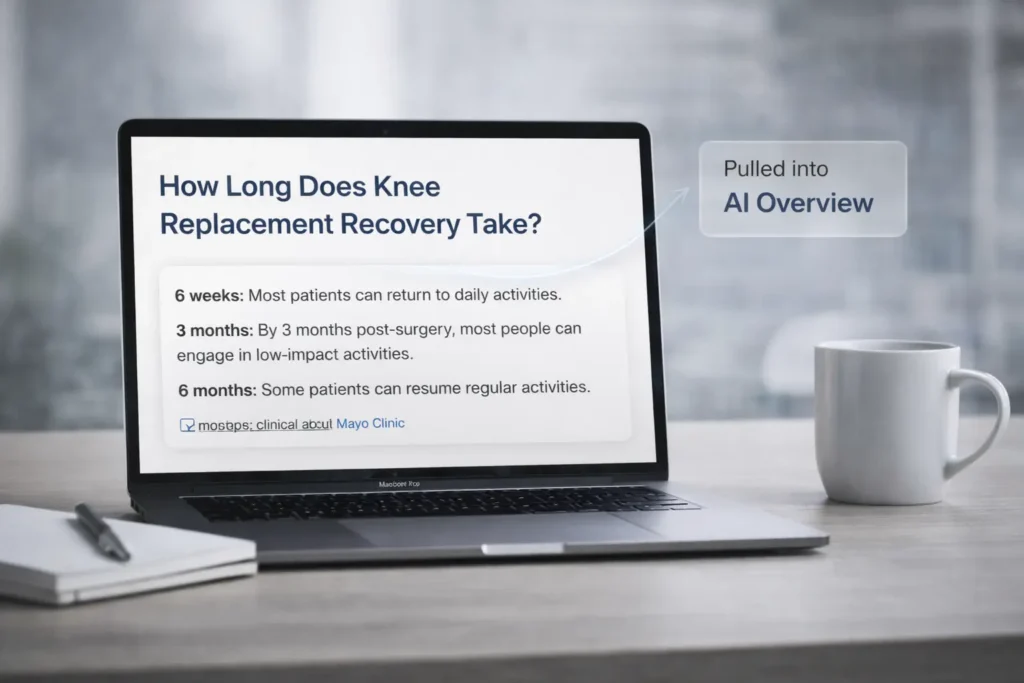
AI platforms love content that clearly and concisely answers specific questions. Not keyword stuffed blog posts. Not thin service pages. Real, detailed answers to the questions patients actually ask.
Think about the questions your patients ask you every single day in your office:
- “How long does knee replacement recovery take?”
- “What is the difference between Invisalign and braces?”
- “Are there non surgical treatments for herniated disc?”
Now create dedicated content pages that answer each of these questions thoroughly. Write from your clinical experience. Include specific timelines, realistic expectations, and practical advice. Cite clinical sources where appropriate.
This type of content is exactly what ChatGPT and Google AI Overviews pull from when generating health answers.
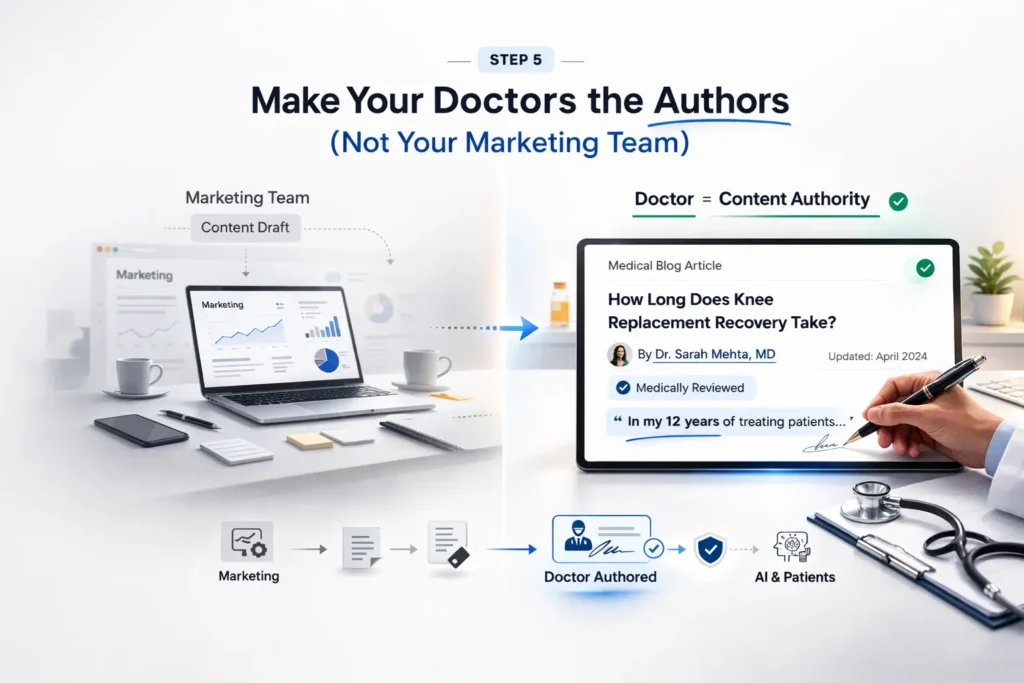
Step 5: Make Your Doctors the Authors (Not Your Marketing Team)
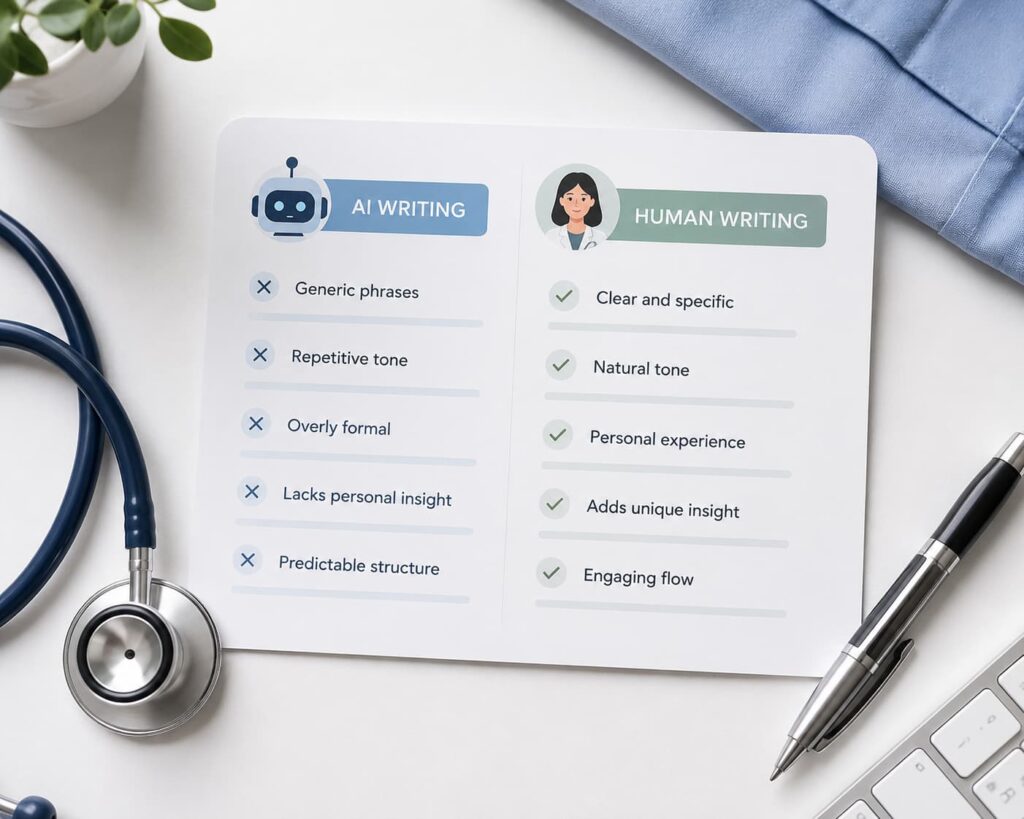
Here is a hard truth. AI platforms are getting better at detecting whether medical content was actually written by a physician or by a marketing writer with no medical background.
Google’s E-E-A-T framework specifically evaluates Experience and Expertise for healthcare content. And AI platforms follow similar logic.
Every clinical article on your website should have:
- A physician byline with linked credentials
- A “Medically Reviewed By” tag if the writer is not a doctor
- First person clinical insights that show real patient care experience
- A review date stamp showing the content was recently verified
This does not mean your doctors need to sit down and write 2,000 word blog posts. It means your content process should involve physician interviews, clinical review, and proper attribution. The marketing team writes. The doctor reviews and adds their expertise. The byline reflects the doctor.
Step 6: Actively Manage Your Reviews Across Platforms
Patient reviews are one of the strongest trust signals for AI recommendations. ChatGPT has been observed pulling from Healthgrades, Zocdoc, Google Reviews, and U.S. News rankings when recommending healthcare providers.
What matters most:
- Volume. More reviews signal more patient interaction
- Recency. Reviews from the last 6 months carry more weight than reviews from 3 years ago
- Specificity. Reviews that mention specific procedures or conditions help AI understand your specialties
- Your responses. Practices that respond to reviews (both positive and negative) show engagement and professionalism
Set up a simple post visit review request system. An email or SMS sent 24 hours after an appointment asking patients to share their experience. Keep it simple, keep it consistent, and watch your review profile grow.
Step 7: Monitor Your AI Visibility Monthly
You cannot improve what you do not measure. Start checking whether your practice appears in AI generated answers for your target queries.
Here is a simple monthly routine:
- Open ChatGPT and ask “Who is the best [your specialty] in [your city]?”
- Open Perplexity and ask the same question
- Search Google for your top treatment keywords and check if your site appears in AI Overviews
- Document the results in a spreadsheet
- Track changes month over month
This takes 30 minutes a month and gives you a clear picture of where you stand in AI search visibility. Over time, as you implement the steps above, you should see your practice appearing more frequently.
What Happens If You Ignore AI Search Optimization?
Let us be honest about the stakes here.
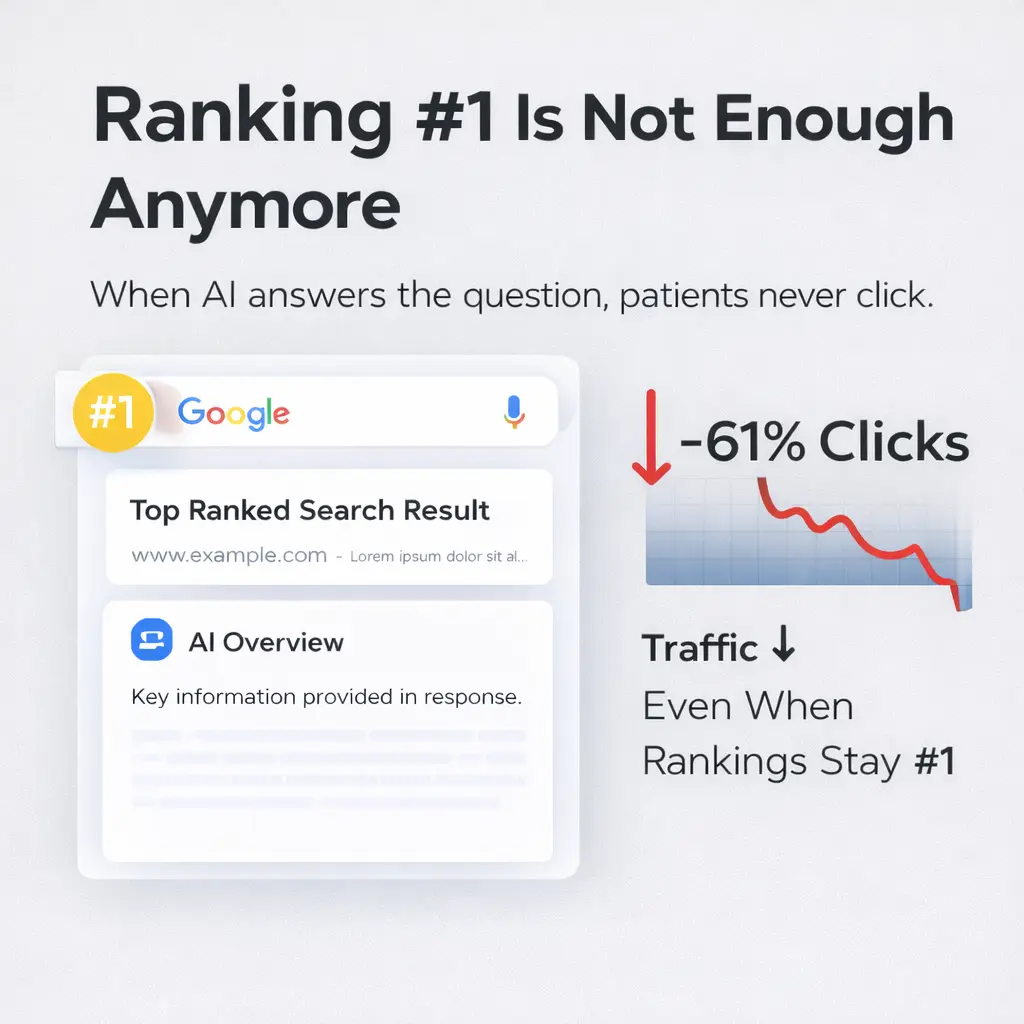
Gartner predicts that by the end of 2026, traditional search traffic will drop by 25%. For healthcare specifically, the numbers are even more dramatic. When Google AI Overviews appear on a health query, organic click through rates drop by roughly 61%.
That means even if your website ranks number one on Google for a valuable keyword, more than half of the patients who used to click on your link are now getting their answer from the AI summary and never visiting your site.
The clinics and hospitals that adapt to this shift will capture the patients that others lose. The ones that ignore it will keep wondering why their website traffic keeps dropping even though their rankings look fine.
AI search optimization for doctors is not a future trend. It is a current reality.
Quick Wins You Can Do This Week
If you are feeling overwhelmed, start small. Here are three things you can do in the next 7 days:
1. Update your physician profile pages. Add full credentials, board certifications, affiliations, and links to external profiles. This takes an afternoon and immediately improves your AI readability.
2. Claim and verify profiles on Healthgrades, Doximity, and Zocdoc. Make sure every detail matches your website exactly. Cross platform consistency is one of the fastest trust signals you can build.
3. Ask ChatGPT about your own practice. Literally go to ChatGPT and ask “Tell me about [Your Practice Name] in [Your City].” See what it says. If the answer is wrong, incomplete, or your practice does not show up at all, you know exactly where you stand and why this matters.
The Bottom Line
The way patients find doctors has changed. It is no longer just about ranking on Google. It is about being the practice that AI platforms trust enough to recommend when a patient asks for help.
AI search optimization for doctors is not complicated. But it does require intentional effort. Build verifiable physician profiles. Implement schema markup. Keep your information consistent. Create physician authored content. Manage your reviews. And monitor your AI visibility every month.
The practices that do this now will be the ones patients find for years to come. The ones that wait will keep losing ground to competitors who moved first.
Your expertise is real. Now make sure AI knows it too.
RankVed is India’s first healthcare focused AI SEO agency specializing in Generative Engine Optimization for doctors, clinics, and hospitals. We help medical practices across India, UAE, and the United States get found on Google, ChatGPT, Perplexity, and every platform patients use to find care. Get a free AI visibility audit for your practice.